Péter Magyar promised a cash injection equivalent to a 14th month's pension – Here are the biggest winners


On September 23, the Tisza Party announced a large-scale pension program: Péter Magyar and András Kármán announced that if their party came to power they would
- raise the minium pension to HUF 120,000;
- apply a differentiated raise to pensions of between HUF 120,000 and HUF 140,000;
- introduce a Pensioner SZÉP Card worth HUF 200,000 per year for those receiving benefits of less than HUF 250,000, and HUF 100,000 per year for those receiving pensions between HUF 250,000 and HUF 500,000;
- double the old-age allowance, which measure would affect senior citizens who reached the statutory retirement age but do not have sufficient service time (20 years) to be eligible for a state pension.
- raise the home care allowance by 50%;
- create 20,000 new places in modern retirement homes, partly financed by the market and partly by the EU and the state.
Interestingly, Péter Magyar had promised to introduce 'Men 40', but this was not mentioned in yesterday's announcements. A "Women 40" retirement scheme is already in place, allowing women with 40 years of eligibility to retire early at any age.
Promised funds equal a 14th-month's pension
The budgetary impact of the promised measures is significant. According to Tisza, implementing the plans would cost the budget HUF 655–795 billion per year. Of this amount, between HUF 515 billion and HUF 570 billion would be allocated to additional benefits for pensioners,
which would roughly equate to a 14th-month's pension, considering that next year's budget law allocates HUF 585 billion to the 13th month's pension.
The Pensioner SZÉP Card would be the most expensive option, representing an additional annual budget expenditure of HUF 350–400 billion. Meanwhile, pension convergence, one-off increases and doubling allowances for the elderly would cost around HUF 165–170 billion per year together.
However, a closer look at the figures reveals that Tisza is not targeting all groups of pensioners equally. The main beneficiaries of the measures are those on small pensions, with
state benefits set to increase threefold or fourfold for those on the lowest pension levels.
At the average pension level of around HUF 245,000, Tisza's pension programme would provide a much smaller increase of around 6% per year. The package announced by the party earlier this week does not offer any additional benefits for those with pensions above HUF 500,000.
How would benefits change at each pension level?
Tisza's promises would effectively result in additional income for all pensioners receiving pensions of less than HUF 500,000.
- Thanks to the catch-up measure, those with pensions lower than HUF 120,000 would immediately be entitled to a HUF 120,000 pension.
- For pensions between HUF 120,000 and HUF 140,000, Péter Magyar and his government would implement a one-off, tiered pension increase. Pensioners would receive an additional HUF 12,000 per month for pensions between 120,000 and 125,000 forints, an additional HUF 10,000 for pensions between 125,000 and 130,000 forints, an additional HUF 8,000 for pensions between 130,000 and 135,000 forints, and an additional HUF 6,000 per month for pensions between 135,000 and 140,000 forints.
- In addition, anyone with a pension of less than HUF 500,000 per month will also receive a Pensioner SZÉP Card. Those with pensions below HUF 250,000 would receive an annual allowance of HUF 200,000, while those with pensions between HUF 250,000 and HUF 500,000 would receive an annual allowance of HUF 100,000.
According to Tisza, the increases would apply to old-age pensions and benefits for people with reduced working capacity. However, they would not apply to survivor's pensions (or widow's/widower's pension).
Based on the above, it is possible to precisely calculate how the total value of benefits received over the course of a year would change at different pension levels. The table below shows how much pensioners would gain at each level if the Tisza Party's promises were fulfilled. This ranges from 50,000 to 550,000 forints per month in increments of 25,000 forints.

The last column of the table shows the percentage increase in benefits that Tisza's promises would result in. These figures reveal significant differences. At a pension level of HUF 50,000, state benefits would almost triple, increasing by 171%. This is partly due to the increase to HUF 120,000, and partly due to the introduction of the HUF 200,000 Pensioner SZÉP Card. The exact threefold increase in benefits would occur at the HUF 45,000 pension level.
Tisza promises a generous increase of more than 80% for pensions of HUF 75,000, while pensioners with pensions of HUF 100,000 can expect a 35% increase. However, as pensions increase in value, the promised rate of increase falls rapidly: for example, the annual benefits for an average pension of 245,000 forints would rise by 6%, whereas for a pension of 300,000 forints, the party promises an increase of less than 3%.
Tisza clearly states that, once pensions reach half a million forints, the party does not plan to increase benefits exceptionally. This is because the highest pensions are excluded from the pension adjustment, the one-off differentiated hike, and the Pensioner SZÉP Card.
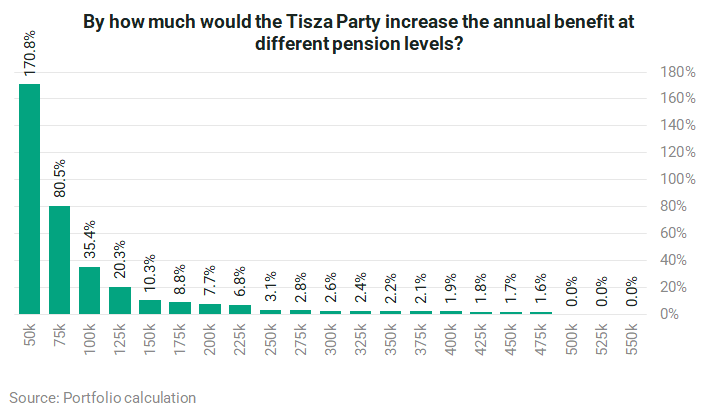
The Tisza measures would therefore benefit small pensioners the most. The higher someone's pension, the less they would benefit from the promised measures.
Consequently, income inequality among pensioners would be significantly reduced.
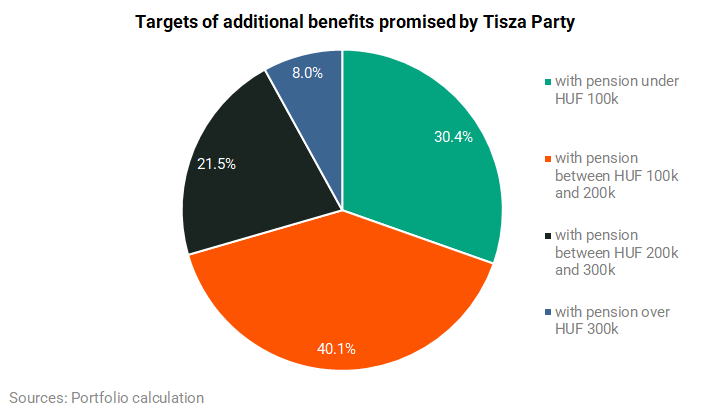
It is also possible to estimate which groups Tisza would target with the additional funds: according to Portfolio's calculations,
- 30% of the total value of the benefits would go to those receiving pensions of less than HUF 100,000, who currently make up just 8% of all pensioners;
- 40% of the benefits would go to pensioners receiving between HUF 100,000 and HUF 200,000, who currently make up 39% of the total number of pensioners;
- 21% of the additional expenditure would go to pensioners receiving between HUF 200,000 and HUF 300,000, who make up 31% of all pensioners; while
- those receiving pensions above HUF 300,000 would receive 8% of the extra money, while pensioners account for 22% of the population.
How much would the average pension increase as a result of Tisza's measures?
Based on the range of HUF 515–570 billion indicated by the party leadership, we can estimate the potential increase to the average pension if the promised measures were implemented. Using the lower limit of the range (HUF 515 billion) and the 2.27 million beneficiaries registered by the Hungarian Central Statistical Office (receiving a pension or other pension-type benefits), we can calculate that the average annual benefit would increase by at least HUF 230,000 per person, which includes not only pension increases, but also the impact of the new SZÉP card benefit.
This means that the average monthly pension per person would increase by at least HUF 19,000, which is a 7.8% increase on today's average pension of HUF 245,000.
Could the Hungarian budget handle such a large additional expenditure?
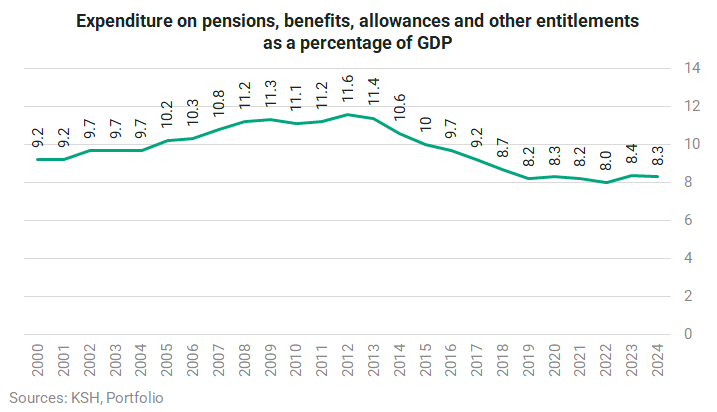
The package, equivalent to a 14th month's pension, would significantly increase pension expenditure in the Hungarian budget. In 2025, the government plans to spend HUF 7,200 billion on pensions and pension-type benefits. A supplementray pension hike is expected to cost an additional HUF 112 billion. This brings the expected total expenditure to around 8.3% of the planned GDP (HUF 87,837 billion at current prices).
The budget pencilled in in HUF 7,700 billion pension expenditure for 2026. Adding the increase resulting from the pension adjustment in November this year, actual expenditure could realistically be around HUF 7,816 billion next year. This would equate to 8.2% of the projected GDP for 2026 (HUF 95,747 billion).
Tisza's announcement of an additional benefit of at least HUF 515 billion would increase direct pension expenditure by around 0.5% of GDP, not including the effect of investments in retirement homes on expenditure.
The problem raised by the party is real. Between 2012 and 2024, pension expenditure as a percentage of GDP fell from 11.6% to 8.3%.
This was due, in part, to the gradual increase in the retirement age, the abolition of mixed indexation and the introduction of pension increases that merely track inflation, all of which occurred during this period.
Pensioners' real incomes do not rise due to inflation-linked pension increases (except for benefits such as the 13th month's pension), while the economy as a whole usually experiences an increase in real income. This means that pensioners' share inevitably declines.
The Achilles heel of the package of measures is financing, and the party has stated that the pension package will be funded by reducing state advertising and communication costs, streamlining public procurement and mega-subsidies, cutting interest expenses and boosting spending capacity through higher economic growth.
However, risks are inevitable given that
the promised measures would clearly result in large-scale, immediate additional expenditure. The feasibility of the planned revenue increases to cover this expenditure is questionable.
Even if these increases were successful, they would have a much slower impact. Taken together, these two factors mean that if the planned savings are not achieved, the country's budget will incur an enormous, unsustainable financial burden equivalent to an extra month's pension, and there will be no solution in sight.
This would not be a novelty in the Hungarian pension system. The 13th-month pension does not have a clear source of funding either. In fact, in recent years there have not been enough pension contributions or social contribution tax (szocho) revenues to pay for the 12th-month pension. This is why the central budget regularly provides the Pension Insurance Fund with hundreds of billions (or even more than a trillion) of forints in support.
The measures promised by Tisza appear to reinforce this trend. Items of expenditure with questionable financing would be included in the pension system, which could worsen the budget balance in the long term and make the first pillar of the pension system increasingly unsustainable.
In 2016, the Hungarian National Bank drew attention to the fact that the sustainability indicators of the pension system can be derived from its future annual balances: the larger the expected annual deficits, the worse the long-term sustainability.
At the time, the MNB calculated that the pension system would be sustainable until 2035, as pension revenues and expenditure could be kept in balance. However, reality has since proven this to be false, with the pension system's balance turning negative much earlier than expected.
If current concerns prove to be justified and the Tisza package of measures fails to generate the planned level of revenue, the pension system may have to be reformed earlier than planned. Measures would need to be taken to restore balance, such as raising the retirement age or restricting pension entitlements, in order to ensure more stable operation.
Cover image (for illustration purposes only): Getty Images





