This is behind Hungary's food price increases - central bank


In its Inflation Report, published on Thursday, the National Bank of Hungary (MNB) reviewed the development of domestic and international food prices, and the causes of prolonged inflation outpacing the consumer price index.
Food prices have been rising for 18 months now
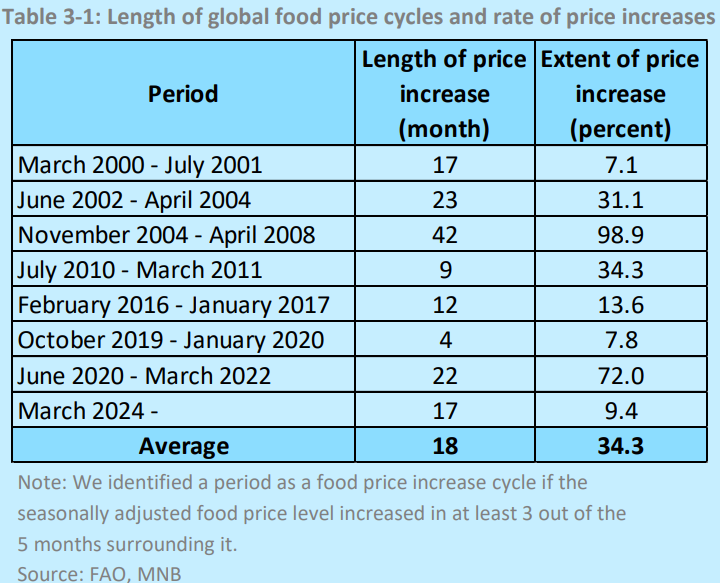
The upward trend in global food prices that started in March 2024 has continued in recent months. The current global food price cycle has been underway for 18 months, which is the average length of the global food price cycle since the beginning of the millennium, while the rate of price increases is below the long-term average.
The international price increase was concentrated in three areas:
- The increase in vegetable oil prices is mainly supply-side: sunflower and rapeseed production was more moderate in the last season, while palm oil production is increasingly used for biofuel production.
- Among meat products, global cattle prices have reached a new high this year, supported by stronger import demand from China and the USA.
- Within dairy products, butter and cheese have seen the largest price increases, driven by declining livestock numbers and rising demand in Asia.
Fast change in Hungarian price tags
The increase in global prices has been felt throughout the domestic supply chain, with food producer prices also rising substantially. The highest price increases were recorded for those product groups for which global prices have also risen most sharply. Producer prices rose by 17.5% in vegetable oil production, 8.7% in milk processing and 7.4% in meat processing. In July, producer prices for domestic sales in the food industry rose by 6.8% on an annual basis, significantly above the overall industrial average (1.6%).

Following the downward effect of the introduction of the price margin restriction, food inflation started to rise again as a result of domestic weather and the pass-through of global market developments,
the MNB also pointed out.
"Between February and April, food inflation according to the MNB’s classification eased from 6.7% to 3.1%, before rising back around 4% in the summer. The acceleration in annual price changes was mainly explained by non-processed food," it added.
The most significant price increases in the last four months were recorded for seasonal fruit. Food prices rose by an average of 0.6% between April and August, but within the main group, fresh fruit prices rose by 21.5%, well above the historical average (7.1%). Peaches accounted for a significant part of the increase in fruit prices, the producer price of which more than doubled compared to the previous year. The significant price increase was explained by a drop in average yields by almost one-third after the frost damage in April.

Cover image (for illustration purposes only): Getty Images





