Hungarian investments have not been so dismal in 10 years as they are now


Analyses of the current state and problems of the Hungarian economy have recently placed great emphasis on the extremely low level of investment, which is one of the main brakes on growth. This was also highlighted in a brief analysis in the September inflation report by the National Bank of Hungary (MNB), which examined the impact of low investment levels on capital formation.
In terms of investment rates, Hungary caught up significantly with the European Union and the Central and Eastern European region in the second half of the 2010s, and in 2018 it even managed to outperform both reference regions. The sector in Hungary was not as severely affected by the coronavirus pandemic as in the other two regions, but in 2022, the momentum of investment suddenly broke down and a significant decline has been observed since then. This is particularly surprising in the regional comparison mentioned earlier, as the other countries of Central and Eastern Europe have continued to rebound from the coronavirus and inflation crisis in the recent past, and no decline is visible in the common customs area either.
As Portfolio has written about several times before, the growth in the Hungarian investment rate prior to 2022 cannot be attributed solely to an increase in the volume of investments; the sharp rise in prices also played a significant role. However, the decline in the investment rate in recent years can only be attributed to the volume effect, as persistent inflationary pressures have caused investments to become more expensive despite the declining willingness of the government and companies to invest.
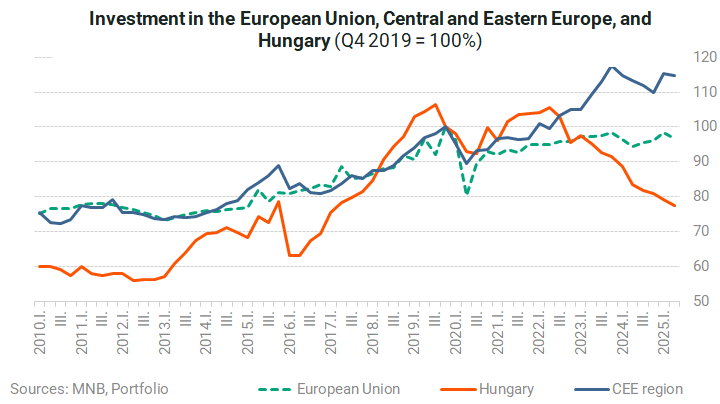
In contrast, in Hungary, the level of investment in the second quarter of 2025 was 22.4% lower than in the fourth quarter of 2019, and the decline was 7% even over the past year. Although the average investment of all European Union countries is still below the 2019 level, the trend shows a slight improvement. In terms of sectors, the other countries of Central and Eastern Europe are performing particularly well, with investment in the second quarter of 2025 already exceeding pre-pandemic levels by around 15%.
The significant downturn in domestic investment activity also affects the development of capital stock,
according to economists at the Hungarian central bank. The impact is so significant that capital's contribution to growth has only been lower than at present during the 2008-2009 financial crisis.
The expansion of capital stock is also an important issue from a monetary policy perspective, as the slowdown in capital growth increases medium- and long-term inflation risks.
In such cases, the supply capacity of the economy can only grow more slowly, which, assuming unchanged (or only slowly adjusting) demand, leads to capacity constraints, faster cost growth, and stronger pricing pressure.
Although investment activity can be measured most accurately on the basis of national accounts data, an approach based on the corporate side (i.e., companies' individual balance sheets) allows for deeper conclusions and situation assessments. For example, the ratio of corporate net investment performance to capital stock shows whether the underlying processes of the economy are pointing towards an expansion of capital stock or, due to its low level, are unable to compensate for depreciation (i.e., the obsolescence and deterioration of assets).
After peaking in 2019, the ratio began to decline, and as a result of low investment performance in 2024-2025, it is expected to fall to around the level recorded after the 2008-2009 financial crisis.
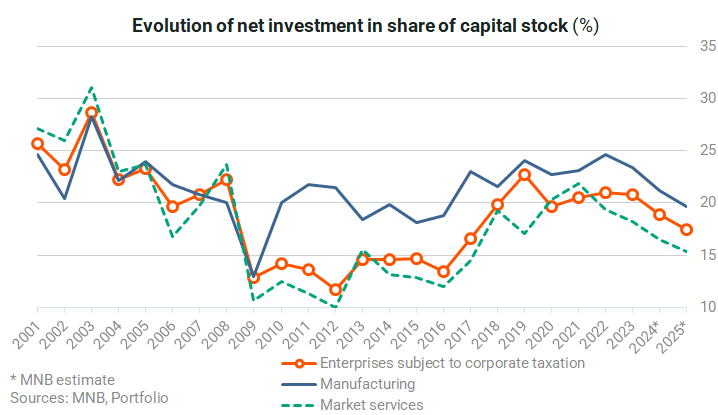
Although this was sufficient for a modest further expansion of capital stock in terms of the economy as a whole, according to our calculations, investment is no longer sufficient to maintain capital stock levels at an ever-increasing share of companies,
the MNB analysts assessed.
Company data show that the balance of investment activity and depreciation had deteriorated significantly by 2023, but still contributed approximately HUF 4,700 billion to capital stock growth. However, the decline of approximately 11% in investment registered in 2024 and the continued decline expected in 2025 may further worsen this balance indicator, causing the rate of capital stock growth to fall back to the level seen during the global financial crisis of 2008/2009.
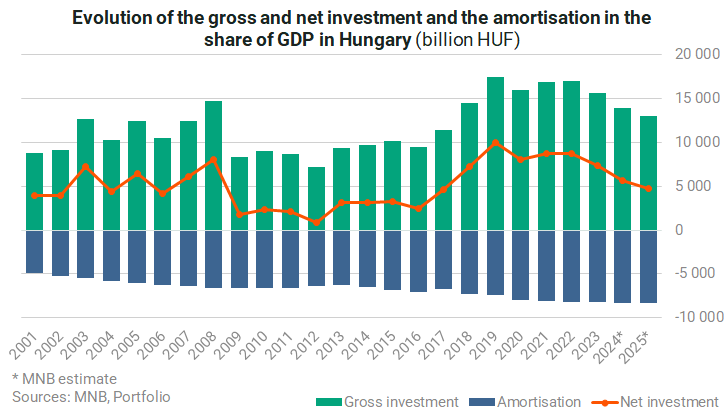
The economists at the MNB emphasize that the slowdown in corporate investment does not yet mean a decline in productive capital, but
if the trend continues, economic growth will suffer significant damage due to the depreciation of productive assets and a decline in productivity.
Cover photo (for illustration purposes only): Shutterstock





