State debt manager publishes third quarter report on Hungary's financing


During the first three quarters of the year, contribution to net financing was almost equal in case of HUF and FX institutional instruments reaching HUF 2,750 billion and HUF 2,781 billion, respectively. The contribution of retail securities was negative (HUF -222 billion). It was the consequence of a technical effect: the maturity and interest payment of series 2025/N Bonus MÁP (with a stock of HUF 442 billion) government bond fell on the last day of the quarter. Corrected for this one-off item, the net financing contribution of retail securities turns positive in the amount to HUF 220 billion, the state debt manager reports.
With regard to the retail market, the debt manager points out that, based on patterns observed in previous periods, customers reinvest approximately 70% of the amounts paid after maturity into the government securities market. In addition, the stock of institutional government securities held by the public increased by nearly HUF 500 billion in the first three quarters.
Gross issuance in the first three quarters reached HUF 16,487 billion, which is 84.4% of the HUF 19,526 billion target.
By the end of September, 86% of the annual gross target for retail government securities had been met, while the figure was 79.7% for forint institutional financing and 99.2% for foreign currency institutional financing. This means that the gross plan as a whole and the three financing segments individually exceeded the pro rata values for the first three quarters.

On the HUF institutional market, net issuance amounted to HUF 2,750 billion in the first three quarters, exceeding the full-year planned amount by HUF 300 billion. On this market, gross issuance amounted to HUF 8,998 billion. Long-term financing from this market consists of HUF bonds and HUF loans. Funds from these loans and securities with maturities exceeding one year finance the state on a protracted basis. In case of institutional HUF bonds, 76.7% of planned gross issuance was completed until the end of the third quarter. Until 30 September, 83.7% of the planned yearly gross issuance was completed in case of short-term discount treasury bills serving primarily liquidity management purposes. In case of HUF loans, the contribution to net financing was positive and amounted to HUF 40 billion against the planned negative contribution in the amount of HUF 35 billion, according to the state debt manager.
Strong demand was observed at institutional forint bond auctions, with Hungarian bonds selling at the end of the third quarter amid outstanding interest. At the auctions held in the first three quarters, demand totaled HUF 4,815 billion for the HUF 1,622 billion offered, of which the ÁKK accepted HUF 2,554 billion, representing 1.89 times coverage.
Based on the experience of the first nine months, the Hungarian population's confidence in government securities remains unbroken, emphasizes the ÁKK. The stock of retail government securities and institutional government securities held by the population amounted to HUF 13,136 billion at the end of September. This figure needs to be adjusted for the BMÁP portfolio that expired on the last day of the quarter, which amounted to HUF 442 billion. The figure at the end of the third quarter is HUF 244 billion higher than the figure observed at the end of 2024, while the adjusted figure is HUF 686 billion higher.
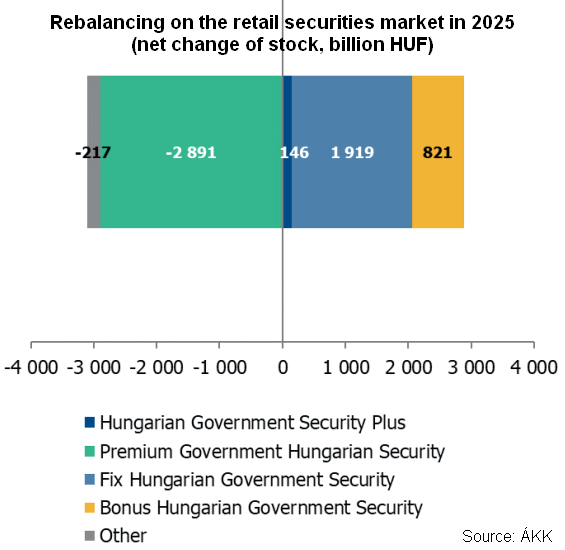
On the basis of its experience in recent years, the ÁKK renewed the terms and conditions of certain retail products with effect from October 1. The average remaining maturity on the retail government securities market has decreased moderately in recent years, from around four years to around three years. Therefore, when developing the new retail portfolio, the focus was on extending maturities and emphasizing predictable, fixed interest rates, which support the development of a healthier debt structure. On October 1, the FixMÁP, MÁP Plusz, BMÁP and PMÁP retail government securities were renewed. The interest rate on the 5-year FixMÁP rose by 0.5 percentage points, offering a fixed annual interest rate of 7.0%, which is not only the highest fixed interest rate but also the highest initial yield within the entire retail portfolio. MÁP Plusz is available with an interest rate that is 0.75 percentage points higher in each interest period. Thanks to its banded fixed interest rate, its new 5-year series starts at 6.5%, gradually rising to 7.5% by the end of the term. BMÁP is available with a 6-year term and a starting annual interest rate of 6.85%. PMÁP retains its 10-year term and continues to offer interest rates above inflation.
On the international foreign currency bond and foreign currency loan market, 165.1% of the annual net issuance plan of HUF 1,685 billion had been fulfilled by September 30. The majority of the HUF 2,781 billion net issuance was realized through the auction of HUF 2,608 billion in long-term international foreign currency bonds, while foreign currency loans contributed HUF 177 billion to the total. In terms of gross issuance, performance was also favorable, as HUF 3,057 billion of the HUF 3,083 billion gross international funding planned for the entire year was realized by September 30, which represents nearly 100%.
In the fall, in addition to a smaller amount of Japanese yen and Chinese renminbi bonds maturing, a EUR 1 billion foreign currency bond will also mature, thanks to which the foreign currency share of total debt may be close to the 30% benchmark by the end of the year, the debt manager notes. Foreign currency funding increases both the flexibility of debt management and the level of mid-year liquidity reserves. Depending on market developments, these market processes may create opportunities for debt structure optimization and further debt repurchases in the remainder of the year.
Cover photo (for illustration purposes only): Shutterstock





