Hungary's EcoMin heralds huge corporate subsidies

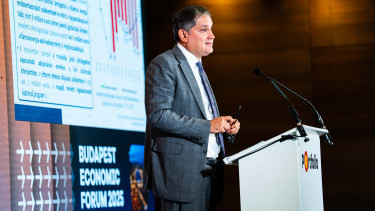
In his presentation, Márton Nagy outlined Hungary's position in the current uncertain global economic climate, as well as the government's economic policy responses. According to the minister, the Hungarian economy will continue to grow faster than those of Germany and the EU in the long term. Between 2000 and 2024, for example, GDP growth exceeded the German rate by an average of 1.3 percentage points and the EU rate by 1.0 percentage points. During periods without crises, this surplus could be as high as 2.3 percentage points.
Can Hungary be economically successful without the European Union?
The politician asked this question at the beginning of his presentation, and then pointed out that the government is trying to support the population and the corporate sector by offering tax breaks and preferential loans.
Regarding what has characterised the Hungarian economy in recent years, he recalled that in the previous decade, the Hungarian economy had consistently outperformed Germany and the EU by 2% in terms of growth. Now, during the crisis, it is possible to exceed Germany and the EU by 1.3% and 1%, respectively.
We must ask ourselves: does this correlation exist now, or will it exist in the future? This is because the EU is currently experiencing a serious competitiveness crisis. Germany may now be entering its third consecutive year of recession, which would be an unprecedented occurrence since World War II,
he added. This indicates that the weakness of Hungary's most important economic partner is a structural rather than a cyclical problem.
In his presentation, he pointed out that the German economy contracted by 0.9% in 2023 and by a further 0.5% in 2024. He added that only 0.2% growth is expected in 2025, with an estimated growth of 1–1.5% in 2026. While Berlin's expansionary fiscal policy could help next year, the politician stated that it is still uncertain whether this will provide the German economy with a lasting boost.
The minister believes that the US trade agreement concluded by the European Commission is particularly unfavourable in the tariff war and is effectively kicking 'Germans who are already down'.
In terms of domestic added value, Germany accounts for 16.9% of Hungarian exports, while the United States accounts for 8.9%. This poses a challenge to the Hungarian economy, as it relies heavily on exports to these two countries.
Márton Nagy said that domestic consumption and fiscal expansion could be the main sources of growth, while the net effect of exports could remain negative. According to IfW Kiel and other German research institutes, US tariffs alone could reduce GDP growth by between 0.2 and 0.5 percentage points.
Germany plans to spend 2.8% of its GDP on defence in 2026, invest €126.7 billion in public works and reduce electricity system usage fees by €6.5 billion, while extending a €3 billion electricity tax rebate. The budget deficit is expected to rise to between 3 and 3.6% in the short term; the last time Germany experienced such a fiscal stimulus was during the pandemic. Public debt, which Germans are concerned about, could rise above 60% of GDP, but the question is what impact this will have.
He also mentioned the government crises and political uncertainty that have unfolded in France over the past year and a half as an additional external risk factor.
Returning to the challenges facing Germany, Márton Nagy discussed how the country's automotive industry is losing ground and market share, both in China and within the European Union.
The minister recalled that, in his meetings with company executives, he often hears that the same thing happened when Japanese brands entered the market in the 1980s and 1990s. However, he believes that a technological shift is underway which German manufacturers cannot win with this attitude.
Based on the current German business climate, economic actors are distrustful of Berlin's new budgetary policy. "It's easy to blame the Germans and the EU for the difficulties facing the Hungarian economy, but in a highly integrated economy, these effects will spill over into investment, industrial production and exports," said the minister.
He explained this by saying that the German automotive industry and the Hungarian economy are almost completely in sync, indicating their mutual interdependence. He pointed out that 44% of vehicle parts and over 55% of batteries are exported to Germany.
Márton Nagy then stated that German business sentiment indices are a better predictor of Hungarian GDP growth than Hungarian ones.
Therefore, it can be said that Hungary cannot be successful without the German and EU economies,
the minister responded to the question posed at the start of his presentation.
According to Márton Nagy, US President Donald Trump's policy of imposing tariffs on imports is a rational approach from a financial perspective. He believes that, if the aim is to increase government revenue, tariffs are one of the simplest and most effective tools for achieving this, given that the United States' huge consumer market means that tariffs imposed on virtually all imported products would immediately generate significant revenue.
According to the minister's calculations, the US could collect around $20 billion (£15.4 billion) per month, or $200–250 billion (£154–193 billion) per year, in customs revenues. The US government could then use this money as it sees fit, for example for economic development, education, or healthcare.
The minister added that he himself would find such a system appealing, as it would provide the state with a direct and stable source of income in the form of customs revenue. He said that the advantage of the American approach is that money comes in first and spending happens later. In Europe, however, the logic is often reversed: they spend first and then try to correct the debt later. According to Márton Nagy, therefore, a tariff war is not an irrational economic policy, but rather a logical tool for maintaining budgetary balance.
He went on to say that, since the Hungarian automotive industry is largely linked to US markets through German supply chains, Hungary could also be severely affected by indirect effects of US tariffs: 28.3% of German exports to the US are automotive products, so a decline in US demand would affect Hungary too. According to OECD data, Hungary is the seventh most exposed EU country to the US market in terms of direct and indirect exports.
The question must be asked: should the Hungarian economy focus on the population or on companies?
the minister continued. In his opinion, consumption has been stimulated so far, which has also benefited companies. While the population has "felt good, had money, and been able to buy" in recent years, companies have been unable to invest due to an uncertain situation.
He explained that consumption is likely to remain the driving force behind Hungarian GDP growth until the end of 2025, with investment picking up only after this period. He pointed out that, when the budget was forecast at 3.4%, tax revenues were expected to be around 1% — in line with current expectations for VAT revenues — but corporate tax revenues are lower.
He emphasised that tax revenues from consumption are performing well, while those from corporate taxes are falling short of projections.
In this regard, Márton Nagy said that, despite the fall in the rate of economic growth from 3–4% to 1%, VAT receipts continued to develop as if the previous, higher growth level had remained in place. He interpreted this to mean that the decline in revenue was not due to a decline in consumption, i.e. household demand remained stable.
According to the minister, the data shows that households are in good financial shape, suggesting that consumption is not a weak point of the economy. However, corporate performance is falling short of expectations, with companies paying less tax than anticipated. This suggests that the slowdown in growth is primarily due to weaker performance in the corporate sector.
Márton Nagy pointed out that household lending is dynamic, while corporate lending is more subdued. He added that this does not yet include the impact of the Home Start Programme on the real estate market.
He went on to say that the government will therefore focus on companies so that the Sándor Demján Programme's 1+1 investment incentive scheme can continue. It is already apparent that the interest rate on liquidity loans under the Széchenyi Card Programme (SzCP) has been reduced from 4.5% to 3% with effect from Monday, 6 October. SzCP investment loans will continue to be available at 3% interest up to HUF 500 million, and the microcredit ceiling has increased to HUF 150 million.
According to Márton Nagy, the government is planning tax and administrative relief for small and medium-sized enterprises, as well as relaxing consumer protection and trade rules. He added that these measures would be complemented by initiatives related to artificial intelligence and energy independence.
The minister emphasised that reducing electricity costs is one of the most important areas, and this can be effectively addressed by installing industrial-scale energy storage facilities.
He believes that if we can store surplus energy generated during peak solar production and feed it back in the evening, this could result in significant savings. He therefore considers the construction of large Battery Energy Storage System (BESS) facilities to be essential and pointed out that Germany has already begun developing them. He added that the capacity of solar power plants in Hungary is now roughly equal to that of the Paks Nuclear Power Plant: 'So we essentially have two Paks – one is the nuclear power plant; the other is Solar Paks.'
Major plans in the cross-hairs
The minister added that tax cuts are also on the way, referring to the support being provided to businesses. He added that
the government is working on a comprehensive tax package, the main elements of which are tax cuts and reducing administrative burdens.
They are considering further reductions in social contribution tax, raising the VAT exemption threshold, improving the conditions for the small business tax (KIVA) and increasing the cost ratio for sole proprietors.
Possible amendments to the rules governing the KATA tax regime are also on the agenda. However, Márton Nagy believes that this issue should be handled with caution. He pointed out that, since 2010, the government has reduced employer contributions from 28% to 13%, resulting in Hungary's tax wedge falling below the EU average.
Márton Nagy emphasised that reducing the administrative and regulatory burden on small and medium-sized enterprises is one of the government's key objectives. This includes a new trade and consumer protection package that will benefit SMEs in several ways. Under the plans, businesses will be able to turn to conciliation bodies for assistance, and the authorities will be able to issue warnings instead of fines in a larger proportion of cases. Companies acting in good faith will also be eligible for exemptions.
The minister emphasised that SMEs are not currently covered by consumer protection legislation. This means that if a large company fails to fulfil its contractual obligations, for example by delivering faulty equipment, smaller companies are effectively powerless. The government therefore intends to introduce legal institutions for warranty and consumer protection that are also available to businesses. The minister believes this could significantly improve the operational security of SMEs.
The minister referred to artificial intelligence (AI) as a new pillar of economic competitiveness. He announced that the national AI strategy had been reviewed and that several specific developments would be launched as a result. These include increasing supercomputer capacity, enhancing social integration and national security considerations, and establishing two new capital funds.
One will be a HUF 17 billion early-stage venture capital fund and the other a HUF 51 billion product-specific capital programme aimed at financing innovative, technology-focused developments.
Regarding solar energy, he returned to a problem that had been raised earlier: Hungarians are solar panel fanatics, but energy storage capacities have not been developed. One reason for this is a lack of focus on the network side, and another is that energy storage battery technology has now advanced to the point where it can be installed close to production sites. He emphasised that this is a significant business opportunity and that storage could generate substantial revenue in this market.
He said that, although BESS batteries are imported as large cells are not manufactured domestically, they significantly reduce energy import dependency. This could also drastically reduce overhead costs.
According to the minister, expanding storage capacity would have three key benefits: reducing electricity prices, reducing the country's dependence on imports and relieving the budget of the expenses of keeping utility tariffs low.
To conclude, Márton Nagy emphasised that Hungary's future depends on energy independence, technological investment and business support, which is why the government is leading the country in this direction with its 'four plus one' economic policy measures, whether through public or private investment.
Cover photo: Portfolio





