Water authority clarifies situation behind reports on Lake Balaton water levels

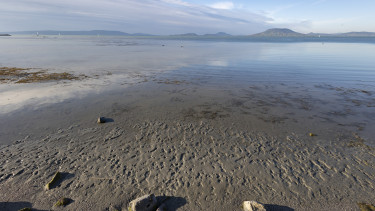
The National Water Authority (OVF) has provided reassuring answers to questions regarding the current low water level of Lake Balaton. Experts emphasize that the lake's water level depends primarily on the amount of precipitation falling in the catchment area.
There is no cause for panic. Lake Balaton is a shallow lake whose water level basically depends on the precipitation falling in its catchment area,
the OVF told Telex.
Water management experts have pointed out that during periods of drought, it is natural for water levels to drop significantly by the end of the summer months due to minimal precipitation and increased evaporation. At the same time, water levels usually rise in the spring, which is part of the lake's natural cycle.
The OVF strongly refuted the assumptions regarding water drainage. "The water authority is working to preserve the lake's natural water resources, as there is no possibility of artificial replenishment. For this reason, for example, we have not diverted water from Lake Balaton into the Sió Canal this year, and we do not plan to do so until the lake's water resources have been replenished," the directorate general said.
Even when viewed in a historical context, the current situation is not unprecedented:
since 2000, lower water levels than the current one have been measured seven times in Lake Balaton.
The record low was registered on October 4, 2003, when the water level was only 23 centimeters. According to experts' forecasts, the current average water level of 66 centimeters is expected to rise to 88 centimeters by January 1, 2026.
However, several factors threaten the long-term health of Lake Balaton: lack of rainfall, environmentally damaging investments, outdated infrastructure, and the unpredictability of climate change could have a negative impact not only on the quantity but also on the quality of the water.
Cover photo: MTI Fotó/György Varga





