Hungary MVM chief explains what is needed to decouple from Russian gas

Exchanging dependencies
The example of the Paks nuclear power plant, which has been in operation for fifty years, also shows that decisions made in the energy sector can determine the future for 30-50 years,
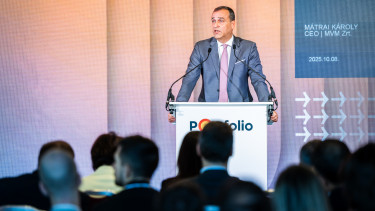
said Károly Mátrai, CEO of the MVM Group, at the beginning of his presentation.
He pointed out that, in this respect, Europe is not leading the way, as
there is no clear vision for the future to which member states can adhere.
Constant changes to policies and goals are putting member states and large companies in an almost impossible situation.
Mátrai then went on to talk about the Hungarian aspects of the European Union's large-scale energy policy programme, REPowerEU, which was launched in 2022 with the aim of reducing dependence on Russian fossil fuels and accelerating the energy transition. However, he pointed out that the EU's infrastructure was built on cheap and predictable Russian energy.
His presentation revealed that
- the European Commission presented a roadmap for ending Russian energy imports in May.
- Specific legislation on the gradual phase-out of Russian gas and oil is expected to be drafted in the third quarter of this year.
- Russian gas imports are then expected to be phased out by the end of 2025 through a combination of new and existing spot contracts.
- By the end of 2027, Russian gas imports to the EU are expected to have ceased completely.
The above measures have resulted in
European gas and electricity prices being three times higher than Chinese prices,
which makes it impossible to compete.
When discussing recent trends, Mátrai emphasised that, although the share of Russian gas has decreased, there has been no significant diversification. Rather, we have simply replaced our dependence on Russia with dependence on the US. Furthermore, despite the EU's goal of ending its reliance on Russian energy, imports of Russian LNG to Europe increased by 23% in 2024.
Diversification in focus
One of the most important ways to achieve independence from Russian natural gas is LNG (liquefied natural gas). Although this system offers exciting opportunities, such as a significant increase in import capacity, it is also important to be aware of the risks. These include the underutilisation of LNG capacities and the risk of dependence on the US. Although LNG imports from the US rose to 43% in 2023, they fell back to 29% in 2024.
Regarding alternative import routes to the EU, he said that, while Europe had replaced its dependence on Russian gas with dependence on the US, our region had diversified more effectively as our market receives gas from several other sources, including Azerbaijan and Türkiye.
Hungary has outstanding infrastructure for gas, with only the Slovak pipeline missing from the transport mix,
Mátrai underlined.
Although we can import gas from many places and there are many LNG terminals available, they are all located far from Hungary. In this regard, what is important is that
Transportation costs are high. Therefore, if we were to completely disconnect from the pipeline and rely solely on LNG supplies, the region would become a premium market.
Keyword: predictability
Research and development at the Neptun Deep gas field in Romania has shown that uncertainty surrounding EU regulations creates a very unfavourable situation. If decoupling from Russian energy is not required until 2028, the transition will not be problematic. However, if it is required in 2027, the Romanian solution will not yet be available, which could place Hungary in a difficult position.
In his closing remarks he said:
We cannot overhaul European industry at such a pace or make such irresponsible decisions. What is missing is predictability. This is the foundation of every company. If we had that, we would know how to wean ourselves off Russian gas.
He added:
We will be able to supply Hungary; the only question is the extra cost.
During his presentation, the CEO also discussed MVM's international diversification portfolio and non-traditional financing transactions. However, he also addressed the challenges posed by the electrification trend in Hungary.
Cover photo: Portfolio





