Professional investors discuss whether AI is a boom or a bubble, and whether the forint is strong or weak

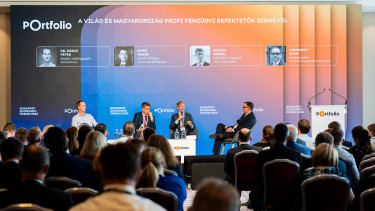
Boom or bubble? That was the question posed by Áron Vidovszky, head of Portfolio Investment Services, in relation to artificial intelligence. Earlier that morning at the conference, Harold James, professor at Princeton University, had said that it was not yet possible to decide whether it was a boom or a bubble.
The AI revolution is both a boom and a bubble, replied Tamás Móró, chief strategist at Concorde Securities.
Every boom has a bubble side to it. There is a bubble, there are signs of it, (...) but no one can afford to be left out of AI,
added Móró.
It's clear that this is a bubble, said Péter Oszkó, founder and CEO of O3 Partners, ex-Finance Minister under the Bajnai government in 2009. At the beginning of every technological shift, development is very expensive, and even those who break through the barriers bleed dry. The investment requirements are extremely high at the beginning, and it is expensive to break through the wall, but after that, it is easy for others to walk through the gap, said Oszkó, citing smartphones as an example, where the investment costs of first-generation and fourth-generation smart devices are completely different.
According to Dániel Móricz, investment director at Hold Fund Management, there are many parallels with what we saw in the late 1990s with the dot-com bubble. He believes that AI appears to be a bubble-prone trend in the capital market. When China enters a room, profits walk out, whether it's electric cars, solar panels, or AI, referring to the DeepSeek moment.
According to Péter Oszkó, DeepSeek was a big favor to the United States. It is not certain that without DeepSeek, all decision-makers could have been convinced that more should be spent on AI. This showed that
China can copy things, but it also has originality, while the US is now investing even more in AI.
Áron Vidovszky also drew attention to the rise of gold, to which Péter Oszkó responded by saying that the dollar's role as a stable reserve currency was beginning to weaken. "We are not yet at the point where central banks are buying bitcoin, so they are turning to gold," he added. Péter Oszkó attributes this process to President Donald Trump's policies.
Tamás Móró added that many people have asked themselves whether America could take away their foreign exchange reserves after doing so with Russia. There are many processes that are driving investors towards gold, he said.
But what is the situation in Hungary? Áron Vidovszky asked investors about domestic investment trends and the forint exchange rate.
Tamás Móró emphasized that the forint is currently considered a relatively strong currency.
In my opinion, it will not really be any stronger than this in the long term.
He added that the MNB is committed to positive real interest rates and curbing inflation expectations. At the same time, it seems that the government is not so committed, as inflation is usually an important factor in elections, he said, referring to the morning remarks of Minister of National Economy Márton Nagy, who urged monetary easing during a break at the Portfolio conference, prompting a fall in the forint.
According to Péter Oszkó, now is the time to start building a diversified portfolio while the forint is strong. This may be the moment, he said.
If verbal interventions cause the forint to fluctuate even more, an automatic avalanche could start,
Oszkó said, referring to the impact of algorithmic trading.
Read our previous reports of the Budapest Economic Forum 2025 conference here:
Cover photo: Portfolio





