Hungary ushers in an energy revolution that will shape our future for decades to come

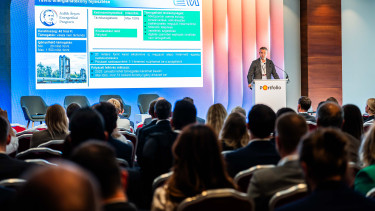
At the closing panel of the Portfolio Energy Investment Forum 2025, participants discussed the future of energy investments, the role of private capital, and the practical effects of the Jedlik Ányos Energy Program. During the roundtable discussion, Attila Steiner, State Secretary for Energy, László Csatári, Deputy Chief Investment Officer at Trustify Investment Fund Management, and Márk Balástyai, CEO of Futureal Energy Partners, discussed the direction in which the Hungarian energy market may move in the coming years.
At the beginning, Attila Steiner spoke about how the goal of the Jedlik Ányos Program is not only to increase renewable capacity, but also to bring balance to the Hungarian energy system as a whole. He recalled that electrification has accelerated at an unprecedented pace in recent years: industrial and residential electricity consumption is growing, and more and more electric cars, heat pumps, and modern household appliances are appearing in the system, which requires huge network developments.
He emphasized that the energy crisis has shown how vulnerable the country is to natural gas, so the government's goal is to reduce gas dependence, while gas will remain part of the Hungarian energy mix, just in a different role. He highlighted the importance of developing geothermal energy and biogas, as these sources simultaneously improve security of supply, price stability, and energy sovereignty.
According to the state secretary, the Jedlik Ányos Program finally provides Hungary with the opportunity to build an energy system that is truly weather-independent and relies on domestic resources.
László Csatári pointed out that fund managers do not work with subsidies, but with market-based investments, so the question for them is where the return and the real business model lie. He acknowledged that the program is forward-looking in several respects: in particular, the focus on geothermal energy and the compensation of deep drilling costs could help boost investor activity. He also called the development of the electricity grid an important step, as solar power plant projects and available land are of little use if they cannot be connected due to grid limitations. He added that the balance between returns, risks, and financing conditions must always be weighed realistically, especially in new areas such as energy storage.
Csatári lamented that wind energy has not yet been given a prominent role in the Jedlik Ányos Program, even though, in his opinion, this segment offers significant opportunities and the industry is increasingly pushing for its return.
On behalf of the Futureal Group, Márk Balástyai assessed that the energy program fills a gap, as Hungary has not had such a complex, long-term strategy until now. He emphasized that there is a particularly great need for energy modernization in the real estate sector, as a significant portion of Hungary's housing stock is extremely energy inefficient. The group is also interested in energy developments on the investor side and is already working on several district heating projects. According to Balástyai, district heating is a key issue: one of the most pressing problems in the real estate sector is the greening of district heating systems.
Balástyai proposed the introduction of a system of guarantees of origin for heat production, which would function similarly to the green certificates that already exist for electricity.
He believes that this would encourage investment and give market value to green heat production, which is currently not adequately rewarded.
László Csatári then spoke about how the reality of capacity expansion depends on financing and technological risks. In his opinion, energy storage is crucial, but it is still difficult to model on a commercial basis. The development of solar power plants is practically inconceivable without storage capacity, but the return on investment depends heavily on the technology chosen by the investor and how many times a day the storage facility can be “discharged.” He believed that the energy mix of the future could be a combination of solar energy, storage, and wind. In the case of geothermal energy, however, he considered it essential to distinguish between deep drilling and shallow exploration: the latter, in his view, is smaller in scale but particularly promising for logistics and commercial facilities.
Speaking about energy storage, Attila Steiner noted that the expansion of storage capacities has already begun, and that the government aims to achieve at least one gigawatt of energy storage capacity by 2030, but developments may progress even faster than this.
Half of the targets set out in the National Energy and Climate Plan could be achieved as early as next year, thanks in part to industrial and residential storage programs. He added that electricity prices are distorted at the regional level due to network bottlenecks, so Hungarian developments serve to reduce regional price differences in addition to ensuring security of supply. He also mentioned that a new legislative package promoting the renaissance of wind energy is already in preparation, which would allow the installation of 199-meter towers in priority zones, making 1 gigawatt of wind power capacity available by 2030. He believed that Hungary's conditions are not outstanding in European terms, but they are favorable regionally, so wind energy could once again become an important part of the domestic system.
Responding to the risks associated with geothermal projects, Márk Balástyai said that, based on their own experience, the technology is viable, but the financing and regulatory environment has not been favorable so far. He recalled that Futureal had already built a condominium with geothermal heating and cooling in 2008, but the investment could only be realized at that time with significant own resources. As an example, he mentioned that they had also examined the use of geothermal energy in a 30-hectare development in the 13th district, but were ultimately unable to incorporate it due to the volume and timing of the investment. In his opinion,
a well-designed support mechanism could make these projects viable immediately, as the main problem is not technological but financial.
In this context, László Csatári stated that geothermal energy is currently still too risky a segment, both in terms of licensing and implementation. For a fund manager, bankability and risk weighting are decisive factors: if projects cannot be fitted into classic project financing models, then interest from the capital market will remain limited. He believed that commercial banks also need to rethink the financing of renewable projects, because many projects cannot obtain credit due to the lack of fixed-price energy purchase agreements and price volatility. He believes that
only the conscious coordination of private capital, state and bank resources can help in this situation, for example in the form of PPP-type constructions.
Returning to the topic of energy storage, Attila Steiner emphasized that this area is crucial from both a technological and investment perspective, but due to rapid developments, everyone is currently learning how to manage it. In his opinion, the financial models for storage are still immature, but experiences in Europe (e.g., in the United Kingdom) clearly show that the existence of a support mechanism is crucial for long-term returns. The costs of storage will eventually be reflected in electricity prices, but in return they will ensure a more stable system and greater consumer control. He added that in his view, the combination of storage and decentralized production could provide a new balance for the Hungarian energy system.
László Csatári added that when designing the support system, care must always be taken to avoid creating a “green bubble,” i.e., excessive government intervention that distorts the market. In his view, the state has a key role to play in the initial phase, but in the long term, the market must sustain the projects.
He said it was important to create a win-win situation between the support conditions and the banks' expectations, which would provide security for both sides.
He mentioned as an example that geothermal energy has a 60-year time horizon, which is difficult to manage from a banking perspective, so it is not possible to rely solely on investment-type subsidies: operational incentives are also needed, such as green energy accounting built into pricing.
In closing, Attila Steiner confirmed that the state is examining not only the return on investment of the projects, but also their impact on the national economy. As he said, any investment that reduces natural gas imports improves the country's energy balance and indirectly increases Hungary's GDP, as the resources remain in the country. The goal is to reduce the current 70% gas exposure to 50% , which could mean replacing up to 4.5 billion cubic meters of natural gas per year. Geothermal energy, for example, is a major investment, but it can be operated cheaply for six decades and provides predictable costs. However, EU regulatory constraints must also be taken into account when developing support models: the Commission strictly examines what constitutes market distortion, which is why the Hungarian government is considering one-off investments rather than ongoing operating subsidies.
Cover photo: Portfolio





