S&P keeps rating, outlook on Hungary unchanged


The credit rating agency did not publish a separate assessment of Hungary, merely indicating that it had not changed its rating or outlook. The last detailed analysis was published in April, when the outlook was downgraded to negative. At that time, GDP growth was estimated at 1.5% for 2025 and 2.5% for 2026. This year's estimate is clearly optimistic, while next year's estimate may be slightly pessimistic given the current situation.
At the time, this negative step was primarily justified by fiscal and external risks. Estimates suggested that the budget deficit could reach 4.5% of GDP this year and 4% in 2026. While this year's forecast may be realistic based on analysts' expectations, some experts anticipate a rising deficit next year due to the elections. The government's target is a deficit of 4–4.5% this year and 3.7% in 2026.
Further excitement is expected in the coming months,
with Moody's announcing its rating for Hungary on 28 November, followed by Fitch Ratings on 5 December.
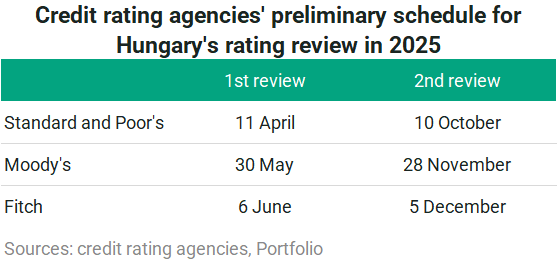
Hungary's rating is Baa2 at Moody's and BBB at Fitch, both one notch higher than at S&P's. What's more, the country's outlook is stable at Fitch. While we cannot say that a negative move is likely with either, it is more probable than the outcome of the S&P review. In Moody's case, a downgrade would be the next step following a negative outlook, whereas Fitch could downgrade its outlook as well. In other words,
Hungary runs no risk of getting a downgrade straight into junk grade.
Prior to this, analysts also gave S&P the lowest chance of a downgrade action, as stronger arguments are likely needed for the credit rating agency to take such a step when a country is on the verge of junk status. Although the Hungarian budget situation remains bleak, the country is not out of line with the rest of Europe. The debt-to-GDP ratio is expected to rise slightly this year, but this is not enough to knock Hungary into non-investment grade.
The dates of the 2026 rating reviews are not yet known; they will be announced in December. However, the next assessment from S&P is expected within six months. However, it is unlikely that they will downgrad Hungary during the parliamentary elections unless the economic outlook deteriorates significantly or some external shock occurs. In the base case scenario, they will probably wait for the election results and consider whether a downgrade or an improvement in the outlook should be the next step in autumn 2026.
Confidence in Hungary remains unbroken, as confirmed not only by credit rating agencies but also by bond issues,
according to a statement issued by the Economy Ministry following the decision.
They added that this year's foreign currency bond auctions had been extremely successful, with ÁKK issuing bonds in three currencies — euros, dollars and Chinese renminbi — and experiencing multiple oversubscription.
The ministry emphasised that Hungary's finances are in order and that the government is implementing Europe's largest tax reduction programme while remaining committed to maintaining budget stability, strict fiscal discipline and reducing public debt and the budget deficit. To this end, the government is following four rules:
- The deficit must be reduced year on year.
- Public debt must remain on a sustainable path.
- Hungary must avoid returning to the excessive deficit procedure.
- The primary balance must stay close to zero.
Cover image (for illustration purposes only): Getty Images





