Earnings fall for many Hungarian workers, but unfortunately this comes as no surprise


Many people may have been surprised when several articles appeared recently reporting that the real wages of one-third of workers are falling. But Portfolio readers were certainly not among those who were taken aback by this news. It has been known for months that this year will be no different from the others:
some workers will again be able to afford less with their income this year.
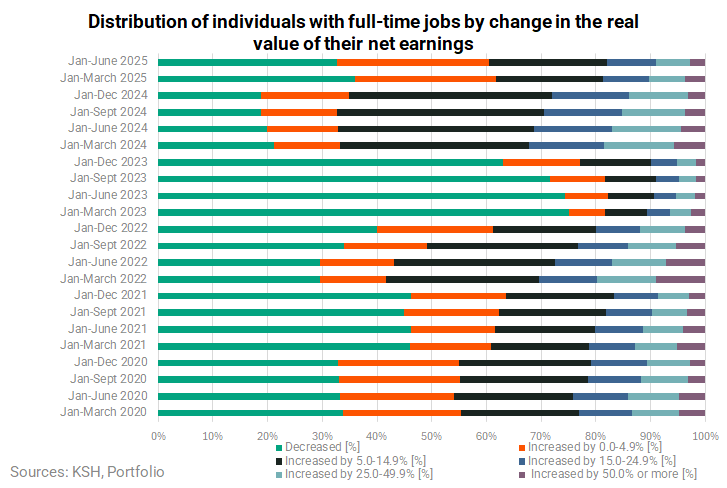
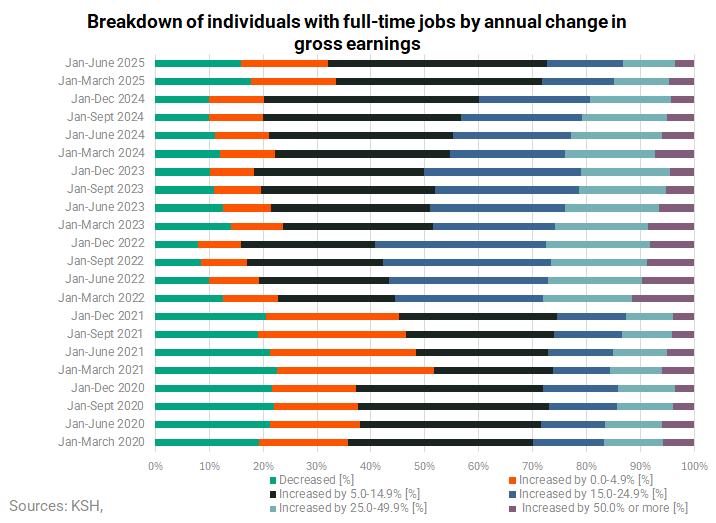
Portfolio was the first portal to start writing regularly about the Hungarian Central Statistical Office's (KSH) experimental statistics. The revolutionary approach introduced by the office last year provides one of the best and most accurate explanations as to why consumption is not so robust, given that purchasing power has increased by 5-10% over the past two years. Well, it is because the average wage increase masks the details.
There are many explanations for wage trends. At first glance, one important factor seems to contradict economic logic, namely that wages are “downwardly inflexible.” According to the data, the nominal wages of more than 15% of people, i.e. wages expressed in forints, have also fallen in recent times, which is not really realistic in economic terms.
But why is this the case? For example, if someone loses their job, they may suddenly find themselves in a position where they can only find work that pays less. This may be more common in countries where it is very important to find a job quickly. Let's remember:
Hungary has the shortest period of unemployment benefits in the entire EU, only 3 months.
At home, people don't really have time to look for a “good” job when they lose their job, but have to find a job quickly, which may not be the best fit for their skills and may not pay very well. Job hunting, applying, the selection process, and interviews do not take place in a day or two, and three months is not enough time even if someone finds a suitable job in no time.
Another possibility is that someone's wages decrease without changing employers. The stagnation of the past three years has required companies to adapt by reducing working hours, weekend work, overtime, and bonuses or rewards. This is accompanied by a decrease in nominal wages. Many employees are forced to accept such wage cuts, as companies are not welcoming new employees with open arms in the current economic situation.
In times of crisis, when some companies are struggling to survive—and there may be quite a few of them after years of stagnation—the principle of nominal wage rigidity also ceases to apply. It is worth remembering that the number of unfilled vacancies has also fallen dramatically, while in some industries (especially manufacturing) the number of workers has also decreased. Thus, we can no longer speak of such a large labor shortage as two or three years ago.
In the particularly uncertain economic environment since Covid, there are also those who have moved away from general wage increases and are instead directing more resources towards those positions and skills (key workers) that really create value. This has led to a situation where, although the company in question regularly raises wages, there are employees who are left out of this.
The above explanations referred to the decline in wages expressed in forints, but there are also many people whose wages are simply “not rising” or “not rising as much as inflation.” Amidst the difficult economic situation and uncertain outlook, some companies may postpone wage increases, especially if they are not afraid that this will be accompanied by a series of resignations.
However, it is quite possible that some companies do not increase wages every year, even under normal economic conditions. This is suggested by figures from the statistical office, which are confirmed by international research. According to an American study, at least one-third of workers do not receive an annual base salary increase, and their wages may remain unchanged in nominal terms for two to three years. In the UK, annual wage increases are not a given either. Wages do not go down, but the upward trend is not so clear either. However, when companies do raise wages, they “make up” for several years of price increases. Domestic labor market surveys also point to this, as many companies do not want to raise wages every year.
Finally, there are those whose wages are rising, but whose purchasing power is declining because their wage increases are less than 4-5%. Admittedly, they are in the least bad situation of the above: although their wages are rising in forint terms, inflation is still higher than their wage increases.
And so we have reached a point where one-third of workers have seen their real wages fall, and the vast majority of them will certainly have to keep a close eye on when and what they spend their money on. So when we expect consumption to grow, we can actually count on two-thirds of the population.
But then how is it that earnings in Hungary are currently growing by an average of nearly 10%? How is it possible that real wages (wage increases adjusted for inflation) are growing at around 5%?
It is because there are many people whose earnings are growing by 25% or even 50%.
Apart from promotions, this rarely means that the employer does not change. The biggest salary increases can be achieved by changing jobs. To achieve increases of 25-50%, you need to consciously prepare for a change of job, often spending months looking for a better opportunity. In general, those who change jobs receive much larger pay increases than those who remain loyal to their employer.
International research has shown that it pays to be a job hopper because, with 5-10 years of work experience, those who have changed jobs a few times achieve a much higher nominal wage level than those who have not. Of course, you have to be careful not to have too long a resume, as employers view it as a warning sign if an employee changes jobs too often. In any case, domestic wage statistics show that 10-20% of employees see their wages increase by more than 25%, and the vast majority of them also change employers. In such cases, the well-established "counteroffers" often come into play, and if the employee does not feel bad otherwise (except for their salary), they may even work.
It is also instructive to examine the rate of wage increases in individual sectors. The data show that even in sectors linked to the state, annual wage increases are not a given. This should come as no surprise, as we have seen over the past decade that wage increases for doctors and teachers, for example, have been delayed for years. In the case of the latter, this continued until many teachers' wages fell to the minimum wage for skilled workers. This year, we see that the worst-performing sectors in terms of wage increases are public administration, defense, and social security.

Cover photo (for illustration purposes only): Getty Images





