The explosion in Hungarian food prices was so dramatic that it still reverberates today


Food prices take off everywhere
Raw material prices have risen significantly worldwide in recent years, mainly due to the increase in oil prices, according to monthly data from the UN Food and Agriculture Organization (FAO). If we thought that the price increases had already subsided, the trend of recent months may cause us to reconsider, as the price of dairy products has also risen sharply alongside the price of oil.
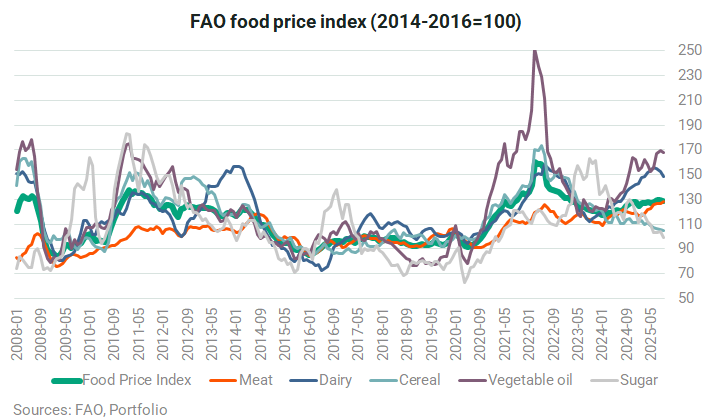
Based on data from September, the FAO composite price index was almost 30% higher than the 2014–16 average. Within this, the world market price of sugar was slightly lower than ten years ago, while the 5% increase in cereal prices was below average. However, the price of edible oils increased by 68%, while dairy prices rose by 48.3%. The increase in the world market price of meat was in line with the average at 27.8%.
However, the surge in food prices is not fully explained by rising commodity prices, as the OECD's food inflation calculation was more than 45% between 2019 and 2025, compared to a 30% increase in the FAO price index.
The price increase in Hungary was exceptional worldwide
The Financial Times also examined in an article the rate of food price inflation in individual countries between 2019 and 2025. During this period, food prices rose faster than the general inflation rate in most countries. The two exceptions were China and, perhaps surprisingly, the Czech Republic.
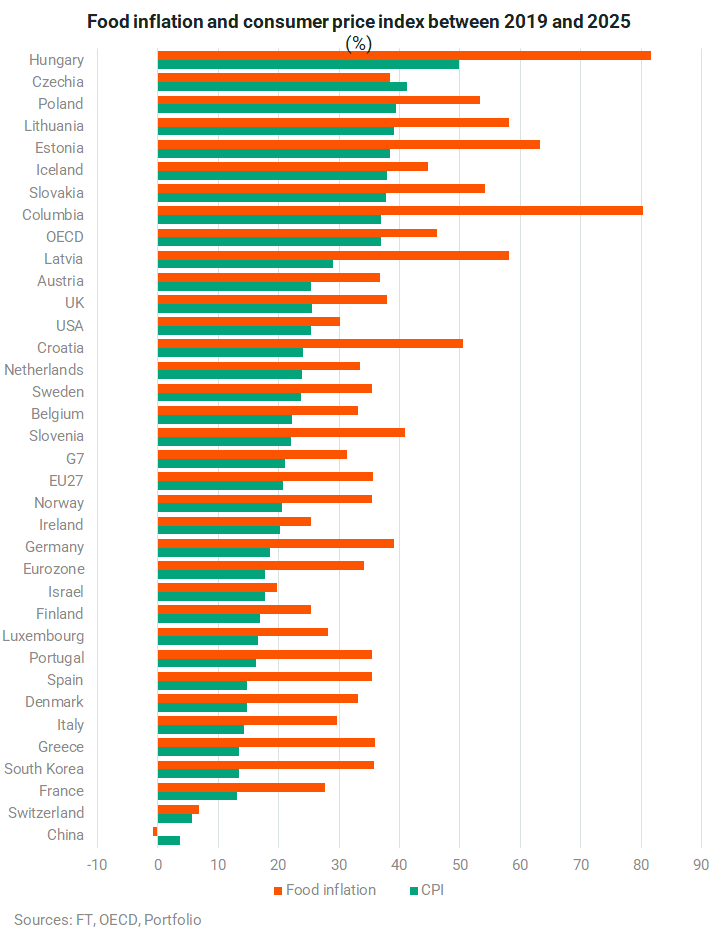
Clearly, Hungary ranks first in the world for both indicators:
cumulative inflation is at 49.9%, and food prices have risen by 81.6% over the past six years.
However, there is one country that has overtaken us in terms of the difference between the two: Colombia, where inflation was 'only' 36.9% over six years, but where food prices have almost caught up with ours.
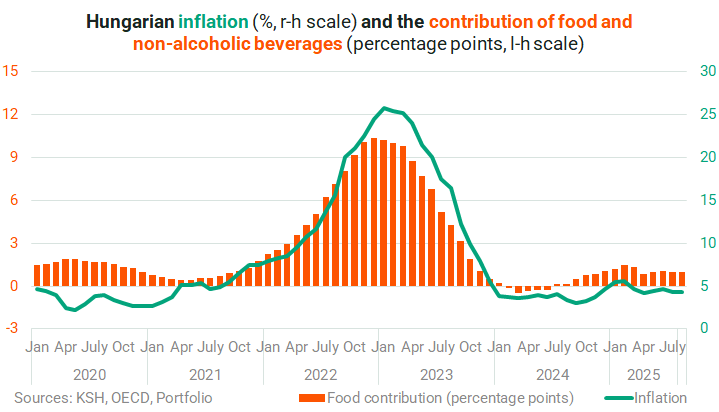
Examining the extent to which rising food prices contribute to inflation in Hungary reveals that this contribution remains at around one percentage point. Between February and May 2024, there was a brief period when this contribution was negative, meaning food prices pulled back the overall rate of price increases. However, since then, the contribution has risen again. At the beginning of the year, the contribution was 1.5 percentage points, falling to 0.84 with the introduction of margin caps. However, the gradual increase in prices since then suggests that retailers are attempting to offset the effects of margin caps by raising the prices of other foods, a practice known as cross-pricing.
Since December last year, Eurostat, the statistical office of the European Unionn has also been examining changes in food prices in a separate database. Hungary's inflation rate stands out when compared with other European countries, as food prices have more than doubled since 2015.
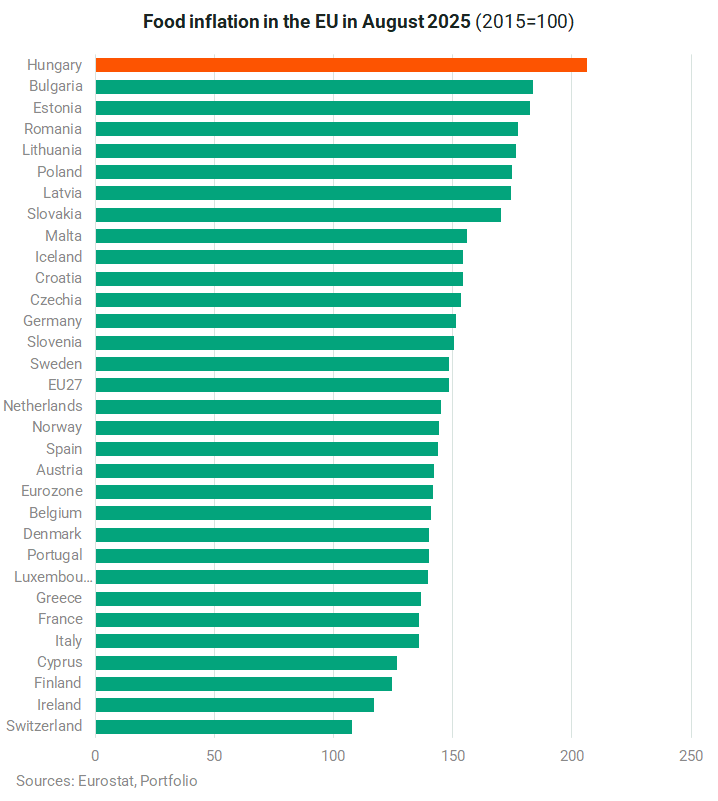
Examining the individual product groups more closely, we can see that, for example, the price of bread in Hungary has risen more than two and a half times over the past ten years, with only Poland and Bulgaria experiencing price increases of more than double this amount. Meanwhile, Hungary's 71.1% increase in meat prices is not even in the top three. In the case of pork, for example, the price increase in seven countries has been greater than in Hungary over the past ten years.
Over the past ten years, the consumer price of milk has risen by 57% in Hungary, and prices have risen even more sharply in ten other European countries. Only Slovakia and Estonia have seen egg prices rise by more than Hungary's 110% increase compared to 2015. Hungary has the highest fruit prices in Europe, with prices rising by over 170% in the last ten years. Even Poland, in second place, did not reach 100%. A similar situation was observed with vegetables, where Hungary's outstanding 130% price increase stood out across Europe.
Regarding the differences between countries, the Financial Times points out that, while food prices in Switzerland have risen by only 7% since the beginning of 2018, they have increased by 93% in Hungary. They add that costs in Switzerland are high and stable. Regarding Hungary, they note that
the depreciation of the forint in 2021–22, which exceeded the rise in global commodity prices, played a role in the sharp increase in food prices.
The article highlights that the Hungarian government introduced margin caps and special taxes due to rising food prices, and blamed foreign retail chains as it felt that rampant inflation was damaging its popularity.
To illustrate the impact of the forint exchange rate, it is useful to examine how the relevant currencies have performed against the dollar over the past five years.
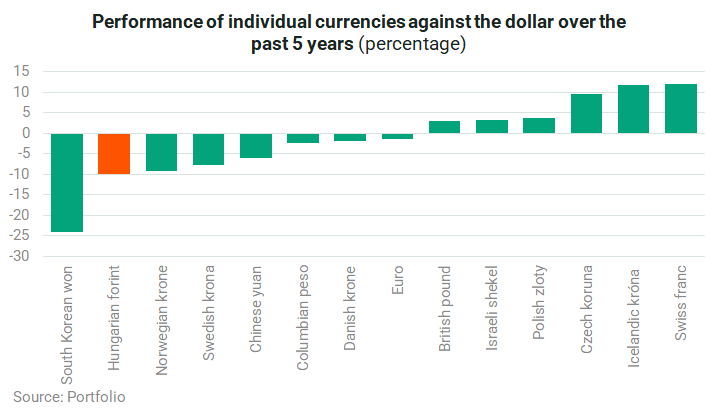
Although the forint was one of the big winners in 2025, it is clear that only the South Korean won weakened more over a five-year period. Of course, many factors influence food price changes, ranging from a country's supply of raw materials to the influence of local companies. However, when compared to regional competitors such as the Czech Republic and Poland, there may be a correlation between the two. This is particularly evident when we consider the similarly small and open Czech economy, where the koruna has strengthened by almost 10% against the dollar in the long term.
Central banks also face a difficult situation
The FT article also highlights that, in economic terms, food inflation has not been a significant factor for a long time. It generally occurs in countries with high income inequality, where lower-income households spend a significantly larger proportion of their income on food. Moreover, food prices are not generally considered to be good predictors of future inflation, so central banks do not pay much attention to them.
This is now changing, as central banks can no longer ignore the issue of rising food prices. For example, the Japanese central bank recently justified its upward revision of the inflation forecast on the basis of rising rice prices. European Central Bank (ECB) executive board member Isabel Schnabel said that rising food prices have a significant impact on population inflation expectations and therefore warrant particular attention.
In the current situation, it is particularly important for central banks to anchor expectations, especially in countries where inflation is persistently above the central bank's target, such as Hungary.
Cover image (for illustration purposes only): Portfolio





