Rating agency warns Hungary against pre-election profligacy


Fitch Ratings has updated its estimates for Eastern European economies on Wednesday. It noted that Hungary’s ratings are supported by strong structural indicators relative to ‘BBB’ peers, including GDP per capita well above the peer median. These are balanced against high public debt relative to peers, a record of unorthodox economic policies and worsening of governance in recent years.
The rating agency trimmed its 2025 GDP growth estimate to 0.6% from 0.7% projected in June, and
slashed its 2026 forecast to just 2.5% from 3.1%.
The downward revision for this year is related to
- increased trade uncertainty,
- limited space for monetary and fiscal easing,
- low EU fund inflows,
- slower real wage growth and
- subdued consumer sentiment.
They expect real GDP growth to rise to 2.5% in both 2026 and 2027 on recovering investment activity, but highlighted Hungary’s exposure to US tariffs is high, with manufacturing, including auto, chemicals and pharmaceuticals the most exposed.
Fitch does not expect Hungary to make significant progress in unlocking EU funds by mid-2026, projecting net fund inflows to average 0.6% of GDP in 2025-2027.
The rating agency expects HICP inflation to average 4.8% in 2025-2026, before moderating to 4% in 2027.
Inflation is forecast to remain above the peer median despite profit margin caps and price freezes in several sectors,
Fitch Ratings said. They expect the central bank to maintain the key rate at 6.5% until end-2025, before cutting to 5.5% by end-2026 and 4.5% by end-2027.
Fitch offered some criticism also about Hungary's budget situation, particularly pre-election tax cuts. They project a primary fiscal deficit of 0.5% of GDP in 2025-2026 and 0.2% in 2027 (against a balanced position in 2024). "This reflects the implementation of targeted fiscal easing measures, which will gradually come into force from October 2025, the two-step rise in child allowances announced in 2024 and weaker growth outlook," Fitch said.
they forecast the budget gap to reach 4.5% of gdp this year, drop to 4.2% in 2026 and further to 3.8% in 2027.
Surprisingly, Fitch expects Hungary's debt-to-GDP ratio to be on a "modest downward path", despite expected small primary deficits and slower nominal GDP growth. However, it noted that at 71.5% at end-2027 it will remain above the pre-pandemic level of 65% and the forecast ‘BBB’ median of 61.5%. They expect interest/ revenue to decline to 8.7% in 2027 from a peak at 11.8% in 2024.
At the end of the brief analysis, Fitch Ratings also lists positive and negative rating sensitivities:
- (+) A sustained decline in general government debt/GDP to closer to the peer median.
- (+) An improved institutional environment and policymaking that support a strengthening of medium-term growth.
- (-) Deterioration in the policy mix that leads to the build-up of macroeconomic imbalances and/or undermines investor confidence
- (-) A loose fiscal stance and/or weaker economic growth that prevents government debt/GDP from falling.
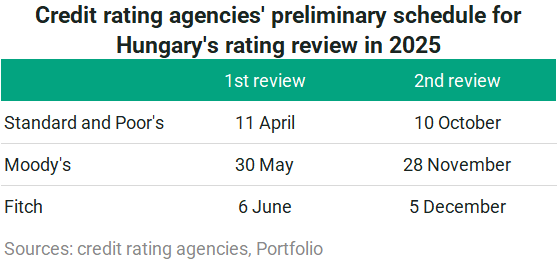
Fitch will review Hungary's credit rating next on 5 December, when it will announce its decision. While no major negative steps are expected following the current analysis, there is a chance that the current stable outlook could be downgraded to negative.
Cover image (for illustration purposes only): Getty Images





