Hungary drops to bottom of EU ranking in World Justice Report


The global rule of law recession has accelerated, according to the new WJP Rule of Law Index 2025.
A stark 68% of countries declined in their rule of law in 2025, compared to 57% in the previous year.
The steady deterioration in the rule of law had slowed in recent years. This year, however, we see a sharp reversal: more countries are declining, and fewer are improving,
said Alejandro Ponce, WJP’s Executive Director.
The disparity between rule of law improvements and declines is widening. In the last year, countries that improved saw an average score gain of 0.52%; meanwhile, countries that deteriorated saw an average decline of twice that: 1.07%. This difference highlights that while building resilient rule of law institutions can be a long and iterative process, dismantling them can happen rapidly.
The WJP Rule of Law Index provides data on eight factors: Constraints on Government Powers, Absence of Corruption, Open Government, Fundamental Rights, Order and Security, Regulatory Enforcement, Civil Justice, and Criminal Justice. Scores range from 0 to 1, where 1 signifies the highest possible adherence to the rule of law. This year, the Index covers 143 countries and jurisdictions, with Qatar integrated for the first time.
The top-ranked countries are:
- Denmark (0.90),
- Norway (0.89),
- Finland (0.87),
- Sweden (0.85), and
- New Zealand and Germany (0.83).
The bottom-ranked countries are:
- Venezuela (0.26),
- Afghanistan and Cambodia (0.31),
- Haiti (0.32),
- Nicaragua (0.33), and
- Myanmar (0.34).
Countries with the lowest scores tend to operate in unstable political and economic environments.
With a total score of 0.50, Hungary ranks 79th in the 2025 ranking, which is the worst result within the European Union.
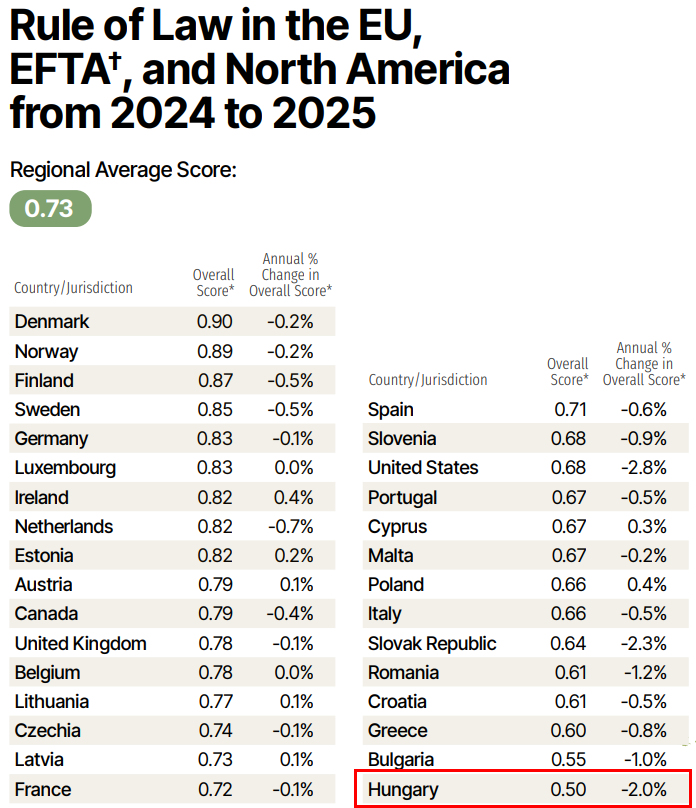
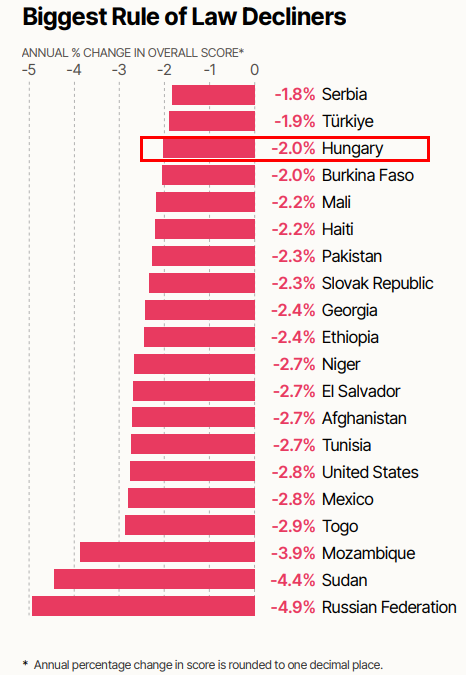
Compared to last year, Hungary's score fell by 2.0%, placing it among the world's biggest decliners. It is at the bottom of the EU rankings, with only non-EU countries ranking below it: Guyana (80th; score of 0.50), Uzbekistan (81st; score of 0.50) and Belize (82nd; score of 0.50) have similar scores.
With a score of 0.64, Slovakia ranks 37th in the region, but it suffered one of the largest declines, dropping by 2.3%.
Among neighbouring countries, Romania ranks 44th with a score of 0.61 (-1.2%), Croatia ranks 46th with a score of 0.61 (-0.5%) and Greece ranks 48th with a score of 0.60 (-0.8%).
Russia performed the worst among the global decliners, with a 4.9% drop taking it to 0.41 and 119th place. It was followed by Sudan (-4.4%), Mozambique (-3.9%), Togo (-2.9%) and Mexico (-2.8%). The United States also saw a significant decline, weakening by 2.8% and falling to 27th place with a score of 0.68, placing it close to countries such as Slovenia and Portugal. Other major European declines include Georgia (-2.4%) and Slovakia (-2.3%).
The Dominican Republic achieved the greatest improvement, raising its score by 2.1% to 0.50. Other countries that made significant improvements include Senegal (1.6%), Sierra Leone (1.4%), Bangladesh (1.3%), Gabon (1.3%) and North Macedonia (1.3%). Brazil improved by 1.1 per cent, reaching 0.50 and placing 78th — practically on a par with Hungary, which is one place ahead.
The new data reveals a widespread deterioration in the rule of law across the EU,
with two-thirds of member states performing worse than in 2024.
Rising authoritarianism—defined by weakening checks and balances and shrinking civic space—has been a primary force in this year’s rule of law downturn, driven by widespread declines in factors measuring Constraints on Government Powers, Open Government, and Fundamental Rights.
Additionally, falling scores in the indicators measuring the judiciary’s checks on executive power and judicial independence indicate that judiciaries are losing ground to executive overreach, with rising political interference across justice systems.
The Index shows that judiciaries are losing ground to executive overreach, with rising political interference across justice systems. Indicators measuring whether the judiciary limits executive power and whether civil and criminal justice are free from improper government influence declined in 61%, 67%, and 62% of countries, respectively.
More broadly, civil justice weakened in 68% of countries. This decline reflects longer delays, less effective alternatives to court (such as mediation), and greater government interference.
Hungary's ranking has been declining for years. It fell to last place in the EU in 2025, ranking in the bottom third globally.
Most of the countries immediately above Hungary in the rankings display similarly weak institutional quality. As many of these countries are less developed, Hungary's further decline is particularly striking in a regional comparison. According to the report, Hungary's main areas of deterioration are transparency in public institutions, judicial independence and increased government influence.
Cover image (for illustration purposes only): Getty Images





