Hungarian economy stagnates in the third quarter


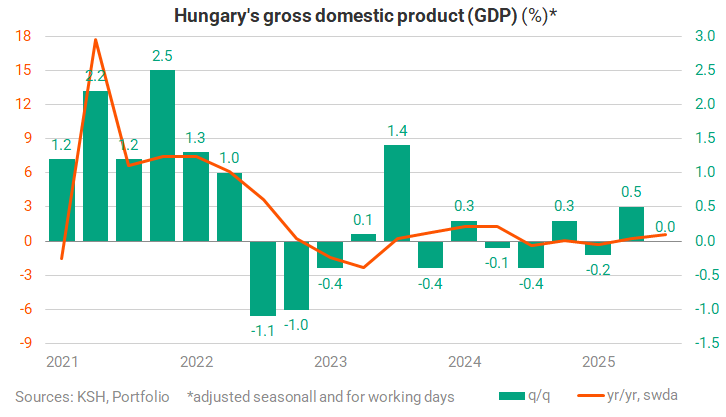
The turnaround in the Hungarian economy is still being delayed. According to data published by the statistical office, economic performance stagnated in the third quarter of this year compared to the previous quarter, based on seasonally and calendar-adjusted data. This came as no surprise, as none of the economists surveyed by Portfolio expected growth.
In light of this, it is not surprising that annual growth has been modest. According to both raw and seasonally and calendar-adjusted data, GDP was 0.6% higher than in the same period of the previous year.
The main contributor to the growth in gross domestic product was the performance of services, within which especially information and communication. Industry and agriculture slowed the economic performance,
the Central Statistical Office (KSH) reported on Thursday.
From a production perspective, therefore, apart from the services sector, which is driven by household consumption, there is certainly no driving force behind the Hungarian economy. Industrial production is shrinking due to weak external demand, and the construction industry experienced an unprecedented slump at the end of summer. Although this decline may be temporary, it does not bode well for third-quarter GDP. Meanwhile, weather-dependent agriculture is not helping the Hungarian economy grow either.
From the consumption side, increased consumption may have boosted GDP growth, but investment has held back the economy for a long time. The budget has certainly not been able to stimulate the economy as it cannot afford to provide any significant stimulus. Exports have been sluggish, partly due to the weak state of the European economy, and partly because domestic industries specialising in car and battery manufacturing have been hit by a sharp decline in demand. The upturn in imports is linked to stronger domestic demand.
Overall, it can be said that the economy as a whole is struggling. Growth in consumer spending has been unable to offset the negative effects of subdued economic activity in Europe and a sustained decline in investment.
Now that the third-quarter data has been released, we only have to wait for the final three months to complete this year's picture. According to raw data, the economy grew by 0.3% in the first three quarters compared to the same period last year. According to seasonally and calendar-adjusted data, it grew by 0.2%. Even if the last quarter is successful, economic analysts expect that this year's average GDP growth will not exceed half a percent.
As we can see from the graph below, at the beginning of last year, economists were still expecting close to 4% economic growth by 2025. However, as time passed and the data worsened, the outlook steadily deteriorated.

As the chart below shows, this year will not bring any significant growth either. This will be the third consecutive year in which the Hungarian economy has been unable to gain momentum. This makes it seem impossible to return to the previous growth trend that existed before the coronavirus pandemic. Although estimates of the Hungarian economy's growth potential are highly uncertain, it is now clear that sustained GDP growth of 3-4% is not possible without a dynamic inflow of EU funds.

Analysts are forecasting growth of just under 3% for next year. It is also true that growth forecasts for 2026 are steadily deteriorating. Analysts expect economic growth to pick up as a result of pre-election handouts and large-scale investment projects getting underway. However, achieving sustained high growth will not be easy.
Of the sources of growth — labour, capital and productivity — employment growth is the least reliable due to the decline in the working-age population. Meanwhile, the fall in the investment rate and the persistent weakness of productivity are becoming increasingly problematic.
It seems that the time has come to seek a new growth model that is not based on increasing employment.
Cover image (for illustration purposes only): Getty Images





