Here are the latest European GDP rankings!


Q3 GDP growth exceeds expectations
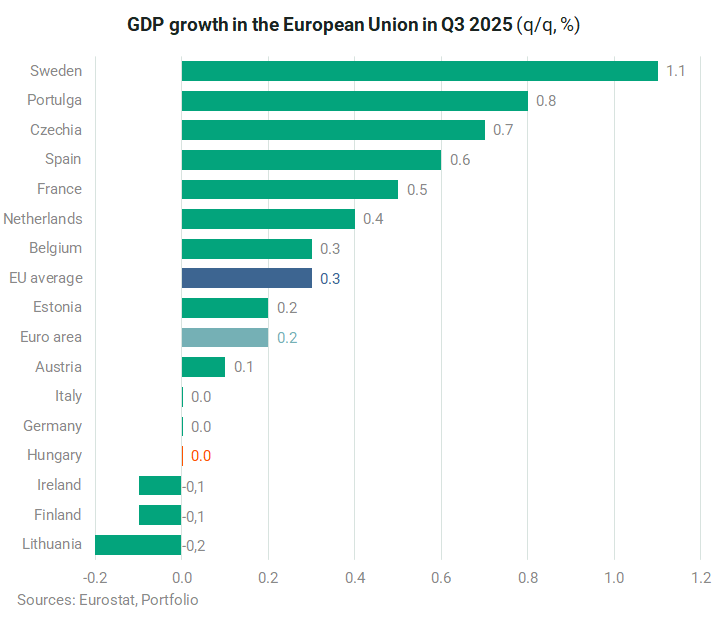
According to Eurostat's preliminary estimate, seasonally adjusted GDP in the euro area increased by an average of 0.2% quarter-on-quarter in Q3 2025, while that of European Union countries increased by 0.3%. The data is clearly a positive surprise, as a Bloomberg survey had expected growth of just 0.1% in the eurozone.
The main surprise was the strong performance of the French economy. Output in the second-largest economy on the continent jumped by 0.5% on a quarterly basis, supported by both exports and domestic demand.
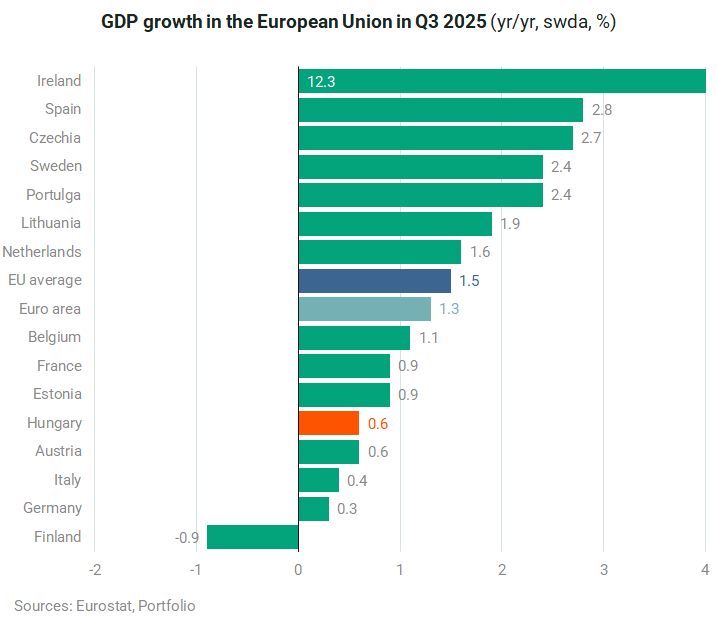
In the third quarter of 2025, year-on-year GDP growth in the eurozone was 1.3%, compared to 1.5% in the EU, down from 1.5 and 1.6% respectively in the previous quarter.
While Germany and Italy narrowly avoided recession and stagnated, Spain remained buoyant as in previous quarters.
This data, released a few hours before the European Central Bank's interest rate decision, indicates that
the 20-member eurozone has adapted well to the unfolding trade war in the wake of US President Donald Trump's tariff measures so far.
According to Bloomberg experts, growth remains modest at present, but new momentum could emerge next year as governments increase defence and infrastructure spending.
The ECB has already cut borrowing costs eight times in this cycle, but now believes that the impact of further easing would be limited. At its meeting yesterday, the central bank kept its deposit rate at 2 percent for the third time in a row.
According to Bloomberg Economics, the euro area's performance slightly exceeded expectations, bolstered by France's unexpected GDP growth and Spain's sustained momentum.
Although there are cautious signs that tariffs may affect Germany, the overall picture is one of resilience for now. This backs up the ECB's view that there is no need for further interest rate cuts in the near future,
Ana Andrade said.
Optimism continues to prevail in the eurozone. According to announcements on Thursday, economic confidence has improved more than expected and unemployment remains close to historic lows. Nevertheless, trade remains a risk, despite the July agreement between Washington and Brussels reducing uncertainty. This month, ECB President Christine Lagarde said that
the global economy has not yet felt the negative effects of higher US tariffs.
Hungary among the last in European rankings
According to the latest data from the Member States, Sweden recorded the highest quarterly growth (+1.1%), followed by Portugal (+0.8%) and the Czech Republic (+0.7%). Meanwhile, declines were recorded in Lithuania (-0.2%), Ireland and Finland (both -0.1%).
As previously reported, Hungary's economy stagnated in the third quarter, placing the country among the worst performers in Europe. However, Hungary outperformed Lithuania, Finland and Ireland, all of which showed a slight decline, and is now joint bottom of the ranking with Germany and Italy.
On an annual basis, growth was positive in 14 countries, while Finland recorded a decline. Hungary's situation is similar:
apart from Finland, which showed a significant decline, Hungary only outperformed Germany and Italy, which have been stagnating for years.
It is important to note that the ranking is still incomplete. The following countries are expected to publish their third-quarter GDP data in the coming weeks: Bulgaria, Cyprus, Denmark, Greece, Croatia, Poland, Latvia, Luxembourg, Malta, Romania, Slovakia and Slovenia.
Cover photo (for illustration purposes only): Getty Images





