Is the problem really that serious? How could anyone suggest that Hungary belongs to junk grade?


No move by S&P
In October, Standard & Poor's kept Hungary's credit rating at BBB-, with a negative outlook. This decision was closely watched, as a downgrade would have placed Hungary in the non-investment (or 'junk') grade, potentially influencing investors' decisions.
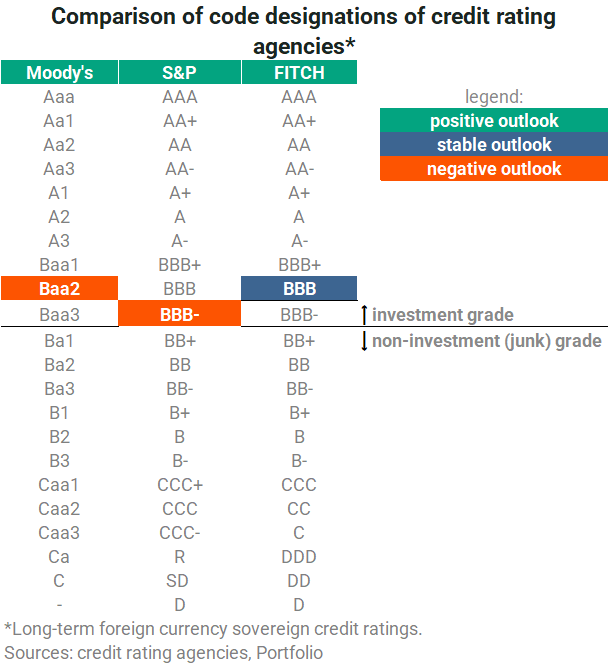
As the table shows, there is currently no threat of a downgrade to junk grade from the other two credit rating agencies, Moody’s and Fitch, as Hungary's rating is one notch higher. Put simply, we can be almost certain that
Hungary will be spared this painful decision in 2025.
This does not rule out a downgrade by Moody's on 28 November or a negative outlook by Fitch, but these would be less painful than a downgrade by S&P.
Would have Hungary really deserved a non-investment grade?
Now, we will examine the basis of S&P's decision, analyse the current figures, and determine whether Hungary deserves to be in junk grade. To this end, we have selected several key economic indicators and compared the situation of countries in the region with regard to their credit ratings.
Currently, none of the countries in the Central and Eastern European region are rated 'junk' by S&P. Like Hungary, Romania has a BBB- rating with a negative outlook. Poland and Croatia are three notches higher with an A- rating, while Slovakia's A+ rating is two notches higher. The Czech Republic currently has an AA- rating, while Slovenia has an AA rating.
In our analysis, we consider the average for each indicator over the 2024–26 period, using S&P forecasts for the values in 2025 and 2026. But let's take a look at how we stand in each area!
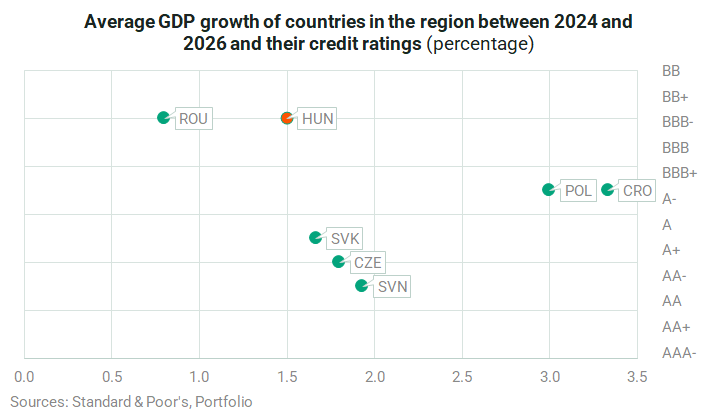
The Hungarian economy has been stagnating for almost three years, failing to achieve a growth rate above 1%. According to the credit rating agency's April forecast, GDP could grow by 1.5% this year. However, this forecast is now outdated, with market experts expecting growth of around 0.5%. However, S&P did not publish an updated forecast in October.
Based on the spring forecast, the Hungarian economy could grow by an average of 1.5% per year between 2024 and 2026. As the graph shows, this is still below Romania's average GDP growth of 0.8%, with fiscal adjustments further dampening growth in our south-eastern neighbour. Interestingly, even Slovakia and the Czech Republic, which have been rated several notches higher, are unlikely to grow much faster than Hungary during this period. In other words,
even when compared with other countries in the region that have significantly better ratings, Hungary's economic growth is not particularly weak.
Of course, GDP growth only indirectly affects credit ratings, which primarily reflect the risk of public debt not being repaid. For this reason, indicators that reflect the economy's equilibrium processes may be more important.
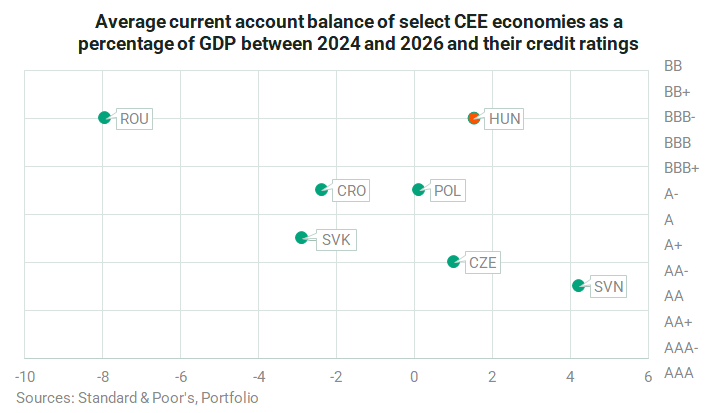
Looking at the current account balance, Hungary has even less reason to be ashamed. S&P estimates that the country's financing surplus could average 1.5% of GDP over the three-year review period. Only Slovenia, which has a much better rating, could have more favourable data in the region. By contrast, in the case of Romania, which has the same rating as Hungary, S&P expects a significant financing deficit of 7.9%.
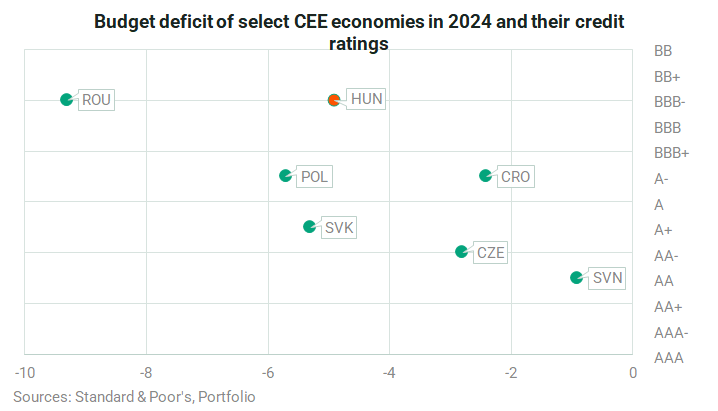
Although we often draw attention to budgetary risks, Hungary is currently not doing badly in terms of its fiscal position compared to other countries in the region. Due to the war in Ukraine, almost all countries are planning to increase their defence spending significantly, which is why, according to S&P, Romania's, Poland's and Slovakia's budgets may be in a worse position than Hungary's estimated 4.5% GDP deficit for 2024–26, despite the latter two countries having significantly more favourable ratings.
The outlook for the Hungarian budget is not rosy, with the deficit potentially exceeding 5% of GDP this year and reaching around 6% next year based on current trends.
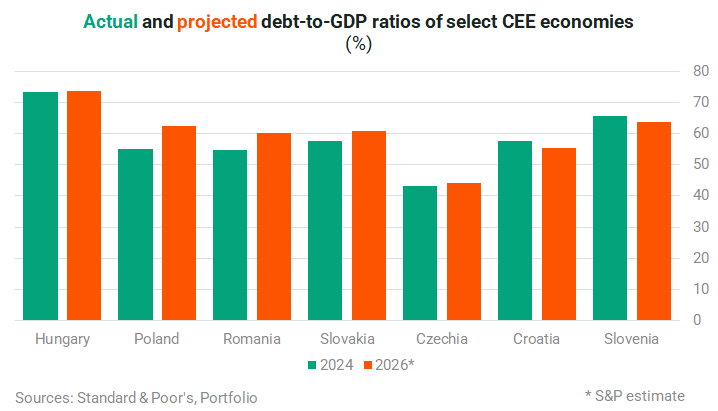
Hungary appears to be in the worst position in terms of public debt, as it continues to have the highest debt-to-GDP ratio in the region, and this is expected to remain the case in 2026. Meanwhile, due to the budgetary situation, S&P anticipates a significant rise in debt ratios in Poland, Romania and Slovakia, while only the Czech Republic and Slovenia are likely to experience a decline.
In other words,
the economic data provided little basis for classifying Hungary as a junk bond country.
Why are we even talking about this issue at all?
Based on what has been said so far, it is surprising that we were concerned at all about S&P's decision in October, given that there seemed to be no reason for us to be placed in non-investment grade.
At the same time, alongside 'hard' economic data, there are so-called 'soft' factors that are difficult to quantify, yet which significantly influence the risk profile of economic processes. Based on previous statements by credit rating agencies, these include the following:
- The lack and uncertainty of EU funds for years.
- Political battles between the Hungarian government and the European Commission.
- Heavy dependence on Russian energy.
- The government's unorthodox, market-distorting measures in recent years.
While these items are difficult to quantify, they manifest as risks in areas such as the current account balance and the budget position. Before S&P's October decision, the question was how the economists of the credit rating agency would evaluate these effects.
Another factor that spoke against the downgrade was that
it was highly unlikely that S&P would make such a significant decision just six months before the 2026 parliamentary elections.
This is mainly because the opposition Tisza Party is partly campaigning on the promise that it will 'bring home EU funds' and significantly improve relations with the European Union if it wins. This could eliminate an important negative factor from the Hungarian economy. It is generally true that credit rating agencies are acting more cautiously in the run-up to the elections, partly due to uncertainty surrounding economic policy, and partly to avoid accusations of interfering in domestic political processes.
What to expect next year?
In addition to S&P, Moody's has also given Hungary a negative outlook, which could have significant implications in the coming year. Experience shows that a negative outlook can signal a possible downgrade within six to 24 months,
which occurs in two-thirds of cases.
At the same time, 2026 could be an interesting year due to the elections. The credit rating agencies are expected to publish their latest reviews next spring, following the reviews in autumn 2025. Based on the usual six-month cycle, S&P is likely to publish its latest opinion around mid-April. This coincides with the expected date of the elections, making it difficult to take the results into account when making a decision.
Moody's and Fitch are expected to conduct their first review in May–June 2026, by which time the results will be visible. The question is how much uncertainty there will be over economic policy in the immediate aftermath of the election.
In other words, unless they see any significant positive or negative risks before April, there is now the greatest chance that S&P will not take any action then. However, they will still need to 'say something' in autumn, as the two-year period following the negative outlook will expire in spring 2027. Depending on the economic outlook, the next step could be a downgrade or an upgrade of the outlook to stable. Moody's and Fitch may even make a decision in spring once the election results are known.
If Hungary's long-term goal is not just to avoid junk status, then it will need to restore the downward trajectory of GDP-to-debt ratio, emphasized Gábor Horváth, Chairman of the Fiscal Council, at a recent conference of the Hungarian Economic Association. AHe stated that two factors had previously ensured this: the primary budget surplus (calculated without interest expenses) and strong GDP growth. However, neither of these factors currently exist.
If we want to be upgraded later, we must reduce our debt ratio, as countries rated one or two notches higher have significantly lower averages for this indicator,
Horváth pointed out.

The chart in the FC President's presentation also shows that, if Hungary wants a rating upgrade, a substantial reduction in public debt will be necessary sooner or later.
Cover image (for illustration purposes only): Getty Images





