Does the "financial shield" that Hungary received from the United States actually exist?

- A financial safety net
- in the form of US assistance in the event of an attack on the Hungarian financial system.
- More specifically a protection of the forint and the budget, as well as the provision of financial resources to the private sector.
This is what we roughly know about the US-Hungarian financial package. On the one hand, the government says "we have resolved this with the Americans", but on the other hand, it seems to still be in the negotiation phase. Either way, the main goal is clear: to secure funding from the United States if necessary.
'The idea that the Hungarian currency can be attacked, that the Hungarian budget can be put in a difficult position, or that the Hungarian economy can be strangled from a financing perspective can be forgotten. That is over. We have resolved this with the Americans,
said Prime Minister Viktor Orbán late on Saturday.
From a distance, it is unclear why Hungary needs such access. Both the Hungarian state and the private sector have access to external sources of financing, so it is only EU funds that make us feel deprived. Let's take a closer look at the bigger picture!
"...the Hungarian economy can be stifled from the financing side"
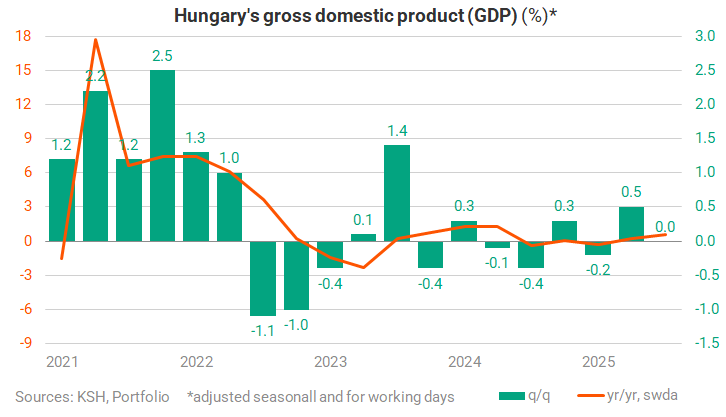
The Hungarian economy has been unable to demonstrate meaningful growth for over three years. The extent of the disappointment is illustrated by the fact that, while macroeconomic analysts and the government consistently forecast growth of around 3–4% for the next year or so, this always turns into stagnation over time.
The economic take-off promised by orbán failed to materialise in spectacular fashion this year too, and it is now questionable whether we will even achieve last year's modest GDP growth rate.
For years, the government has maintained that one solution to the growth problem is to involve external financial resources. At the time of the announcement of major Chinese investments, analysts warned that foreign direct investment (FDI) is not EU funding. However, economic policy continues to believe in this exchangeability.
"I still need two to three years for the country to receive all the money from Brussels. There is no need to postpone or reschedule anything; we can achieve everything," Viktor Orbán emphasised in connection with potential large-scale projects. In other words, it seems as if the government wants to avoid a repeat of 2022, when investments worth thousands of billions of forints had to be cut from the budget, which contributed significantly to the recession.
From here on, we are entering somewhat shakier ground, as
- it is unclear what EU-funded projects could be realised with American foreign direct investment (FDI), or
- what large-scale public investments could be financed solely with American loans. While the cost of the loan may be appealing, interest rates in the United States are currently higher than in Europe.
In other words, the attractiveness of US money in terms of funding real economic goals, such as investment and development, is unclear. However, based on the prime minister's words, the idea that he wants to boost the economy ahead of the election does not seem well-founded. Moreover, it would not be realistic in such a short time frame.
"...the Hungarian budget could be put in a difficult position"
According to the government, another motivation is managing potential financing risks to the budget. In this case, however, the electoral aspect takes precedence, as economic policy is finding it increasingly difficult to prioritise budgetary stability over popularity considerations. This year's deficit is approaching 5% of GDP, and an upward trend is already apparent for next year. Election promises relating to income tax, pensions and mortgage lending will have a significant impact for several years to come.

The government may be concerned that further spending could upset market financiers and credit rating agencies. This kind of balancing act has been evident in economic policy communications for some time now. Consider, for example, the recent visit to London by Economy Minister Márton Nagy where he met investors and rating agencies.
However, in our opinion, this does not mean that the government is seeking funding for additional spending.
As long as you can get funding from the market, it looks much better than an emergency solution. What is more likely to be on the minds of economic policymakers is that the rather fragile international financial market sentiment could be shaken by a shock that would make financiers risk-averse. In this case, they would see a more cooperative United States as a much better choice than the IMF.
The US has an institutional solution to this problem. Through the Exchange Stabilization Fund (ESF), extraordinary intergovernmental loans can be granted. Mexico received one in 1995, and Argentina may receive one this year.
The American package could result in an agreement similar to those typically made with the International Monetary Fund by countries that are becoming more vulnerable and expecting crises to occur. One such agreement is the Flexible Credit Line (FCL), which provides immediate assistance in the event of a crash. This is the IMF's classic 'safety net' for when trouble is not yet too serious. Only minor.
However, it is important to note that this would still be very much a "last resort" type of agreement, which seems very strange from a purely visual perspective. For this reason, we believe it is more likely that such a formal agreement will ultimately not be reached.
"...the Hungarian currency can be attacked"
According to the Prime Minister, "If Hungary were to suffer any kind of external attack on its financial system, the Americans have promised to protect its financial stability. If Hungary were to suffer an external, speculative or political attack, we could count on an American financial protective shield."
If a financial attack were to be launched against Hungary from any corner of the world, affecting either our exchange rate or our debt rating, we would have American assistance at our disposal to fend it off, the PM added.
These statements suggest that the government is working on establishing a swap line to provide dollar liquidity in a tense foreign exchange market environment. However, the justification for this is even less apparent than it was for budgetary and credit rating concerns.
The forint is strengthening, supported by the current account surplus and the central bank's encouragement of speculative investors to engage in carry trade rather than short selling through high interest rates.
In such an environment, it is hardly realistic to expect a swap line to be announced, given that Mexico and Argentina only resorted to this measure during the most severe financing crisis.
Based on the above, one interpretation of the overall financial package is that there is no secret plan within economic policy to introduce risk-increasing measures that would prompt US assistance (for example, due to the logic of the election cycle). The government wants to proactively build institutions that will generally increase the resilience of the Hungarian economy to future shocks, simply by taking advantage of its good relations with the United States.
In this case, the 'financial shield' is not particularly significant at the moment; the fuss surrounding it is more likely to be a campaign tactic.
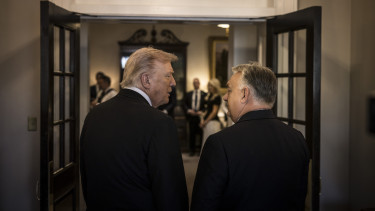
At the same time, some of the potential tools and solutions are emergency measures, so reaching an agreement on them could send a confusing message to the markets. This is why we believe that most of these measures will never be institutionalised, as Viktor Orbán suggested when he said that "the Americans have given their word". The financial protective shield is represented by the handshake between Donald Trump and Viktor Orbán, and it is unlikely that we will see anything more substantial than that.
It may also be questioned whether the above has broadened the scope of Hungarian economic policy. We believe that this is not really the case.
In fact, when the government talks about attacks on the forint and financing challenges, this serves as a warning to the market, making it more alert to signs of increased risk.
Cover photo: MTI





