We may have the truth on what Trump actually promised Orbán about Russian energy

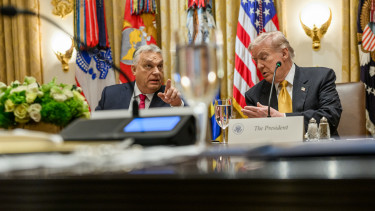
Following talks in Washington on Friday, the Budapest administration announced that Hungary had been granted an indefinite exemption from US sanctions on the purchase of Russian oil and gas. However, this announcement caused uncertainty as, according to information received from the White House by several news agencies, including Reuters, CNN and the BBC, the US currently only considers a one-year exemption to be valid.
However, Portfolio's diplomatic sources say there is a simple and obvious explanation for this discrepancy.
Can you haveyour cake and eat it?
Those we spoke to said that no official decision on the exemption had yet been made, and that the agreement's content would ultimately be determined by a licence issued by the Office of Foreign Assets Control (OFAC) under the US Treasury Department. The Hungarian side would have to formally apply for this licence.
According to the Hungarian government, US President Donald Trump granted Prime Minister Viktor Orbán an unlimited exemption from sanctions on the purchase of Russian oil during their meeting. Orbán stated that Trump had said Hungary would be exempt from US sanctions indefinitely.
In an interview with public radio MR1 on Sunday, Foreign Minister Péter Szijjártó said that no timeframe had been mentioned at the meeting, that the agreement had been reached with a handshake, and that it was now only a technical matter for the US to put it in writing. The foreign minister thus implied that the exemption is unlimited in time and that the main focus is on formalising the agreement.
By contrast, the White House responded to Telex's enquiry by confirming that Donald Trump had granted Hungary a one-year exemption from US sanctions on Russian oil and gas imports.
As Portfolio was informed, the European Union's institutions are not considering the possibility of an unlimited exemption either. According to the assessment in Brussels, the provision is time-limited, subject to review and conditional. The EU's sanctions policy remains unchanged as the US exemption does not modify EU rules in itself.
Diplomatic sources interviewed by Portfolio emphasised that, although an agreement had been reached at the political level, a licence issued by OFAC would provide substantive exemption.
In practice, the procedure is as follows: as Péter Szijjártó explained at the weekend, the Hungarian side must first submit an official request. Only then can OFAC issue a general licence.
According to our diplomatic sources, even if the licence text specifies an indefinite period, such rights are reviewed annually in accordance with US practice.
In other words, the duration of an agreement that has not yet been finalised is open to interpretation. Strictly speaking, the permit is expected to be reviewed again in a year's time, so it is valid for one year. However, there is a significant difference in that the permit does not expire and has to be renegotiated; rather, an automatic decision can be made on its extension. Donald Trump may even have made a verbal commitment that the extension would not be a problem.
Given the current situation, it is possible that, despite the political agreement, OFAC will issue a licence for a specific period, such as one year, or only suspend it during the review process every 12 months.
According to diplomatic sources with insight into US decision-making who spoke to Portfolio,
the one-year interval also signals to Brussels that the US does not intend to influence the European Union's decoupling plans.
Washington has explicitly endorsed the EU's efforts to reduce its reliance on Russian energy sources. At a White House press conference, Trump criticised several EU member states for continuing to purchase Russian oil and gas via covert or backdoor channels.
In May, the European Commission announced their plan to break free from Russian energy completely by 2027 or 2028. This will be achieved through trade restrictions, such as tariffs or import quotas. This approach requires only a qualified majority of EU countries to be adopted, and abstentions technically count as support. Therefore, the move cannot be vetoed.
As the US also supports the EU's target date of 2027, setting a temporary exemption period for Hungary would not necessarily disrupt the EU's schedule. At the UN General Assembly in September, US President Donald Trump and Commission President Ursula von der Leyen demanded that the EU stop buying Russian energy sooner than planned in May.
During a White House press conference at the weekend, the US President criticised Viktor Orbán and other EU member states for continuing to purchase fossil fuels from Russia, primarily in the form of LNG. He emphasised that Hungary, being landlocked, is in a particularly difficult situation with regard to decoupling from Russian energy.
In this regard, the undeclared one-year period subject to OFAC review can be considered a safety measure, which may align with the European phase-out schedule.
The outcome of the meeting is therefore ambiguous at present. While there is broad agreement that a verbal agreement on Hungary's partial exemption from US sanctions has indeed been reached, affecting shipments arriving via the Friendship oil pipeline and the TurkStream natural gas pipeline, the duration of the exemption remains unclear. While the Hungarian side is talking about an unlimited time frame, US and international sources continue to mention only a one-year exemption.
Meanwhile, the EU's rules remain unchanged, meaning Hungary is still obliged to comply with Council decisions on EU trade restrictions within the Community framework.
Over the coming weeks, the focus will be on clarifying precisely how and within what timeframe OFAC will draft the licence text. This document will ultimately determine the actual legal consequences and the scope of Hungary's energy strategy, so despite the current contradictions in communication, it remains unclear whether the exemption is unlimited or only temporary. The situation may also be influenced by OFAC's annual review process, meaning the Hungarian-American agreement may need to be reassessed periodically.
Cover photo: President Donald Trump after bilateral talks with Hungarian Prime Minister Viktor Orbán in the Cabinet Room on Friday, November 7, 2025. Source: official photo, White House, Daniel Torok.





