Hungary's EcoMin set to raise windfall tax for banks in 2026!

How have the economy and the budget changed?
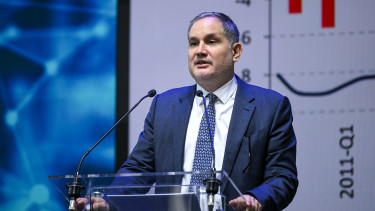
On Monday, Márton Nagy, the Minister of National Economy, held a background briefing in which he discussed the financial aspects of the US-Hungarian agreement and provided a detailed overview of the current state of the budget and its prospects. He reiterated that the fundamental principles of Hungarian fiscal policy remain unchanged: reducing the deficit, ensuring the sustainability of public debt, and avoiding excessive deficit procedures.
From the outset of the conversation, it was clear that he had not mentioned the fourth principle communicated so far: that "the primary balance must remain close to zero". Later, in response to a question from Portfolio, the minister mentioned that a primary balance of -1.1% of GDP this year and -1.2% next year would still put the Hungarian budget in a favourable position compared to those of other countries. He emphasised that, to ensure the sustainability of public debt, the primary balance would have to return to zero.
At the event, the minister presented data showing how much the macroeconomic trajectory had deteriorated since the government's expectations in the summer, and confirmed that this downward trend would continue into next year.
It is noteworthy that the government has once again adopted the early budget submission practice, submitting the budget for next year in the summer. This budget forecasts GDP growth of 4.1%, inflation of 3.6%, and a deficit target of 3.7%. According to the government's explanation, lower GDP growth next year will impact the budget; as a rule of thumb, a 1 percentage point shortfall in GDP growth will worsen the budget balance by 0.4 percentage points.
He also mentioned that, in recent months, the government had decided on new economic policy measures not included in the budget for 2026, which was submitted in May. These include tax cuts for individuals, planned tax cuts for companies (more on this later), the Otthon Start (Home Start) Programme, 3% loans for SMEs, and additional payments for pensioners.
He said that it is difficult to find the necessary resources for these items and that this will result in a higher budget deficit than planned for next year. However, he emphasised that the above three fiscal principles must be met.
At this point, he revealed that the ministry is currently planning for the government
to pay one week's worth of the 14th-month's pension next year.
This is new information compared to previous reports, as the timing had been unclear until now. If this goes ahead, an additional spending of HUF 150 billion will be added to the state budget at the beginning of next year, bringing the total annual expenditure on the 14th month pension to around HUF 600 billion.
This is how the budget deficit would grow
Based on the above processes, one of the most important messages from the background discussion is that
the deficit targets for both 2025 and 2026 will rise to 5% of gdp.
Nagy added that, consequently, the deficit-to-GDP ratio may stagnate for three years (2024–2026), as will the debt-to-GDP ratio (73.5%). Emphasising this macroeconomic situation and the new economic policy measures, he said, "We cannot reduce the deficit, but we will not raise the deficit target either." This is how we guarantee budget stability," said the minister.
It is worth recalling what changes this means in the main budget figures compared to the original plans:
- It is worth bearing in mind that the government originally set a deficit target of 3.7% for 2025, but has gradually increased this figure in recent months. The latest official forecast in the EDP report puts the target at 4.3% for this year, though Márton Nagy has suggested a figure of 4.5%.
- In May, the government submitted the 2026 budget to parliament, which also had an initial deficit target of 3.7%. More recently, the Economy Ministry increased its forecast for next year to 4%, which has now apparently risen to 5%.
His words suggested that there is a hierarchy among the fiscal principles outlined above. It appears that the government's priority is to avoid the country falling back into the Excessive Deficit Procedure (EDP) at all costs, as both the deficit reduction and public debt reduction targets will not be achieved this year or next, and both indicators may stagnate for three years.
During the background discussion, Márton Nagy said that, with a deficit target of 5%, the government would meet the criteria for exemption from the EDP, but that if the deficit exceeded 5.1%, the EDP could be reopened for Hungary next year. This justifies the need for new fiscal measures to ensure budgetary stability.
In response to Portfolio's inquiry, the minister explained that the annual cash flow deficit target, which has already increased to HUF 4,774 billion this year, will rise further to HUF 5,055 billion. The original cash flow deficit plan for 2026 was HUF 4,218 billion, but this is now going up to HUF 5,445 billion.
According to the ministry's new proposal, this means that the nominal cash flow deficit will be HUF 1,227 billion higher than originally planned next year.
Márton Nagy also mentioned that, in order to secure additional financing, it is likely that foreign currency bonds will need to be issued at the beginning of next year. He said that the amount would depend on when Hungary receives an advance payment from the EU SAFE credit line, which could be as much as 15%.
This is new: two key measures for the budget
The minister also explained that, alongside raising the deficit target, the ministry's proposal includes two new measures to meet the increased 2026 target. These measures will have a total impact of nearly HUF 400 billion.
- Freezing HUF 192 billion in general reserves.
- Increasing the extra profit tax on banks, which could generate an additional HUF 185 billion.
The government expects to collect HUF 180–185 billion next year under the current regulations, meaning that half of the additional profit tax levied on banks could be offset through the purchase of government securities (i.e. the total expected revenue would amount to around HUF 360 billion). However, under the ministry's new proposal, this revenue would double next year. This would mean that the ministry would increase the windfall tax on banks and financial institutions, resulting in the state coffers receiving not HUF 180 billion in 2026, but HUF 360–365 billion.
Later, in response to a question, he also said that, "Unfortunately, due to slower economic growth, the only way I can ensure budgetary stability is by making banks pay more."
In his opinion, there is scope to increase the windfall tax on banks, given their extremely high profitability. "In the Hungarian banking sector, ROE was 18–19%, and after-tax profits exceeded HUF 1,500 billion in the recent period. This is also expected this year," he explained. He also mentioned that the Hungarian banking sector's profitability is outstanding even with the current tax burden, with only the banking systems of Lithuania and Cyprus performing better in the entire EU.
Bank tax details
The minister emphasised that the new rules on the extra profit tax for banks are only proposals from the ministry at this stage, and that the government has not yet made a decision on the matter. The discussion also revealed that the affected banks and financial institutions were not informed of the tax increase plan in advance.
He explained that the base for the windfall tax levied on banks and other financial institutions will be their pre-tax profits for the respective years: 2022 in 2024, 2023 in 2025 and 2024 in 2026. He added that the adjusted consolidated tax base would therefore be around HUF 1,600–1,700 billion next year.
It was revealed at the background discussion that there are plans to increase budget revenues by modifying the extra profit tax rates for banks and the deductibility arising from the purchase of government securities in 2026.
Under the current regulations, the tax rate would be 8% on the portion of the tax base not exceeding HUF 20 billion next year. However, based on the ministry's proposal, this would rise to 10%. Meanwhile, the currently planned 20% rate for the portion exceeding HUF 20 billion would increase to 30%. Additionally, the deductibility of government securities purchases would decrease from 50% to 30%.
The table below summarises these planned changes:
| The planned change to the extra profit tax payable by banks in 2026, based on a proposal from the Ministry of Economy. | |||
| 2025 | 2026 (current) | 2026 (planned) | |
| On tax base not exceeding HUF 20 billion | 7% | 8% | 10% |
| On tax base exceeding HUF 20 billion | 18% | 20% | 30% |
| Deductibility of government securities purchases | 50% | 50% | 30% |
| Source: Economy Ministry proposal | |||
He then mentioned that the Tisza Party, the biggest challenger of the ruling Fidesz-KDNP coalition in next year's elections, has promised to abolish the bank tax, while the government is raising the special tax on banks. "This is a clear difference in values," said Márton Nagy.
Therefore, the most relevant upper limit will be 30% instead of the 20% included in the spring plans. This would mean an approximate 50% increase in the tax burden, despite an unchanged tax base. However, if banks can only write off 30% of tax through the purchase of government securities next year, instead of 50% as previously, the new extra profit tax regulation for banks could generate nearly 70% x 150% / 50% of the planned HUF 180 billion to be collected next year, with an unchanged tax base.
This amounts to approximately HUF 380 billion in annual revenue, which is the amount by which the burden could reduce banks' pre-tax profits. Banks typically account for extra profit tax as an expense, similar to the traditional bank tax, so this would have a significant impact on their profits. This is more than double the amount in the previous plan. For comparison, the banking sector achieved HUF 1,645 billion in unconsolidated pre-tax profits in the past year (July 2024 to June 2025).
It is not yet known by how much banks will need to increase their holdings of government securities in order to take advantage of the discount. Assuming it remains at ten times the amount, the banking sector is expected to purchase around HUF 1,630 billion worth of government securities. This equates to ten times the 30% tax burden calculated without the discount and, although it is a considerable amount, it seems feasible at the sector level based on its free liquidity.


Why is all this necessary?
Responding to questions, the minister also said that if there is no economic growth, this will have an impact on the revenue side of the budget, while economic policy decisions that have been made must be implemented (pension payments, individual wage increases) and fiscal balance must be maintained. He also acknowledged during the discussion that if next year's growth, currently revised to 3.1%, again falls short of expectations, there will be no freely available reserves in the budget, which poses a risk, but the ministry is still considering where there might be a buffer available. He mentioned the possibility of further reducing operating expenses in the ministries. He does not see any further risk to next year's deficit, as he believes that no further fiscal easing measures are to be expected.
He also explained that the loss of revenue is primarily felt by companies (corporate tax [TAO], small business tax [KIVA], business tax), and that there is no shortfall in tax payments by the population, with VAT and personal income tax revenues coming in as if economic growth would reach 3% this year.
He also said that credit rating agencies would not tighten their standards due to the increase in deficit targets and new fiscal measures. According to Márton Nagy, this is because credit rating agencies had already expected a deficit of around 5% next year (Moody's had a similar figure, while Fitch had 4.5%).
Among the positive risks, he mentioned possible interest rate cuts by the Hungarian central bank and their impact. If interest rates were to be cut next year, the government could reduce its interest expenditure by 0.2 percentage points in relation to GDP, he said.
In response to our hypothetical suggestion that if investors read news about the deficit increase and bank tax hike, they may have doubts about the stability of the budget, which could trigger a weakening of the forint, a rise in yields on Hungarian markets, and even a downgrade, the ministry is not concerned that this will lead to the "attack" envisioned by the government in the event of a more unpleasant economic scenario. Márton Nagy explained that this will not happen at a deficit level of 5%, and it is important to note that in many cases Hungary is still two notches above junk status in credit rating decisions.
Cover photo: MTI Photo/Tamás Purger





