Special taxes on government's table again – What could this mean for Mol?


Background: During today's press briefing, Gergely Gulyás, the Minister of the Prime Minister's Office, stated that, given the current challenging budgetary situation, energy companies, in addition to the financial sector, must also contribute more to the public burden, potentially in the form of sector-specific taxes. This suggests that, in the event of a further budget shortfall, the government may widen the net beyond the banks to include energy companies, which are already subject to special taxes, and increase the levy.
As the largest player in the domestic energy sector, Mol pays a significant amount of tax into the state coffers. Let's take a look at how much the oil company currently pays.
Special taxes paid by Mol
Almost exactly a year ago, in mid-November, the government announced its decision to keep extra profit taxes in place in 2025. From Mol's perspective, it was important that
the special tax on the Brent-Ural spread remained under the decree,
- while the special tax proportional to sales revenue and
- the extra mining royalty were abolished.
Then, in April of this year, it became clear what the company could expect in 2026. According to the plans, the tax levied on the Ural/Brent spread will remain in place next year.
The government expects this to generate an additional huf 50 billion in revenue.
Regarding the extra tax levied on the price difference between Western and Russian oil, the decision was made last summer to lower the tax threshold on the Ural/Brent price difference from $7.50 per barrel to $5.00, meaning that the company would pay a special tax of 95% on any price difference above this level. This difference has become smaller and smaller over the past few quarters.
Based on Gergely Gulyás's statement, we cannot rule out the possibility that the current special tax threshold of USD 5 per barrel on the Brent-Ural spread will be lowered, or even abolished. However, it is also possible that one of the other extra tax burdens that were phased out this year could be reinstated.

Next, we will look at what you need to know about the phasing out of extra tax burdens, namely the mining royalty and the special sales-revenue-based tax.
Which levies were phased out?
Mining royalty
Since 1 September 2023, Mol has been paying lower mining royalties on domestic hydrocarbon production. According to the company's calculations, this resulted in a surplus of approximately $400–450 million for Mol in the 16 months between September 2023 and December 2024 — equivalent to a quarterly 'surplus' of around $80 million. Based on this,
not paying this amount could result in a surplus of around $320 million for the company in 2025.
The prospect of reinstating this tax could be reinforced by the fact that experts did not rule out an increase in mining royalties last year, one of the reasons why Erste lowered its target price in September 2024.
Revenue-based tax
As analysts had generally expected, it comes as no surprise that this tax was phased out for Mol as of 2025. The amount was not insignificant: In the first quarter of last year, Mol accounted for the 1 percent tax burden for 2024, meaning that
the oil company had to pay $114 million at that time.
At the Budapest Economic Forum 2024 conference organised by Portfolio, György Bacsa, the managing director of Mol Hungary, said that the most painful burden for Mol is revenue-based taxation.
Deep pockets
For context, it should be noted that oil and gas prices skyrocketed following the outbreak of the Russian-Ukrainian war, causing Mol's EBITDA and profits to jump significantly during the energy crisis. In the energy price environment that has since consolidated, the company's results have normalised at a much higher level than before, as evidenced by Mol's decision to pay out HUF 220.4 billion in dividends to shareholders following last year's results.
In short, Mol has deep pockets to pay from
– although, from a competitiveness perspective, this could be very unfavourable for the oil company, as we will discuss in more detail below.
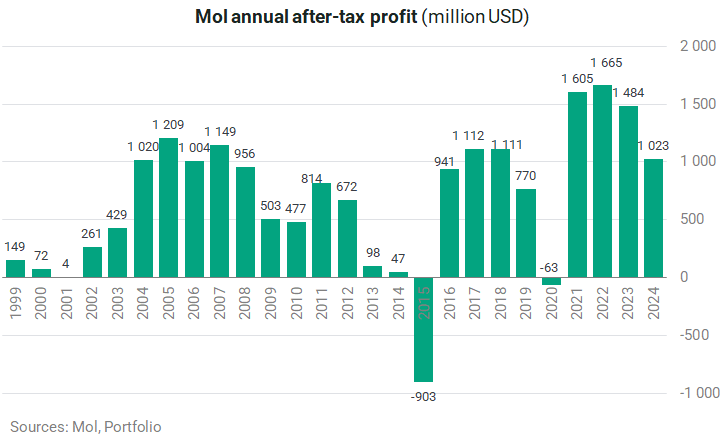
Mol's management has spoken out against the taxes on a number of occasions
Zsolt Hernádi, the Chairman and CEO of Mol, has repeatedly drawn attention to what he considers to be excessive tax burdens. At the company's general meeting in April this year, he pointed out that
the group had paid nearly $3.5 billion in extra taxes to various governments over the past three years.
According to Hernádi, this is detrimental to competitiveness.
Please note that, in Mol's annual profit and loss statement, mining royalties, windfall taxes, the retail tax and industrial safety contributions are listed under 'other operating costs'. This category also includes items such as provisions for CO₂ emissions, other services and the results of non-hedging commodity transactions. Therefore, the exact amount of extra tax that Mol paid to the Hungarian budget in forints is not known, but information is available regarding the amount of the Slovak solidarity contribution and the Czech special tax in each year. These two contributions totalled HUF 6 billion in 2024.
In addition to the issue of taxes, Zsolt Hernádi emphasised the importance of improving competitiveness at the general meeting and drew attention to the importance of more predictable domestic regulations.
Share price reaction
Investors have yet to react to Gergely Gulyás's comments,
with Mol shares rising by 0.7%. The share price has risen by 13.8% so far this year.

Cover photo: Portfolio





