Orbán: US financial shield will be activated if HUF comes under speculative attack

Highlights of the interview
- According to the Prime Minister, the US exemption from energy sanctions will remain in effect for as long as the current Hungarian and US political leaderships remain in place. He believes this will stabilise energy and fuel prices.
- In response to criticism, he stated that various US military and energy purchases are independent, economically justified decisions, and that Trump's favourable attitude also played a role in the agreement.
- The PM presented the five-year LNG purchase agreement as one that strengthens diversification and increases the security of Hungary's energy supply, despite its small share.
- Regarding the US financial shield, he clarified that it is not a credit facility, but rather an international tool designed to stabilise the financial environment when necessary — for instance, during speculative attacks.
- Regarding the tightening of EU energy supply rules, he stated that Hungary would take legal and political action against the extension of the ban on Russian oil beyond 2027, as it believes this would harm domestic energy prices.
- On the subject of the 14th-month pension and other long-term social measures, he said that these are only sustainable if backed by a stable economic foundation. According to the government's calculations, this is the case.
- He justified the doubling of the foster parent allowance, stating that foster parents perform an extremely difficult task and that a significant increase in their moral and financial recognition is necessary for the child protection system to function properly.
- Regarding institutional care, he explained that church and state operators both play an important role in child protection and that continuous regulatory and quality review is required for the system to function.
The exemption from energy sanctions hinges on the individuals who made the agreement
At the start of the interview, the presenter mentioned last week's Hungarian-American summit in Washington. Several of the agreements reached there sparked heated debates in Hungary, particularly those concerning exemption from sanctions on Russian energy and the so-called financial shield. When asked about these issues, Prime Minister Viktor Orbán reacted with surprise to the suggestion that they would cause controversy. Regarding sanctions, Orbán said that, in his opinion, they were definitely a controversial issue, at least for certain political actors.
The contradiction between the earlier statements lies in the fact that, on Tuesday, Orbán said that the exemption from sanctions would remain in force for as long as he was prime minister and Donald Trump was US president. However, the day before, the US secretary of state said that the exemption would only last for one year. In response, Orbán said that, in his opinion,
it is ultimately the person at the top who has the final say, and in this case, the US president is at the top of the hierarchy.
He stated that this is not a personal issue, but rather a matter of government policy. Orbán stressed that once he is no longer prime minister or Trump is no longer president, Hungary's household utility reduction regime will be over.
Exemption from sanctions does not cost Hungary a dime
Using a classic fear-mongering technique, Orbán emphasised that energy and fuel prices in Hungary will not increase drastically as long as he and Trump are in power. He added that in a different situation every Hungarian family would pay about three times as much in utility bills and the price of petrol could rise to up to HUF 1,000 per litre. The average price is currently HUF 579, which means Orbán envisions a 73% jump in petrol prices.
He could have said utility bills would grow tenfold or that a litre of petrol would cost HUF 1,500 per litre; he did not elaborate on how he came up with these numbers.
He concluded that the country had been saved from this price increase. In his opinion, there was no real debate about this because it had benefited all Hungarians.
The host raised the issue that Hungary would effectively have to pay for the sanctions exemption, for instance through military, nuclear energy or LNG purchases. The question was whether these purchases were the 'price' of the agreement or whether they were necessary for market or strategic reasons anyway. Hungary has committed to spending HUF 466 billion, although Orbán has not actually paid anything yet, but he has made a very significant commitment.
We did not pay a penny for the exemption. The United States does not operate in this way: agreements are not tied to hidden conditions.
He indicated in his response that, in his view, the listed purchases do not represent the price of the agreement, but rather separate transactions that justify themselves.
We didn't pay a penny for this exemption because the President of the United States likes Hungarians,
he said.
Trump says what Trump thinks
Orbán explained that, in his opinion, Donald Trump is striving for peace not because he wants to implement a conscious peacemaking strategy, but because he fundamentally considers war to be senseless and evil and therefore instinctively feels it must be 'eliminated'. He said that Trump is "the kind of person who is happy to do good if he has the opportunity."
According to Viktor Orbán, Hungary's energy imports from Russia account for just 0.2% of Russian exports, perhaps even less, meaning he believes they have no practical significance in terms of 'disciplining' Russia. He claimed that the quantities of energy purchased "on the sly" by Western European companies, who he said were publicly promoting anti-Russian policies, represented a much larger share.
Orbán noted that Trump had said this himself and believed that the US President wanted to handle the situation in Central Europe fairly.
In his view, Trump intended to put pressure on the Russians, but did not want to harm his allies. The prime minister said that Trump had given his word on this and that he could be trusted.
You can track Trump's promises and whether he delivered on them here, here, and here.
According to the latest data (end-October) on Russian fossil fuel shipments since EU oil bans by the Centre for Research on Energy and Clean Air (CREA), Russia’s fossil fuel exports remain highly concentrated, with China dominating coal and crude oil purchases, Turkiye dominating purchases of oil products, and the EU still the largest buyer of LNG and pipeline gas — showing Moscow’s dependence on a narrow set of key customers. The EU remains the largest buyer of Russian LNG, and has bought almost half (49%) of Russia’s total LNG exports, followed by China (22%) and Japan (18%). The EU is the largest buyer, purchasing 34% of Russia’s pipeline gas, followed by China (30%) and Turkiye (29%).
In October 2025, the five largest EU importers of Russian fossil fuels paid Russia a combined EUR 938 mn for fossil fuels. Natural gas — unsanctioned by the EU — accounted for two-thirds of these imports, delivered mainly by pipeline or as liquefied natural gas (LNG). The remainder was largely crude oil, which continues to flow to Hungary and Slovakia through the southern branch of the Druzhba pipeline under an EU exemption.
Hungary was the EU’s largest importer, purchasing EUR 258 mn worth of Russian fossil fuels. This included EUR 83 mn of crude oil and EUR 175 mn of pipeline gas.
Slovakia was the second-highest importer, with imports totaling EUR 210 mn. Crude oil delivered via the Druzhba pipeline made up 77% of the total (EUR 162 mn), while pipeline gas accounted for EUR 48 mn.

The conversation then turned to the importance of cooperation in the fields of energy and technology. Viktor Orbán said that he usually concludes agreements that benefit the Hungarian economy, regardless of any packages. He views the current situation in the same way: the parties have agreed to a five-year contract for the purchase of liquefied natural gas.
He explained that Hungary will require a total of around 945 billion cubic metres of natural gas over the next five years, 2 billion of which will be sourced from the US.
Although this is a small volume, he believes it is important because it increases diversification. The more sources of gas or oil there are, the greater the security for the country.
His statements revealed that, in his opinion, the long-term infrastructure and procurement strategy that aligns with current US energy agreements has been in development for years and was not devised as a one-off political deal.
Financial shield
The issue of the financial shield was also raised, although the exact details are not yet known. Viktor Orbán was asked how he would respond to criticism from the opposition that the protective shield is, in fact, a large loan that will burden the country with debt and can be compared to the IMF loan of 2008. The Prime Minister dismissed the comparison, describing the opposition's accusations as "nonsense". He said:
The purpose of the financial safety net is not to take out loans in exchange for internal economic austerity measures, but to provide instruments within the international financial system that enable friendly countries to support each other when necessary.
Unlike the IMF loan, he claimed that these do not come with conditions that would require measures detrimental to the Hungarian people.
He emphasised that he had previously rejected the IMF loan because it contained domestic political preconditions that would have placed a heavy burden on the Hungarian population, such as the abolition of 13th-month bonuses.
By contrast, he now spoke of a mechanism that he believes operates on a reciprocal basis.
If one of them got into trouble — for example, if the forint came under speculative attack — countries would take action. In such a situation, he said, instruments that are internationally accepted and used by central banks or governments could be activated.
He added that the scope and framework of these tools are currently being defined, and that, if necessary, Hungary would turn to the United States for appropriate support.
Peace in Ukraine
In response to the suggestion that little has been said in recent days about whether progress has been made in the Washington negotiations, Viktor Orbán replied that
he did not wish to discuss specifics because preparations for the Budapest "peace summit" are currently underway and such a process requires a sensitive diplomatic environment.
However, he emphasised that Hungary was the only European country to maintain open diplomatic channels with Russia, and that the government maintains regular contact with the Russian side. He described his own role as being the only European prime minister who can and will talk to the Russian president when necessary.
According to Orbán, the ability to communicate could be crucial to peace efforts, as he believes that peace cannot be achieved without dialogue between the parties involved. He believes that this is precisely why Hungary can contribute something unique to peace preparations. He added that there are personal and political reasons for this situation that go back many years.
For over a decade, I have been working to ensure that Russian-Hungarian relations are functional, reasonable and, primarily for the Hungarian side, beneficial, despite the historical burdens.
Orbán will fight tooth and nail against EU's decoupling plans
According to the prime minister, the US sanctions exemption only has full value if the European Union grants the same opportunity. However, Brussels is moving in the opposite direction: from 2027, Russian oil imports would be banned at EU level. Viktor Orbán interpreted this as meaning that Hungary had two "battlefields" to defend itself on: the US left-wing administration on the one hand, and the Brussels bureaucracy, which he believes is even more left-wing, on the other. He claimed that the American front had been successfully 'consolidated', but that the debate in Brussels still needed to be fought.
Orbán claimed that Brussels had resorted to a new method of imposing trade restrictions rather than sanctions in order to decouple from Russian energy, because he had consistently vetoed energy sanctions which he believed would harm Hungarian households. He said that:
He had repeatedly played the '26 against 1' game and stuck to his veto.
No, he had not. Orbán did weaponise the country's veto right, but eventually Hungary nodded on all of the EU's 19 sanctions packages against Russia.
He claims that the EU is now attempting to circumvent this by reclassifying the import of Russian energy sources as a trade policy issue rather than a sanction. This would allow the rule to be passed by a qualified majority vote instead of requiring unanimous agreement. The prime minister described this procedure as "contrary to the rule of law", the European legal order, and EU constitutionality. In his opinion, this could not only put Hungary in an uncomfortable position, but also any member state that currently supports it, if they were to be bypassed in a similar manner.
The Prime Minister stated that Hungary would not accept this solution in any form and would take various measures to oppose it.
- Firstly, they will appeal to the European Court of Justice because, in his opinion, there has been a clear violation of the law.
- He also indicated that he would seek political and diplomatic means, as well as legal measures, to prevent the decisions made in Brussels.
14th-month's pension
The Prime Minister later stated that decisions regarding the payment of the first instalment of the 14th-month pension and the transfer of pension supplements represent a long-term financial commitment. Therefore, multiple factors must always be considered when making these decisions.
He stated that
any such measures, whether concerning the expansion of the pension system or elements of family support, can only be implemented if there is a stable financial and economic basis for them. According to the government's calculations, these conditions are currently met.
According to the Prime Minister, such decisions also require long-term economic foresight. It is important not only whether a given measure can be financed in a given year, but also whether it will remain sustainable in the years ahead. He said that this is an ongoing professional debate with different views on how pension and benefit systems should develop.
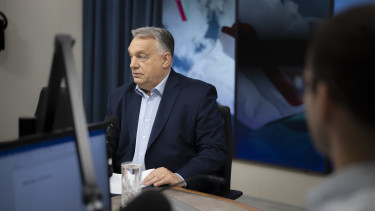
Cover photo: Prime Minister Viktor Orbán gives an interview on public radio MR1's morning programme on 31 October, 2025. Photo source: MTI/Prime Minister's Communication Department/Zoltán Fischer.





