Hungary's Orbán announces 11-point deal with Chamber, 6-month delay to hike of excise tax on fuel

Tax agreement signed
Following the announcements, the parties signed the agreement.
There was no opportunity for questions, but a background briefing will be provided shortly with details of the announcements.

Elek Nagy makes an announcement
According to the president of the MKIK, a great deal of joint work preceded the announcement of the current agreement. There are usually two pilots on an aeroplane: one navigates and the other flies the plane. The two pilots work together. He explained that the government and the chamber are working together to ensure that Hungarian companies can fly safely and high, and of course land safely.
He reminded us that the chamber listens to entrepreneurs' problems and cooperates with the government by conveying these problems to them and proposing solutions.
Next year, this package will have an impact of HUF 80-90 billion, and that the total impact over several years will exceed HUF 100 billion,
Elek Nagy explained.
The valorisation of the retail tax bracket and the shift in fuel excise tax will amount to nearly HUF 50 billion, he continued.
This 11-point package will help to move the Hungarian economy forward in this difficult situation, he stated.
Elek Nagy also revealed that they are working on further collaborations aimed at making life easier for entrepreneurs. He cited the pursuit of one-stop administration as an example of this.
The content of the agreement
Having presented the economic policy environment, Viktor Orbán moved on to the current agreement.
For Hungarian entrepreneurs, this means that the government will reduce taxes and cut bureaucracy.
we had agreed on 11 points with the Chamber of Commerce and Industry, he revealed
The measures, which will have a combined impact of HUF 80–90 billion, are as follows:
- The VAT exemption threshold will gradually increase over the coming years. In 2026, the threshold will be HUF 20 million, and it will continue to increase in 2027 and 2028. (The previously proposed multi-stage increase in the VAT exemption threshold would see the threshold rise to HUF 20 million in 2026, to HUF 22 million in 2027, and finally to HUF 24 million in 2028. This would affect around 150,000 businesses.)
- In 2027, the government will raise the cost ratio for flat-rate taxpayers to 50% [from 40%], with negotiations ongoing for 2028.
- The social contribution tax base will be reduced for sole traders.
- The circle of those eligible for the small business tax scheme will be widened.
- Environmental restoration and green investments will be supported with a tax credit of HUF 100 million.
- Tax breaks will be given to Hungarian energy suppliers to encourage them to upgrade their infrastructure. Some sectors of the Hungarian industry are highly profitable, so we are introducing special taxes on them. However, infrastructure investment is also needed, so we are incentivising service providers with tax breaks. 'We hope to see improvements,' said Viktor Orbán.
- We will raise the retail tax thresholds, but the rates will remain unchanged. This will benefit 3,500 companies.
- We will postpone the excise tax increase on fuels by six months.
- Significant reductions in administrative burdens are planned. The value limit for corporate tax advances will increase from HUF 5 million to HUF 20 million, which will benefit 20,000 companies.
- The value limit for simplified reporting by micro-entrepreneurs will also increase. This will benefit 10,000 businesses.
- A special simplification has been introduced for 80,000 sole traders: the NAV will automatically register insured persons and social contribution tax (szocho) returns will be reduced to quarterly.
This will be funded through special taxes on banks. He acknowledged that there is debate about how much of a burden can be placed on the banking sector. 'Our aim is to encourage as much production activity as possible. While the financial sector's concerns are important, they can only be secondary,' the Prime Minister explained.
'We have agreed with the president that they will also participate in economic management. Negotiations are underway on how the Chamber can take over economic management tasks, participate in economic decisions and exercise independent economic powers,' Orbán said. He added that there will be more such agreements, and that he is confident a third economic action plan will be announced soon. The first plan offered a fixed 3% discount on loans for SMEs, while the second is the current HUF 80 billion tax reduction package.
The background of the agreement
'The government has been struggling with a very difficult dilemma since the start of the war, which is posing an increasing challenge for us,' the Prime Minister began his speech. 'Europe is marching towards a war situation and the rhetoric of war is becoming increasingly harsh,' he said.
'Wartime economy, we must be ready to fight the war by 2030,' the head of government quoted everyday political statements.
This has an impact on economic policy because economic policy is more about the future and is based on plans, said Viktor Orbán, who believes that the plan from Brussels is to build a war economy.
This includes Ukraine's EU membership, the restructuring of the Ukrainian army, and changes to the EU budget in Ukraine's favor, he said, listing the financial consequences.
The question is how Hungary should respond to this situation, he continued.
The government does not accept this, and the question is whether it is possible to stay out of the war economy policy, he emphasised.
'No matter what decision you make, events are constantly changing, so this approach must be constantly revised,' he said.
'Márton Nagy and I decided to develop a national economic policy, and we must continually review it to ensure our assessment remains valid,' he added.
After consulting at length with the Minister of National Economy, we concluded that it is possible to continue with this economic policy.
However, he acknowledged that we cannot escape the effects of the war.
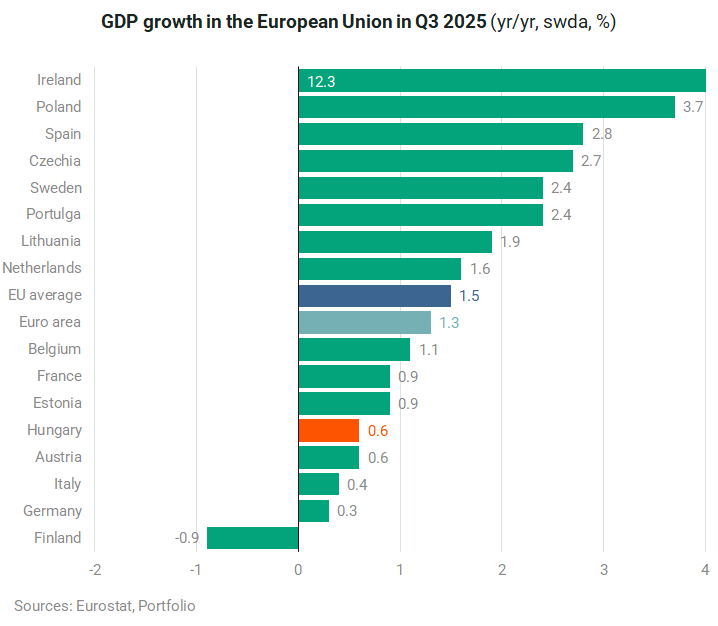
It seems the Russia-Ukraine war does not affect every EU member state the same. While the Hungarian economy grew by 0.6% year-on-year in the third quarter of 2025, Poland's GDP soared by 3.7%, and Hungary's q/q stagnation compares with Poland's 0.8% q/q GDP growth. But it's easy for them, they are not Ukraine's neighb... Oh, oh no. They are.
The press event is about to begin
According to Zoltán Kovács, State Secretary for Communications, the renewal of the agreement between the HCCI and the government on taxation will be announced.
I have a difficult task ahead of me, and I'm not sure I'll succeed. We are in a sombre mood, and yet I have important and good news to announce,
Viktor Orbán began his press conference, referring to the result of yesterday's national football team match.
Those in attendance:
The press event is attended by Ádám Balog, Vice President of the Hungarian Chamber of Commerce and Industry; Bence Gerlaki, State Secretary for Tax Affairs; and Richárd Szabados, State Secretary for SMEs at the Ministry for National Economy.
Meanwhile, the Prime Minister's official Facebook page says that he will soon have good news to share.
Viktor Orbán will soon make important announcements
It is already possible to guess what Viktor Orbán and Elek Nagy will discuss at their meeting.
Last week, the government made several statements indicating that it may announce new measures for small businesses in the coming days. Based on Economy Minister Márton Nagy's statement last Monday, we can also infer that the package of measures aimed at reducing taxes on smaller companies and easing administrative burdens could have a budgetary impact of around HUF 80 billion.
In fact, at a press briefing last week, Gergely Gulyás, the Prime Minister's chief of staff,
linked the SME support package to the need to raise the extra profit tax on banks.
According to Gergely Gulyás, supporting small and medium-sized enterprises is a priority in the current economic situation, and the government is committed to doing so despite the challenging budgetary circumstances. This will require doubling the windfall tax on banks, made possible by their profit growth in recent years. Gulyás also said that financial and energy companies, as well as multinational corporations, should bear a greater share of the public burden, and that this could be achieved through sectoral taxes.
Several meetings over the past few months
This is not their first joint appearance. On 4 October, Viktor Orbán and Elek Nagy announced the launch of a business loan scheme offering a fixed interest rate of 3% for small and medium-sized enterprises, up to a value limit of HUF 150 million. On 6 October, they also made a joint statement on several economic policy goals, including the future of the KATA (Itemized Tax Liability of Small Taxpayers) system and issues relating to corporate taxation.
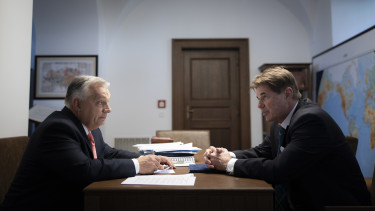
Cover photo: Prime Minister Viktor Orbán meets with Elek Nagy, President of the Budapest Chamber of Commerce and Industry, at the Carmelite Monastery on October 4, 2025. Source: MTI Photo/the Pirme Minister's Communications Department/Zoltán Fischer





