There are surprises in Hungary's latest tax reduction package

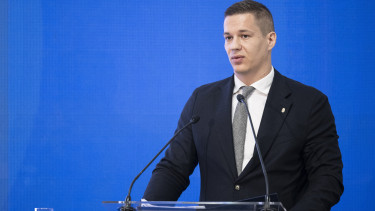
Bence Gerlaki began by saying that the total impact of the package will be 80-90 billion forints next year.
Bence Gerlaki said that eight measures represent tax cuts, while the other three elements of the package represent simplification. Of the 840,000 businesses, 31% are subject to corporate tax, 100,000 to small business tax KIVA and 126,000 to KATA, an itemsed tax for small taxpayers. The largest group comprises 265,000 sole traders subject to flat-rate tax and 93,000 subject to itemised tax.
This package takes into account all affected groups, he explained, before presenting the steps and content of the corporate tax reduction package point by point.
In response to a question, Bence Gerlaki explained that wage negotiations are proceeding independently of this tax package.
According to State Secretary for SMEs Richárd Szabados, the banking sector's high pre-tax profits justify an increase in the extra profit tax on banks. He believes that this increase would have justified a higher voluntary contribution from banks in the form of a windfall tax. However, as this did not happen, the government raised the tax itself. At the event, it also became clear that this is not open to negotiation, as the government has already made its decision.
'The decision has currently only been made regarding the banking sector,' replied State Secretary Bence Gerlaki when asked whether other sectors that currently pay special taxes could be expected to contribute more to the state budget in order to stabilise it.
When asked about plans by service providers to raise prices at the beginning of next year, Bence Gerlaki explained that they are constantly monitoring price increase plans and consulting with sector representatives. He also pointed out that, as part of its online price monitoring system, it already closely monitors the prices of over 100 product groups (comprising thousands of products), and that the price margin cap enables it to track intentions to increase prices and identify where in the value chain these increases are taking place (i.e. among suppliers, processors, wholesalers and retailers).
Detailed content of the 11-point package
1. Raising the VAT exemption threshold
Entrepreneurs whose annual income does not reach the threshold amount are exempt from VAT returns. This includes car mechanics, hairdressers and taxi drivers. The relevant threshold will be raised in three stages from the current HUF 18 million
- to HUF 20 million in 2026,
- to HUF 22 million in 2027, and then
- to HUF 24 million in 2028.
The number of potentially affected taxpayers is estimated to be 10,600 in 2026, 20,100 in 2027 and 28,900 in 2028.
The budgetary impact will be HUF -7 billion in 2026, HUF -6.5 billion in 2027 and HUF -7.5 billion in 2028.
2. Sole proprietors who opt for flat-rate taxation will have their cost ratio increased.
Currently, 40% of their income is classed as a deductible expense. This will rise to 45% in 2026 and 50% in 2027.
This means that, from 2026 onwards, the flat-rate income of the affected self-employed individuals will decrease, as will their tax liability. This will affect around 110,000 taxpayers on the flat rate. The loss of revenue will be 10-12 billion forints in both 2026 and 2027.
3. The government will abolish the social contribution tax base multiplier for full-time sole proprietors.
This will also reduce their tax liability. It affects 140,000 sole traders and has a budgetary impact of HUF -10 billion.
4. The circle of those eligible for small business tax (kiva) will be broadened.
They will double the entry and exit thresholds, meaning that companies currently classified as medium-sized enterprises will also be eligible for the tax break.
This will affect 3,000–5,000 companies employing 150,000 people. The budgetary impact in 2026 is expected to be between HUF 10 bn and HUF 15 billion.
- Companies will be able to remain in the KIVA scheme even if their turnover is between 6 and 12 billion forints.
- Companies will also be able to remain in the KIVA scheme with up to 200 employees instead of 100.
The 10% tax rate replacing the social contribution tax and the corprorate tax is attractive to the entrepreneurs concerned in this area, said Bence Gerlaki.
5. Tax relief for remediation and clean industry investments.
This can be claimed for investments worth at least HUF 100 million, such as brownfield investments or the conversion of old industrial areas into residential parks.
It is a new EU legal title: the clean industry legal title.
The agreement encourages investment in the decarbonisation of the energy and industrial sectors by increasing the subsidies available through the development tax credit scheme. Companies can reduce their corporate tax liability by up to 80%.
According to the Economy Ministry's expectations, only a few dozen companies will be affected, and the loss of revenue will not impact the state coffers until later.
6. Support for investments in energy infrastructure.
Among those subject to the energy suppliers' income tax (Robin Hood tax), distribution network operators will be eligible for tax relief from 1 January, 2027, following their investments in energy infrastructure modernization begun in 2026. The six affected companies are all distribution network operators. The loss of revenue to the state coffers will only become apparent in later years.
'They can write off up to 80% of their calculated tax and their 2027 tax liability,' the state secretary explained. Compared to the original plans, the government will support an additional investment.
According to an earlier plan, the tax rate will be reduced from 41% to 31%, the state secretary recalled.
7. The retail tax brackets will be raised.
The government will increase the current retail tax thresholds: to HUF 1 billion from HUF 0.5 billion; to HUF 50 bn from HUF 30 bn;, and to HUF 150 bn from HUF 100 billion. Tax rates will remain unchanged.
The current rates, which will remain unchanged next year, are as follows:
- 0% below HUF 500 million;
- 0.15% between HUF 500 million and HUF 30 billion;
- 1.0% between HUF 30 billion and HUF 100 billion; and
- 4.5% above HUF 100 billion.
And while the keys remain the same, the bands and tax obligations change as follows:
- 0% below HUF 1 billion;
- 0.15% between HUF 1 bn million and HUF 50 billion;
- 1.0% between HUF 50 billion and HUF 150 billion; and
- 4.5% above HUF 150 billion.
A total of 3,500 companies will be affected (15-20 of which fall into the upper bracket). Consequently, retail tax revenue is expected to decrease by HUF 26 billion in 2026.
Bence Gerlaki emphasised that this measure has the most significant budgetary impact of all the measures in the 11-point package.
All of this is particularly interesting given that when the budget deficit target is overshot, the government usually responds by raising special taxes and tightening restrictions, as was the case with banks. Meanwhile, the retail sector is benefiting from relief measures.
8. Government has postponed the increase in excise duty on fuels by six months.
The implementation of the excise tax hike is being postponed until 1 July 2026. According to the Economy Ministry, this will help to ensure that domestic fuel prices remain below the average in neighbouring countries.
With this decision, the government is postponing an 8–9 forint per litre increase in fuel prices. If the increase were to take place, Hungarian fuel prices would exceed the regional average, contrary to the government's objectives, as explained by Bence Gerlaki.
9. Increase in the general threshold for corporate tax advance payments.
From 2026, the government will raise the corporate tax prepayment threshold from HUF 5 million to HUF 20 million. This change will affect between 10,000 and 15,000 companies.
10. The value limit for simplified annual reporting by micro-entrepreneurs will be raised.
They are increasing it by 20%. This much is permitted by EU regulations.
The limit on total assets will increase from HUF 150 million to HUF 180 million, and the limit on annual net sales revenue will increase from HUF 300 million to HUF 360 million. Reporting requirements will be simplified.
These changes will affect 5,000–10,000 micro-entrepreneurs.
11. Reducing the administrative burden on sole traders.
This measure will affect around 80,000 sole traders.
The Chamber's plans
The Chamber's Vice {resident then spoke about the new steps it is preparing to take in cooperation with the government to exercise its economic powers. The MKIK is preparing to communicate more actively in this area.
Cover photo: MTI Photo/Zsolt Szigetváry





