The new leadership of the MNB is approaching its first real test. What will the Hungarian central bank do?

Nothing to make rate-setters scratch their heads
According to statistics from the Central Statistical Office (KSH), inflation was 4.3% in October, marking the fourth consecutive month at this level. Meanwhile, core inflation rose to 4.2%, up from 3.9% in September. Price increases have remained within the central bank's target range of 2–4% for almost a year, as last seen in November last year. Meanwhile, core inflation temporarily fell below 4% in August and September,
with the last sustained period below this key level occurring in 2021.

In other words, the inflation target is still far from being sustainably met, as the MNB has repeatedly emphasised. However, analysts expect the rate of price increases to fall below 4% by the end of the year, meaning that inflation will return to the target range of 2–4%.
The question is when the central bank will consider the target to be sustainable. The Monetary Council does not examine the current inflation picture, but rather the outlook for the near future, which it can influence through its decisions. Opinion is divided, with some experts suggesting that annual inflation could fall sharply in early 2026 due to this year's high base, while others do not rule out the possibility of
price increases of around 2% in the first months of the year.
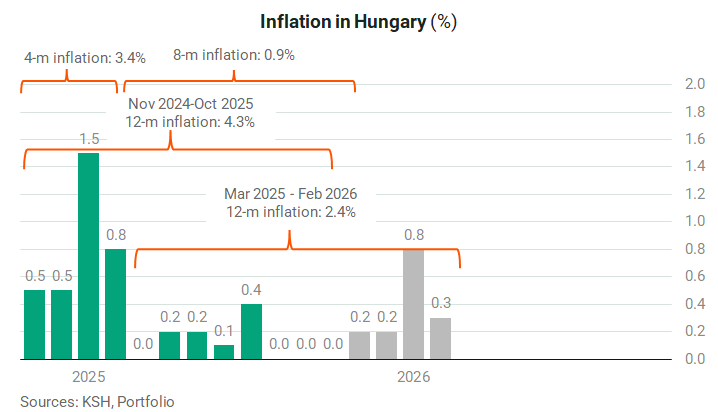
But what could cause inflation to fall so sharply in the first few months of 2026? To answer this question, we need to understand how inflation developed throughout the year and what is expected to happen in the future. The chart below shows the annual values calculated from monthly inflation data. As can be seen, inflation over the last 12 months can be divided into two sharply contrasting phases. In the first four months of this period (from November last year), there was a significant intensification of price adjustments in the economy, with 80% of the annual increase occurring during this short period.

However, over the next few months, data from these four months will gradually disappear from the annual price index. The question is what will replace it. For several reasons, we can rightly assume that we will see lower monthly values.
- One of the main reasons for the increase in repricing decisions was the significant weakening of the forint from autumn 2024 onwards. This is no longer the case; in fact, due to the gradual strengthening of the forint, the euro is now 8% cheaper than at the start of 2025.
- Prices rose sharply at the beginning of the year during the intense period of repricing that occurs at this time of year. However, this was not the only reason for the increase. Expectations and high wage dynamics also contributed to significant price increases by major service providers. We anticipate that the impact will be more moderate at the start of 2026. On the one hand, the government's agreement with various service providers, such as telecoms companies, banks and insurance companies, to freeze prices is valid until the middle of next year, meaning that they will not be raising prices in January. Furthermore, the government and the central bank are paying close attention to price changes and will certainly try to persuade companies to exercise restraint in their price increases at the beginning of the year if necessary.
- At the beginning of the election year, we can also expect official price increases and tax hikes to be postponed.
Our hypothetical calculation below shows the impact of base effects and the absence/postponement of price increases. It assumes that inflation over the next four months will be approximately half of that seen at the start of 2024-25. This would result in annual inflation falling to 2.4% by early 2026, due to higher drop-out values and lower incoming monthly data.
Margin caps are still here, but how long will they stay?
However, the biggest question regarding the inflation outlook is what will happen to margin caps and what will happen after they are eventually phased out. It is, of course, impossible to say exactly what will happen to inflation during this critical period. The central bank will also be monitoring repricing decisions closely, such as whether wage dynamics, expectations or the strong forint will have a greater impact than suppressed price increases.
However, the bigger picture is fairly clear. What should the central bank do in such a situation? Should it be pleased that inflation is below the 3% target? Should it be concerned about delayed effects? What should it do about the margin cap, for example, the future of which is completely uncertain? The latter is worth considering. Most recently, the government extended the measure until the end of February and expanded it to cover 14 additional product categories. This suggests that they are not considering phasing it out any time soon.
Analysts still expect these restrictions to be lifted after the 2026 elections, meaning inflation is likely to remain below 4% temporarily at the start of the year. The MNB estimates that the margin cap currently reduces inflation by around 1.5 percentage points. This suggests that the official figure of 4.3% is likely to be closer to 5.5–6% in reality.
Due to repricing, it is uncertain whether this effect will be fully reflected in prices. The central bank has suggested that the increase may be only 1–1.2 percentage points after the phase-out. Nevertheless, this must be considered when evaluating the outlook, provided it is assumed that the government will abolish the margin cap within the next year and a half to two years. Currently, the MNB is working on the basis of what has been decided by the government, i.e. the phase-out in February.
But will it really put an end to it? Most economists argue that market conditions cannot be distorted indefinitely by artificial price interventions; at some point, they will have to be allowed to prevail again. However, the government is now suggesting that
the margin cap may remain in place permanently.
Prime Minister Viktor Orbán referred to this a few weeks ago when he said that, depending on international inflationary trends, a decision could be made on whether to phase out, further extend, or possibly expand the measure. While the government has typically decided on the fate of the margin cap a few months in advance,
if they intend to use this tool in the long term, it could present analysts and the central bank with a new situation.
Where is inflation headed?
Having hit rock bottom in February, the price index may start to rise again simply because the margin cap pushed prices down at the beginning of last spring and this will no longer be included in the annual indicator. If the margin cap is phased out in the second half of the year, this will further impact the price index. At the same time, we may see price increases by service providers, tax hikes — we already know about the fuel excise tax — and stabilisation measures built into other prices. Due to the significant spending before the election and strong wage growth, service providers are unlikely to hold back.
Even if inflation falls sharply in early 2026, these considerations may deter the Monetary Council from cutting interest rates for quite some time, as the outlook will suggest that inflation will start to rise again afterwards.
At his press conference on Tuesday, Mihály Varga also referred to this when he said that, according to the MNB's calculations, inflation could fall within the target range in the coming period. However, he added that "the fight against price increases is not over yet". Consequently, there is now a greater chance that the central bank will 'overlook' the temporarily lower inflation at the beginning of the year.
Furthermore, it will likely only become apparent after the April elections what the new government intends to do regarding the margin caps, since none of the potential winning parties will commit to discussing their potential removal during the campaign. Therefore, it is almost certain that the government will extend the measure by three months in February, and the outlook will only become clear by the middle of the year. This is why analysts believe that, if these effects occur simultaneously,
inflation figures will rise above 4% again in the second half of 2026. This would mean that price increases could exceed the central bank's target range once again.
Are there any other options for the MNB? Could it wait until it knows for sure before acting on the expected removal of the margin cap? Central banks have been known to behave in this way. For example, the Polish central bank recently responded to the Polish government's decision to extend the deadline for utility subsidies until the end of the year by saying that this would give them more room to continue the interest rate cuts they had already begun.
In theory, the MNB could say that it will continue to cut interest rates until it sees a definitive end to the margin cap. Then, when the government announces the phase-out, the MNB will stop depending on the impact. The difference is that Polish inflation is currently at 2.8%, within the central bank's target range of 1.5–3.5%. This means they can cut interest rates.
In Hungary, however, even artificially reduced price increases cannot yet meet the MNB's target.
At the beginning of next year, the Monetary Council may also adopt a cautious approach due to the upcoming elections and growing uncertainty. In other words, Hungarian central bankers are unlucky that inflation is expected to fall within the target range at a time of increasing uncertainty.
In any case, it will be interesting to see how the MNB's decision-makers interpret the anticipated significant slowdown in price growth around January–February.
Will the overly strong forint have the final say?
The year 2025 showed the impact that high interest rates can have on the forint market. At the beginning of the year, when the euro exchange rate was above 410, few people would have thought that we would reach a point where we could realistically talk about a level of 380. Throughout the year, the significance of the carry trade as the primary driver of the forint was frequently discussed.

If the MNB remains cautious despite a possible fall in inflation, this could further encourage investment in the forint. Assuming inflation of around 2% and an unchanged base rate of 6.5% at the beginning of the year, a significant real interest rate of over 4% could temporarily emerge, as was last seen at the start of 2024.
At the same time, some analysts believe that the Hungarian forint may soon become too strong and that
the economy may not be able to sustain an exchange rate of around 370 to the euro in the long term.
The MNB is comfortable with the strengthening of the forint this year, periodically emphasising that the exchange rate plays a significant role in disinflation and in anchoring inflation expectations among the population. However, the question remains as to whether they would still think this way if the forint were to strengthen further and companies were to become increasingly vocal about how the exchange rate is already damaging the economic outlook.
Cover photo: MTI Photo/Róbert Hegedüs