Péter Benő Banai: "The era of negative real interest rates is over"

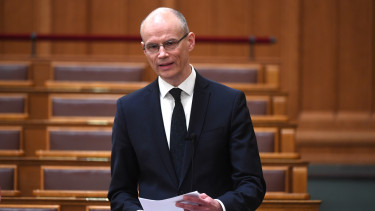
The parliamentary hearing of Péter Benő Bana has taken place. As expected, he will replace Barnabás Virág, who resigned last week, as Deputy Governor of the National Bank of Hungary (MNB), responsible for analysis, money supply and central bank programmes.
It comes as no surprise that Péter Benő Banai is the frontrunner for the vacant position, given that central bank Governor Mihály Varga clearly stated during his parliamentary hearing in December 2024 that he was counting on the expert's work at the MNB.
According to his mandate, Barnabás Virág was due to hold the position of Deputy Governor responsible for analysis, cash flow and central bank programmes until 22 June 2026. However, according to a statement released by the central bank last Friday, he has resigned from his position. Prime Minister Viktor Orbán has nominated Péter Benő Bánai for the vacant position. He was interviewed by the Economic Committee of the National Assembly today, and a decision was made on his nomination to the Monetary Council at the same time.
According to his CV, Péter Benő Banai has worked at the Ministry of Finance and the Ministry of National Economy since 1998. Starting as a clerk, he went on to work as a department head and deputy department head in the Budget and Fiscal Policy Department, before becoming acting head of the EU Budget Relations Department.
In 2010, he became Deputy State Secretary for Budget at the Economy Ministry, and from 2014 he served as State Secretary for Public Finance at the Economy Ministry, and from May 2018 at the Ministry of Finance. He held this position until March 2025, when he joined Mihály Varga at the MNB as an advisor to the governor.
During his hearing before the Economic Committee, Péter Banai provided detailed insights into his objectives, strategies, and professional principles deputy governor. During the hearing, he delivered a speech focusing on three main topics: his professional background; his ideas regarding the tasks of the central bank; and his principles of leadership and institutional governance.
Péter Banai emphasised that he had climbed the career ladder all the way to the position of State Secretary during his career, thus gaining first-hand experience of the interrelationships between the real economy, inflation and the budgetary effects of exchange rates. He oversaw the State Treasury for many years and worked as a member of the board of directors and supervisory board in the real economy and financial sector, including at the MNB. From May 2025, he served as chief advisor to Mihály Varga. He emphasised that his career to date has been defined by a professional approach and objectivity.
When discussing the role of the central bank, he emphasised that controlling inflation was paramount. He pointed out that, since 1990, when inflation was above 4%, economic growth had averaged only a third of that experienced during periods of low inflation.
He therefore believes that
a stability-oriented monetary policy is necessary in order to serve the interests of the entire national economy.
He believes that the central bank's operations, particularly in the production of economic and fiscal analyses, research and statistics, must be transparent and disciplined. Not only must these be accurate and traceable, they must also directly support decision-making.
With regard to cash flow and financial infrastructure, he emphasised that the system functions like "invisible yet vital air". He believes that all payment systems must operate flawlessly, and that technological developments — such as digital central bank money — point towards continuous innovation. Péter Banai believes that more efficient and cheaper payment solutions must be used, and he sees further development opportunities in the application of artificial intelligence.
With regard to central bank programmes, he emphasised that there are currently no real constraints on the demand or supply of credit,
with businesses instead perceiving uncertainty and weak market demand. The Hungarian banking system has high liquidity and a low loan-to-deposit ratio. This enables it to provide large-volume lending without external intervention. However, continuous monitoring of lending activity is important. According to Banai, the resolution processes need optimising, though he hopes that no substantive intervention will be necessary.
Finally, he summarised his leadership principles. He believes that all institutions should serve the public interest, and that the central bank should consider all opinions while making decisions independently within its own sphere of responsibility. According to Péter Banai, the cornerstones of the central bank's operations are credibility, integrity, and professional considerations.
When asked about the strengthening of the forint, Péter Banai replied that this was primarily due to the central bank's activities, which, while not the only factor, had a significant impact on the markets. Investors clearly accept and consistently appreciate the measures and communications of central bank governor Mihály Varga; high interest rates and firm statements bolster confidence in the currency. The international environment is also changing. European bond yields suggest that
the era of negative real interest rates has ended, and investors are responding positively to this change.
The strengthening of the forint is already evident in inflationary processes. Since June, industrial purchase prices have been falling, which has moderated imported inflation and significantly dampened consumer price increases.
Meanwhile, inflation expectations are much higher than actual inflation, with the exchange rate having a particularly strong influence on their development.
According to Banai, the more stable exchange rate is also expected to moderate inflation expectations, which could improve the outlook for price stability even further.
When assessing the current government's economic policy, he emphasised that the performance of a small, open economy is fundamentally determined by the external environment. The weak performance of the German economy, the inflationary shocks of recent years, and the global slowdown in growth have all played a significant role in making it difficult to restore price stability in Hungary.
He believes that sustainable growth can only be achieved if there is also an upturn in external markets.
Banai explained the high financing costs of Hungarian public debt, pointing out that, since 2011–12, the population has become an increasingly important source of financing. Its share has grown from 2–3% to over 20%. This means higher costs, but also that the funds remain in the country. He believes that the current market financing structure will remain in place, and is confident that the deficit will decline in the coming years. Moderating inflation could also lead to a gradual decline in interest rates, which could improve the budget situation.
In response to suggestions that the domestic banking sector is passing on unreasonably high costs to consumers despite its profitability, Péter Banai said that, in addition to monitoring system stability, the central bank is also duty-bound to curb excessive fee increases. He added that the institution headed by Mihály Varga has already achieved concrete results in this area. The first step in this process was taken in the spring, when banks agreed not to raise fees on a number of items.
According to Banai, the central bank's most important task is to strengthen market competition,
since the most efficient operation and lowest costs can be achieved through the presence of fintech service providers.
At the end of the hearing, the Committee members voted on Banai's suitability. The result of the vote was 11 in favour, 1 against and 2 abstentions.
Péter Benő Banai was therefore deemed suitable for the position of Deputy Governor of the MNB.
Cover photo: MTI Photo/Attila Kovács





