Hungary's demographic situation grows increasingly tragic with historic lows


In October 2025, 5,979 children were born, 10% (686) fewer than in October 2024.
We have seen lower birth rates before, but never in October. At the turn of the 2010s and 2020s, 7,500-8,000 children were born in the middle of autumn.

The declining birth rate is, on the one hand, a natural process and an inevitable demographic phenomenon due to the decrease in the number of women of childbearing age. What is even sadder is that not only this, but also the willingness to have children contributes to the historic low. The total fertility rate per woman is estimated at 1.31, down from 1.39 a year earlier. Seasonally adjusted, this figure is also a historic low. There were 35.3 live births per 1,000 women aged 15–49, 1.9 per thousand fewer than a year earlier.

On a positive note, however, the number of deaths is declining. In October, 10,333 people lost their lives, 6.8% fewer than a year earlier. As a result, natural population decline was 4,354 in October 2024, compared to 4,424 in October 2023, which at first glance may suggest that population decline is not accelerating. However, looking at the processes from a distance, we can see that the decline has accelerated. Previously, the balance between deaths and births resulted in a monthly decline of around 3,000 people, but now this figure is around 4,500.
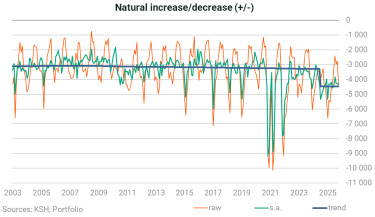
This downward trend is confirmed by the fact that between January and October 2025, natural population decline amounted to 42,444 people as a result of the balance between births and deaths, which is 5.7% more than the previous year's figure of 40,140. This roughly corresponds to the population of Dunakeszi.
Cover photo (for illustration purposes only): Getty Images





