More people in Hungary admitted to hospital with respiratory infections

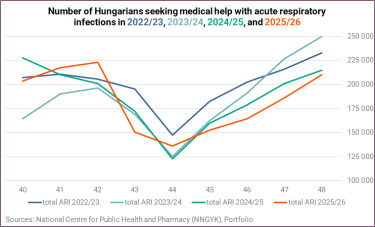
As regards the estimated number of Hungarians seeking medical help with acute respiraotry infection, the current respiratory season started worse than in the previous years. However, the ARI numbers have been lower than in the previous three years for the fourth consecutive week now.
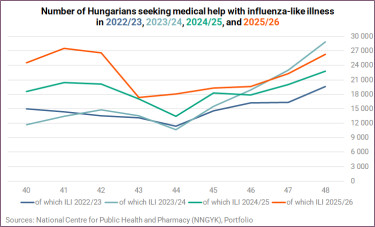
Meanwhile, the number of influenza-like illness (ILI) is currently the second highest compared to the past three years.
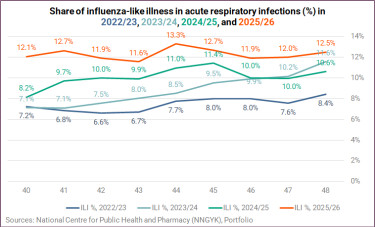
The share of ILI in ARI was 12.5%, higher than in the previous three years, and a tad up from 12.0% a week ago.
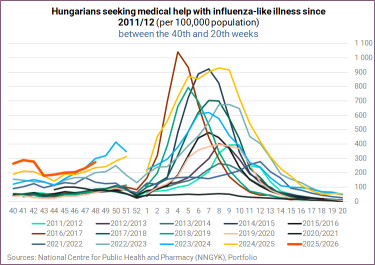
With regard to the number of ARI patients per 100,000 inhabitants, we were better off than in the previous three seasons. The number of patients with ILI per 100,000 people was slightly higher in 2023/24. In fact, the current one is the second highest figure since 2011/2012.
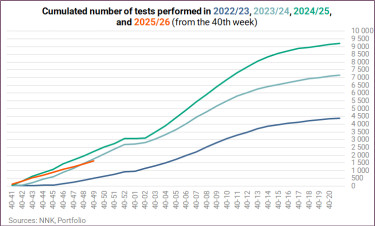
While the total number of samples tested exceeds the 2022/23 figure by the 48th week, it remains below the 2023/24 and 2024/25 figures.
The Covid-19 positivity rate came in at 12.2% when considering all positive tests (19) of the samples submitted by sentinel GPs (156) and at 11.6% when calculating with all positive tests (22) in all of the samples (i.e. those submitted by sentinel hospitals and also traditional diagnostic samples, 190 in total).
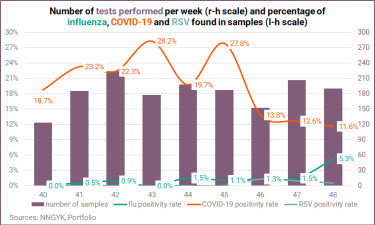
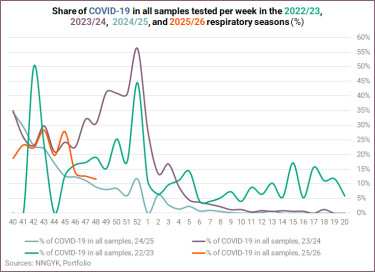
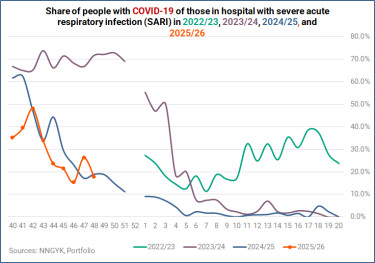
The coronavirus positivity rate retreated further from 12.6% on the 47th and 13.8% on the 46th week and was lower on the 48th week than on the same week of 2023/24 and 2022/23 but higher than in 2024/25.
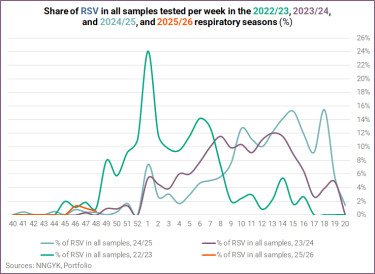
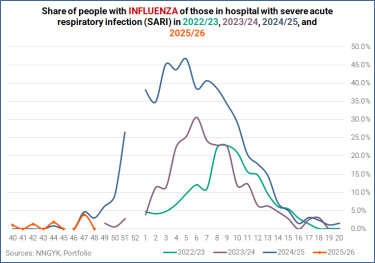
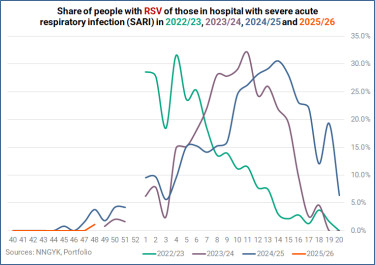
The influenza positivity rate picked up to 5.3%, as expected. The first time samples showed the presence of respiratory syncytial virus (RSV) was on the 46th week and although the positivity rate remains low, it's worth pointing out that it peaked around 24% at the end of 2022, early 2023. However, the patterns of the last three seasons have provided very little useful information for making forecasts.
Hospitalisations
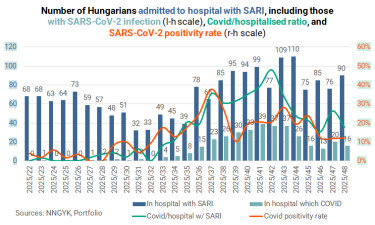
There were 90 people in hospital with severe acute respiratory infection (SARI), up from 76 a week earlier, of whom 16 tested positive for COVID-19 (17.8%), which compares with 18.9% in 2024/25 and 71.8% in 2023/24, when hospitals admitted more SARI patients on the 48th week, 132 and 266, respectively.
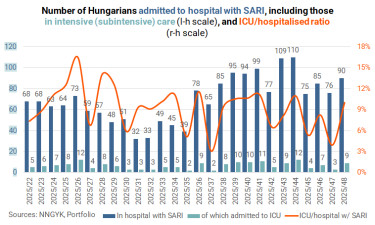
Nine of the 90 patients needed intensive of subintensive care, a ratio of 10.0%, which marks a sharp rise from 3.9% on the 47th week, and compares with 16 in the same week of 2024 and 28 in 2023 (with ratios of 12.1% and 10.5%, respectively).
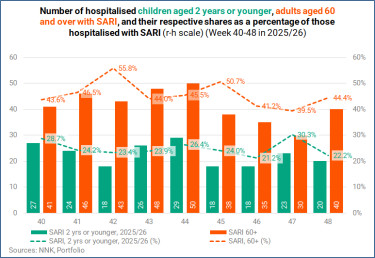
Three quarters of people admitted to hospital with a coronavirus infection were over 60 years old (12 in total), and more than 44% of SARI patients were in this age group (40 in total). About a quarter of SARI patients were under two years old (20 in total).
The National Centre for Public Health and Pharmacy (NNGYK) also had some key data published since the official end of the previous respiratory season on the 20th week, which show a general increase in the number of hospitalsed SARI patients since the 35th week, except for a surprise drop on the 42nd week. We also find that SARS-CoV-2 is the main reason behind hospitalisations.
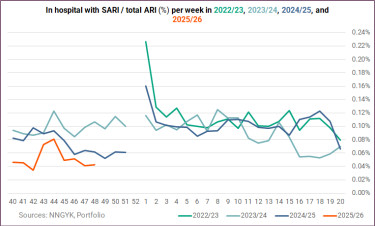
So far, this season is less serious than the previous ones when it comes to how many of all people with ARI end up in hospital. We were concerned a few weeks ago that the orange line might be on its way to cross the blue (or green) ones, but it turned down instead and remained fairly steady.
The patterns of the previous years suggest that the ratio of coronavirus infections in hospitalisations should keep dropping and get close to 0-10% by the 5th or 6th week of next year. In parallel with this, influenza infections behind hospitalisations should start to pick up before the end of the year or early 2026. And then there's the respiratory syncytial virus (RSV) to consider.
This is how the pathogens 'swapped places' as the main reason behind hospitalisations last year, although there's absolutely no guarantee that we'll see the same trajectories this year.
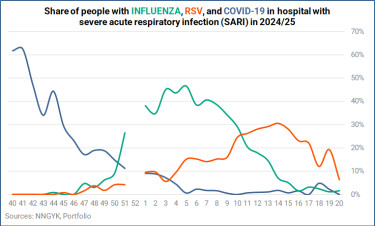
Here is a side-by-side comparison of hospitalisations by type of infection for the current and past respiratory infection seasons. In 2023/24, the share of coronavirus infection behind hospitalisations hovered between 65% and 74% in the first nine weeks of the season.
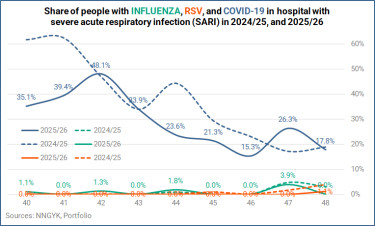
And this is how they have been changed in the current and past three seasons of respiratory infections. (Note that the the RSV was not reported to be behind any hospitalisation until the 47th week in 2024 and the 49th week in 2023, and that's why the orange line remains at 0% on that graph.)
Age breakdown
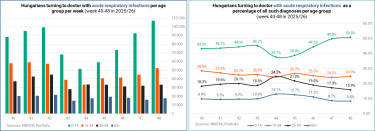
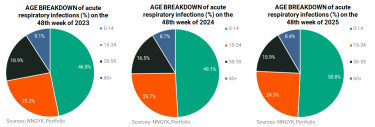
More than half of people seeking medical help with an acute respiratory infection (ARI) in week 48 were children aged up to 14 (almost 107,000), up from around 92,500 or 49.8% a week earlier. About than a quarter (52,400) were aged 15–34.
The graphs below show a breakdown of ARI patients by age group for this year and the previous two seasons.
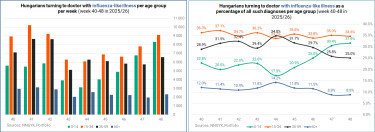
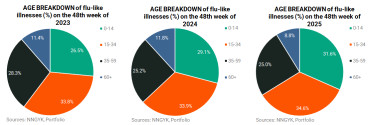
When it comes to ILI, the most affected age group was people aged 15-34, accounting for 9,100 (34.6%) of all patients with influenza-like illness, followed by the 0-14 age group (8,300 or 31.6%).
A címlapkép illusztráció. Címlapkép forrása: Getty Images