Hungarians crank up A/Cs, power consumption reaches record in heatwave


New 2023 record
System load, indicating instantaneous national electricity consumption, peaked at 6,264 MW at around 20:30 on Monday 21, according to Mavir's verified gross actual data.
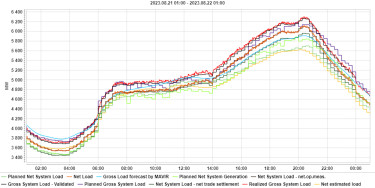
The record for the summer of 2023 so far was 6,154 MW at 18:45 on 17 July, when increased use of air conditioning also increased national electricity demand during a heatwave (with an average temperature of 28.6 degrees Celsius).
However, this summer's new peak of 6,264 MW is far below not only the historical record of 6,940 MW set in 2021, but also the highest system load values of recent summers, excluding 2020, the year of COVID-19.
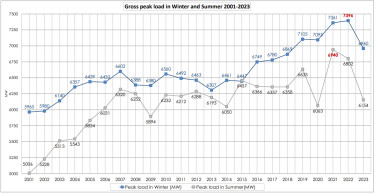
The reasons for this can be found in the consumption-reducing effects of high energy prices - and of high inflation in general - as residential, institutional and business users responded to the soaring costs by saving, investing in energy efficiency and toning down their economic activity. This effect can also be seen in the monthly electricity consumption data, which show a steady year-on-year decline for more than a year now.
The reduction in consumption is made even more pronounced by the fact that, partly due to the warming climate, air conditioning systems are also spreading in Hungary, and the electrification trend worldwide is leading to an increasing number of other electricity-consuming appliances (and electric cars) in Hungary, so that an increasing share of final energy consumption is now electricity.
Solar panels contribute
The occurrence of peak system loads is also significantly influenced by the operation of the also growing number of household-scale solar power plants (HMKE in Hungarian). Most of the electricity generated by the more than 222,000 household PVs on domestic rooftops today is used locally on hot days, mainly due to the increased use of A/Cs.
Household PVs are not formally part of the electricity system, and therefore their production and on-site consumption is not included in the load statistics. However, as their installed capacity is already approaching 2,000 MW, their production is certain to contribute significantly to meeting electricity demand on sunny, hot days.
This is also indicated by the fact that in recent years, the times of peak system loads have shifted noticeably later in the day, to the time of sunset or after. At this time of day, the heat is usually already abating, but this has less of an impact on reducing consumption than the surge in demand for network supply resulting from the shutdown of household PVs at dusk.
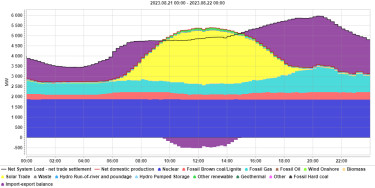
The transformation of the intraday load curve in recent years due to the impact of household PVs is illustrated by Mavir's graph from five years ago in 2018 (also during a second heatwave alert) and the current record day.
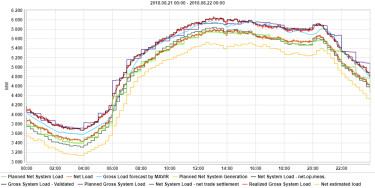
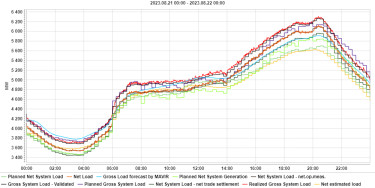
At the time of the new record, solar energy no longer played a role in the supply mix, with imports accounting for approximately 40% of the mix, the Paks Nuclear Power Plant 30%, domestic gas-fired power plants around 20%, and the brown coal/lignite-fired Mátra Power Plant around 5%, while the remainder was mainly provided by other renewable capacities (biomass, waste incineration, hydro, reservoir and other power plants).
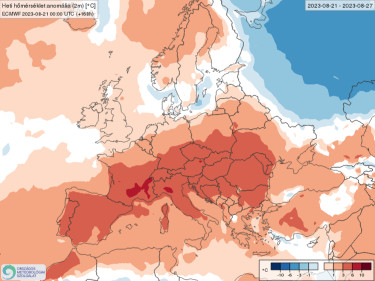
The current heatwave is forecast to last until the second half of the week, so there is a chance that this summer's peak system load will be broken again in the next few days, but the historic record is unlikely to reached. Based on the forecast of the National Meteorological Service (OMSZ) and taking into account the professional recommendation of the National Centre for Public Health and Medicine, the National Chief Medical Officer has issued a second-level heat alert for the whole country from Monday 14:00 until Thursday midnight.
Increased A/C use can also raise electricity bills; for residential users, this can happen if monthly consumption exceeds 1/12th (210 KWh) of the annual consumption (2,523 kWh) under the overheads protection threshold.
Cover photo: Shutterstock


