New wind power plants cannot be expected in Hungary before 2029 - minister


Parliament's Economic Committee has held its annual hearing for Csaba Lantos, who, according to vg.hu, hvg.hu and Telex, said the following (subject grouping and comments by Portfolio):
New wind plants not be added to the grid before 2029
No new wind capacity is expected to be connected before 2029, because there are so many solar developments in the pipeline that this is not possible, except in cases where projects had been previously licensed but not built, but could be built if they change hands.
Regarding the 2029 date and the host of PV projects, we need to highlight that there is currently around 3,300 MW of solar capacity that has been granted grid connection rights before the first publication procedure, so it could be connected between 2024 and 2026. In the recently concluded first publication procedure, projects have obtained guaranteed connection rights from 2028 onwards. In the second publication procedure, which will be launched shortly, projects can apply for a subsequent period of connection. As Lantos stated, these cannot be preceded by new wind capacity.
Exaggerated estimates
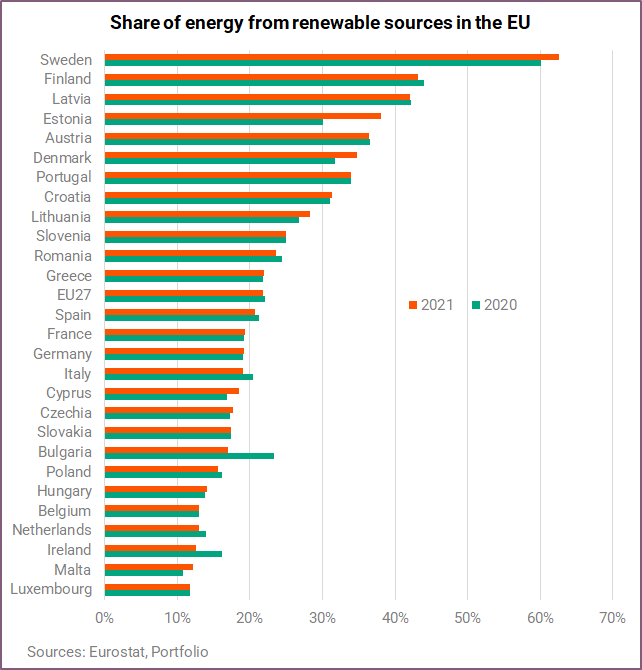
Lantos spoke in detail about the prospects for wind power last week to Inforadio, saying that the installed capacity could increase from the current 0.33 GW to around 1 GW under the changes announced. In 2016, the government amended energy laws, banning wind turbines within a 12-kilometre radios of populated areas, essentially in the whole country. Under a current modification, the radius of the protection zones will be reduced to 0.7 km from from 12 km, and the 40-metre height limit will be waived individually, while local communities will have a say in the construction.
Red marks the banned and white the permitted areas. Cannot see any white spots? Exactly!

Today, in response to a question from an opposition MP, Lantos stressed that estimates that 3-3.5 GW of wind capacity could be installed are exaggerated. He believes that it only makes sense to install wind power in 11% of the country, so that a total capacity of 1-1.5 GW could be rationally operated in a commercially viable way, after the current 0.3 GW. He stressed that the state does not want to subsidise the creation of new capacity.
Pumped storage hydropower
In his radio interview last week, Lantos hinted at the idea of creating a power plant to store green electricity by exploiting the difference in water levels between two lakes. But now he has also announced that a government decision has been taken to launch such a project, with a feasibility study already underway and a location being sought. This is expected to be decided by the end of next year, after which it will take a long time, up to ten years, to complete the project. In an interview last week, he hinted that one of the possible sites could be the area around the Mátra power plant.
Combined cycle gas turbine plants (CCGTs)
According to Lantos, the plans for the three large CCGTs have reached the tendering phase, and there is strong international competition for the construction. Final bids are due next year, and from there it will take three and a half years to complete. This means, for example, based on next spring's tender opening date and a 3.5-year construction period, the earliest the first CCGT plant could come on stream would be towards the end of 2027, a delay compared to the plans made in May this year.
As MVM CEO Károly Mátrai outlined in an interview with Portfolio, the plan was to have the CCGTs in operation by the beginning of 2027, for which the winners of the public procurement should have been announced by the end of this year, and they should have started construction works at the beginning of next year. "It will take about three years to complete, so that these power plants can gradually enter the Hungarian electricity system from the beginning of 2027," he added.
Remarks made by Lantos and Mátrai suggest that the potential closure of the Mátra power plant will also be delayed until 2027-2028, as a recent government decision has stipulated that lignite-based power generation will continue until the CCGT is completed on the plant site.
Gas consumption plummets
Gas consumption in Hungary has fallen significantly. According to Lantos, in the previous gas year, between autumn 2022 to autumn 2023, domestic gas consumption was 8.3 billion cubic metres, which marked a drop in excess of the EU's 15% consumption reduction target, which is also important for greenhouse gas emissions. The 8.3 billion cubic metres means that the reduction so far since the change of regime has been 37%, compared to the original target of a 40% reduction by 2030. That is why the 2030 target has been increased to 50%.
Geothermal energy
Lantos said they have made major progress in terms of geothermal energy with the new regulation that came into force on 1 March. He noted that investor interest has increased and some drilling has already started. He added they would like to increase the current 10% share of geothermal in district heating significantly, and that a number of new exploration permits have been issued, but these will be small projects with a capacity of 2-4 MW, up to 20 MW.
Solar power
No new information was shared in this respect. From January 2024, they will launch the HUF 75 billion Solar Plus Programme, which will support solar panels and storage together with a two-thirds subsidy rate to encourage further the consumption of self-generated energy. It is also known that the grid-connection freeze will be lifted on 93% of the country's territory from January to further increase the number of household solar projects from the current 245,000.


Cover photo: MTI Photo/Zoltán Balogh


