Number of household solar power plants in Hungary doubled in three years


The total installed capacity of the 7,218 MW of solar power plants in Hungary reported by the ministry is based on the fact that industrial plants contribute almost 4,000 MW, "small household-scale power plants (HMKE in Hungarian) add almost 2,600 MW and the captive power plants (CPPs) add another 650 MW."
A captive power plant, also called autoproducer or embedded generation, is an electricity generation facility used and managed by an industrial or commercial energy user for their own energy consumption. Captive power plants can operate off-grid (in an island mode) or they can be connected to the electric grid to exchange excess generation. CCPs are generally used by power-intensive industries where continuity and quality of energy supply are crucial, such as aluminium smelters, steel plants, chemical plants, etc. However, the radical cost declines for solar power systems have enabled the opportunity for less energy-intensive industries to economically grid defect by coupling solar PV with generators or cogeneration units along with battery systems. (Source: Wikipedia)
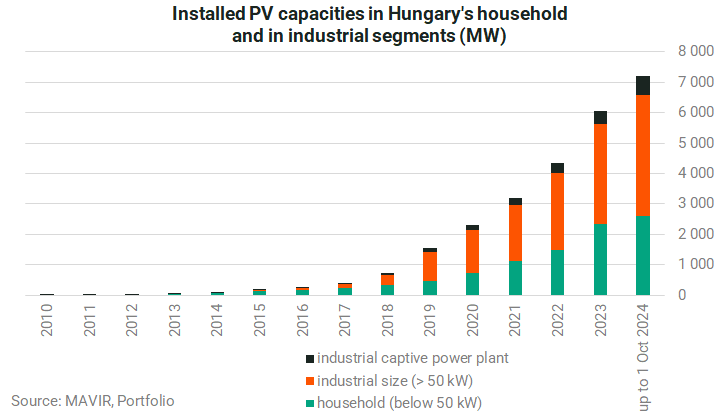
The ministry pointed out that "55% of domestic solar capacity of all sizes has been installed since 2022", and as the graph above shows:
this year marks the third consecutive year in a row that the installed capacity of solar power plants has increased by more than 1 GW. We are now at 1,167 MW with three months of the year left.
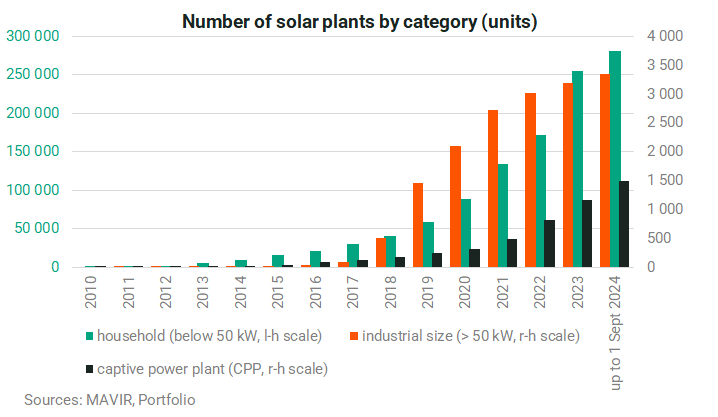
They added that there are already more than 283,000 household-sized small power plants in the country, mostly in detached houses, and their number has more than doubled by the end of 2021.
They pointed out that the Solar Energy Plus Programme, launched in January, has already received more than 20,000 applications and is contributing to the 300,000 target. This will bring Hungary up to one and a half times the number of solar panels also estimated for 2030 in the foreseeable future.
Even though solar power output continued to grow briskly in September, no new generation records were set last month amid the gloomier weather, leaving the record unchanged at 3,338 megawatts set in August this year.
Last year's peak (2,731 megawatts) will be surpassed in 2024 by larger photovoltaic systems in nearly 1,500 quarter-hours, or 15 days.
The ministry noted that Hungary's peak solar production is capable of covering more than nine-tenths of electricity consumption in suitable weather conditions, which makes the country one of the best in Europe in this respect.
Last year, the share of Hungarian solar power in electricity generation was the third largest in the world after Chile and Greece.
The ministry recalled that the National Energy and Climate Plan, which is currently under review, builds on the progress made and expects to double the previous expectation to 12,000 megawatts of total solar capacity by 2030.
In addition to the production of green energy, the government is also supporting families and businesses in the storage of green energy through a range of initiatives worth a total of HUF 260 billion. The National Geothermal Energy Utilisation Concept, which includes measures to increase the use of geothermal energy, is another example of the promotion of non-weather-dependent renewables.
Cover photo (for illustration purposes only): Getty Images


