Hungary signs its largest ever gas contract with the West


Today, we are announcing the signing of a new long-term contract with Shell. This is the largest and longest-term contract we have ever signed with a Western supplier,
announced Péter Szijjártó in Milan. However, he added that this does not mean that we will be able to break away from Russian natural gas.
the politician has not divulged specific amounts or the duration of the deal.
However, Bloomberg reported that Budapset clinched a 10-year gas supply agreement with Shell Plc, marking one of its first steps to diversify away from Russian flows as a European Union deadline to phase out those imports nears.
The news agency said Hungary signed a deal for 2 billion cubic meters to be delivered over the course of a decade starting in 2026, foreign minister Szijjártó said in an interview on the sidelines of the Gastech conference in Milan. The supplies will be delivered to Hungary via Czech and German pipelines, he added.
In September 2020, Hungary inked a six-year purchase contract with Shell for 250 million cubic metres of natural gas annually, for the period between 2021 and 2027. That was the first long-term liquid natural gas (LNG) purchase agreement with a Western energy company in Hungary’s history.
"Hungary has a long history of LNG deliveries from Shell, and today's announcement will further confirm that this cooperation is working well," an active trader from the Central European gas market told Reuters, adding that Hungary was nonetheless the single biggest buyer of Russian gas within the European Union.
In addition, in June 2024, Hungary purchased a 5% stake in Azerbaijan's Shah Deniz natural gas field, which produces 29 billion cubic metres of gas per year. This provides the country with around 1.5 billion cubic metres of gas each year.
There's still room for diversification
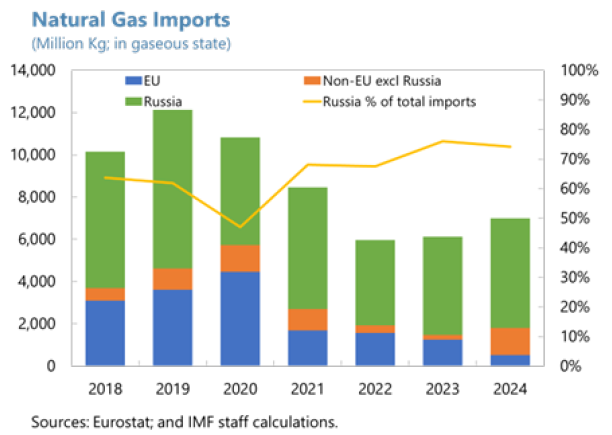
Despite recent progress in diversifying its energy production mix, Hungary remains heavily dependent on Russian energy imports, the International Monetary Fund (IMF) said in an August analysis (Article IV consultation Staff Report).
In 2024, Hungary covered about three quarters of its gas and oil consumption from imports, with
74% of the gas and 86 of the oil supplied by russia, compared to 64% and 66% in 2018.
In addition to high dependency, the IMF emphasised that energy flows rely on a few critical transit routes, such as the Turkish Stream pipeline through Serbia and the Adria pipeline through Croatia. This increases the risk of disruption. They write that efforts to diversify supplies, such as new imports from Azerbaijan and Türkiye, remain limited in scale.
Earlier this year, Slovakia and Hungary rejected the European Commission's plans to phase out Russian gas and other energy imports, further straining their relations with Brussels.
Hungary has been receiving Russian gas from the south via Bulgaria and Serbia through the TurkStream pipeline and increased its purchases from Gazprom last year.
Earlier this month, Szijjártó announced that Hungary had imported around 5 billion cubic metres of gas via the TurkStream pipeline through Serbia by the end of August. He added that this year's gas imports via TurkStream could reach an all-time high.
Hungary ships gas to Slovakia via an interconnector and also buys gas from Romania and in smaller volumes via the HAG pipeline, which runs from Austria into Hungary.
Cover image (for illustration purposes only): Getty Images


