This is how top decision-makers see the biggest challenges facing the energy sector

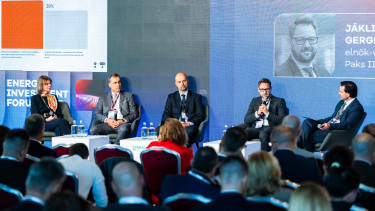
According to Károly Mátrai, CEO of the MVM Group,
unpredictability is one of the biggest challenges facing company managers,
with expected price developments causing great uncertainty, replied the CEO of the MVM Group when asked how daily price fluctuations affect investment scheduling and financial modeling. The business world manages risks, but this is also reflected in costs and prices, which can cause competitiveness problems at both the corporate and national economic levels.

According to Éva Pillár, executive director of METCE Hungary's electricity wholesale division,
it is important to distinguish between spot and forward market price volatility.
Price volatility is currently most noticeable in intraday prices, as peaks in supply and demand do not coincide in time. Price fluctuations are caused by physical constraints, so we expect that with the launch of a large number of energy storage projects in the future, this volatility in hourly prices will decrease significantly.
Gergely Jákli, President and CEO of Paks II, said that not all SMRs will be suitable for installation everywhere, and logistical difficulties may also arise in the case of small modular reactors.
In addition, there is no European value chain for the technology,
pointed out the expert, who believes that the optimism surrounding the renaissance of nuclear energy is exaggerated. Two large nuclear power plants have been built in Europe in the last two decades, meaning that there is no real benchmark market for nuclear power plant construction, so a sobering moment may also come in the countries where they are being built, he said.
According to Gábor Králik, deputy chairman of MEKH responsible for energy, investors must consider the plans thoroughly, while the Office only checks whether the player has sufficient capital to enter the market.
In any case, there is probably no power plant in the world that has paid for itself according to its original business plan, and this will continue to be the case,
he said. In his opinion, any operator who builds a power plant solely for the purpose of arbitrage should take responsibility for their own actions.
According to Károly Mátrai, vertically integrated energy companies are more crisis-resistant and have greater economies of scale, which is why they are experiencing such a renaissance today; such large companies are increasingly being established and gaining ground. The MVM CEO believes that
it is important to maintain a healthy balance between traditional and renewable sources,
as highlighted by the major power outage in Spain in April. We cannot overextend renewables, he said.

According to Gábor Králik, there is no such thing as ideal technology;
rather, the question is whether the new entrants will become cooperative members of the electricity and natural gas system
and how they will be integrated into the system. The expert believed that sooner or later, reverse power plants will also have to be included in the regulation of the system.
Éva Pillár emphasized that the MET Group, which now operates in more than 20 countries, also uses a wide range of flexibility solutions.
However, the value of flexibility varies significantly from country to country,
she added.
In her view, there is still plenty of work to be done and room for improvement in the area of flexibility tools, which she has divided into three categories in Hungary: solar power plants subject to accreditation, gas engines that have been regulated for several years now – which may already have visible commercial value – and so-called "don't touch" devices, i.e., production equipment that supports industrial processes.
She added that the inclusion of the third group of instruments is still a question for the future, as it requires a market player with the appropriate expertise and capital to integrate these instruments effectively. Referring back to the presentations in the opening segment, the expert confirmed that
although gas will continue to be part of the energy mix, its importance will decline.
The role of LNG in the future will be to fully replace the role previously played by piped gas.

Gergely Jákli said that, looking at the prospects, if we consider the new grid-connected generation capacity expected to come online in the next 15-30 years and
the many nuclear power plant investments that have begun in the region,
this is expected to result in an increase in baseload power generation and a decrease in price volatility in the future, even with the expected increase in demand. (Conventional nuclear power plants are most efficient at around 90% capacity utilization and are less suitable for flexible operation from a financial and technological point of view.)
Károly Mátrai pointed out that Hungary is well connected to its neighbors in terms of electricity and natural gas infrastructure. However,
in recent years, there have been problems with the transmission capacity of neighboring countries, which has limited network capacity,
he said.
Regarding the lack of necessary developments, he said that Europe shows a complete lack of solidarity, which also hinders regional developments. He said that cooperation between national TSOs (system operators) is also a key issue, and that the creation of interconnectors and cross-border capacities has been a major step forward in recent decades, which could also make it possible to break away from Russian gas.
When asked about the role of PPAs, Éva Pillár replied that
long-term power purchase agreements may have a bright future ahead of them, and interest from customers is growing,
but currently they only cover 2% of consumption needs. Signing a PPA means a 10-15 year commitment, and it is very difficult to predict economic and business developments over such a long period, but more and more users are considering complex solutions for their energy management and covering at least part of their energy procurement with a stable, predictable source in the long term.
In his response, Károly Mátrai also pointed out that,
given the uncertainties, it is very difficult to sign a 10-year fixed-price electricity supply contract,
so although there will be demand for the scheme, the MVM CEO does not expect PPAs to achieve a double-digit market share. At the same time, circumstances are changing, and long-term contracts are sometimes more popular and sometimes less so, he pointed out.
According to Gergely Jákli, the Sizewell C nuclear power plant currently under construction is also being built under a PPA-type arrangement. However,
digitalization has been less prominent in the nuclear industry in recent years, partly due to market weakness, but digitalization is essential in many areas of this industry, from documentation and investment control to rapid response.
However, there are also legal restrictions in this area; for example, drones are not allowed to fly or scan the construction site in the vicinity of the Paks II investment.
Cover photo: Portfolio


