Equity
OTP buys banks in Bulgaria, Albania - Was it worth it?

How large are the banks OTP is buying?
OTP has announced on Thursday the acquisition of Societe Generale’s Bulgarian and Albanian units, Expressbank and SocGen Albania. Both banks are relatively large on their respective markets. The Bulgarian bank is the 7th largest with a 6.7% market share and the Albanian unit is the 5th largest with a 5.7% market share. Compared to OTP Group they are extremely small, of course. While OTP has total assets of HUF 13,511 billion, Expressbank’s balance sheet total is HUF 1,150 bn and SocGen Albania’s is nearly HUF 220 bn. Looking at OTP’s previous acquisitions we find that the Bulgarian bit can be considered a big one. In fact, strictly on a total assets basis, OTP has bought a larger bank than Expressbank only once.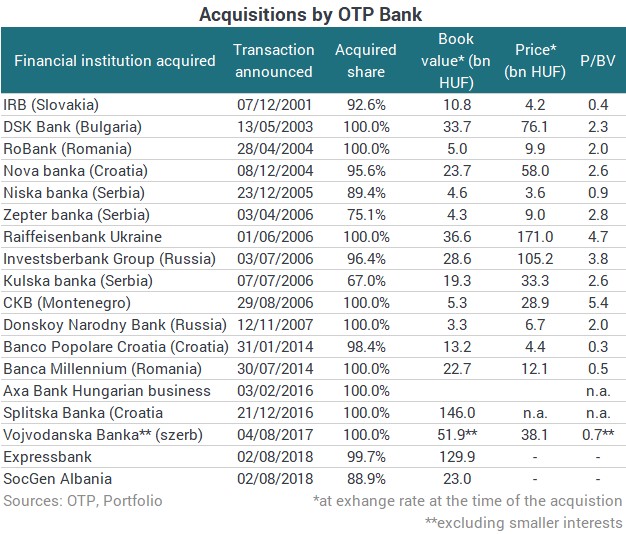
Are the Bulgarian and Albanian units of high quality?
Basically, they are, but there is still room for efficiency improvement. Both banks are profitable; their revenues and profits grew over the last few years.


How large will OTP be in Bulgaria and Albania?
OTP’s Bulgarian arm DSK has been the second-largest bank on the local market. By purchasing Expressbank, OTP will become the largest bank of the country, taking over the pole position from the local operation of UniCredit.

How much will the acquisitions add to OTP’s size?
Total assets of DSK reached HUF 1,978 bn at the end of March, to which Expressbank will add nearly HUF 1,150 bn (as of end-2017), i.e. the balance sheet total of OTP’s Bulgarian operation will jump by 58%. Total assets of the Albanian bank was HUF 219 bn at the end of June, and the two newly acquired banks could boost OTP’s total assets by nearly 10%. Portfolio estimates that the share of the Bulgarian operation within OTP group could rise to 21% from the current 15%. And the Albanian unit will cease to be the smallest one in the group, and it will replace the Montenegrin OTP in terms of total assets.
The number of branches could go up from 1,481 as of end-March by 151 (Bulgaria) and 38 (Albania), i.e. nearly 13% to 1,670. The number of employees in the group may rise from 35,309 by 1,621 (Bulgaria) and 413 (Albania), or 5.8% to 37,343, excluding potential layoffs at the two newly acquired units.

How much could have the Bulgarian and Albanian banks cost?
OTP did not disclose the purchase price for either transaction but we can still make an educated guess:- considering the previous acquisitions it is safe to assume that OTP did not pay book value for any of them;
- secondly, Chairman-CEO Sándor Csányi said in an interview with Portfolio last November that OTP investment strategy is conservative, and multipliers of around 1x are better than those of 1.6-1.8x.
Consequently, we estimate that OTP bought the banks somewhere around book value. It might have paid slightly more, though, considering that these are high-quality assets (especially the Bulgarian operation), and also because they bought relatively large players on their respective markets. The table below contains three possible scenarios. The first one is that OTP acquired the banks at book value. In the second, we used an average multiplier of banking stocks in the region, and - just for the sake of showing something interesting - we also toyed with the idea that Hungary’s largest bank acquired the Bulgarian and Albanian units at its own valuation. At book value, the banks would cost nearly HUF 150 bn; the 1.3x P/BV of CEE banks would cost OTP about HUF 195 bn, and at OTP’s own rate the bottom line would be around HUF 232 bn. At book value, the two banks would cost as much as OTP has recently paid for Croatia’s Splitska banka. The only time OTP paid much more than this for a bank nominally was in 2006 when it coughed up over HUF 170 bn for a Ukrainian operation.