Shocking proposal by the IMF: Hungary should put a cap on 'superbond' purchases


Domestic or non-resident investors?
The IMF's note describes and discusses potential implications of recent changes in Hungary’s public debtstrategy. Special attention is paid to the motivation for, and recent experiences with, the “HungarianGovernment Security Plus Scheme” (MÁP+) for physical persons, introduced in June 2019. One of themain benefits of retail bonds is that they usually are perceived as more stable funding. However, it isargued that MÁP+ should be continuously monitored to ensure its objectives are achieved in the mostcost-efficient manner and to avoid unintended distortions.
Click on the links below for more about the IMF's country report on Hungary:
The Fund stresses that the choice between domestic and foreign currency denominated and external funding should strive to achieve a broad investor base with due regard for cost and risks, while treating investors equitably.
For instance, continued presence in international markets may facilitate access if suddenly needed. On the other hand, unhedged foreign exchange rate risks can be costly in case of volatile markets. Moreover, foreign investors may suddenly change behavior due to unrelated external events, which can be disruptive, particularly in case of illiquid markets. It can also be useful to consider a sovereign asset-liability management approach to gage the financial risk exposure of the public sector as a whole.
Attention to the external exposures of the private sector and its market access may also be warranted.
Even if there is no immediate need from a public debt perspective, there could be other reasons, like the need to boost international reserves to influence the perceived sovereign risk, or if the government is able to raise foreign currency much cheaper than the private sector, depending on the private sector saving-investment balances.
The IMF also highlighted that external vulnerability of Hungarian public debt has been significantly reduced. The decline in the share of both FX denominated and nonresident held government securities is appreciable. When Hungarian public debt peaked in 2011, foreign currency denominated debt amounted to 48.5% of central government debt .
This share has since been more than halved to 18.25% by September 2019. The decline was facilitated by adecline of the share of government securities held by non-residents from about 40% to just below 25% during the same period. This has been mirrored by an increasing share of residents’ holding, particularly of retail government securities, mainly held by households, but also wholesale bonds held by financial institutions, primarily banks.
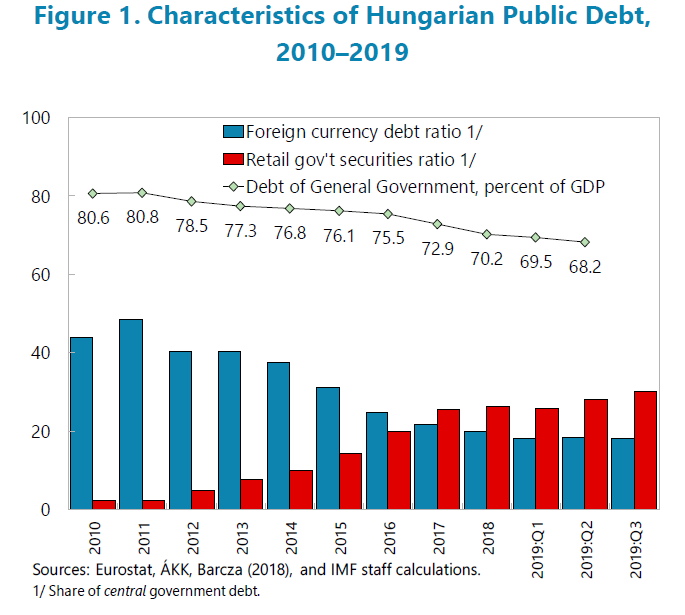
As regards the sales of the MÁP+, the IMF says it is too early to assess whether the objectives are being achieved, but the initial demand has exceeded expectations. As of end-September 2019, about HUF 2.1 trillion (just over 4.5% of GDP) MÁP+ had been issued, while total retail government securities amounted to about 19% of projected GDP.
Almost half of purchases appear to be funded from roll-overs and sales of other retail government securities. Another 10-15% are from investment funds, including property funds. It is estimated that around 10% of the funding has come from bank deposits. Market observers estimate that up to 10% of the funding has come from a smaller increase in currency in circulation.
The remaining part reflects increased savings. According to some market observers, many new accounts for these securities have been established, but about 70%of the sales have been to account holders with addresses in the capital area. Anecdotal evidence suggests that the interest for residential housing for investment purposes in Budapest has eased after the introduction of MÁP+.
Potential Implications of MÁP+
The IMF puts the spotlight on this issue from various perspectives. Here are a few of these:
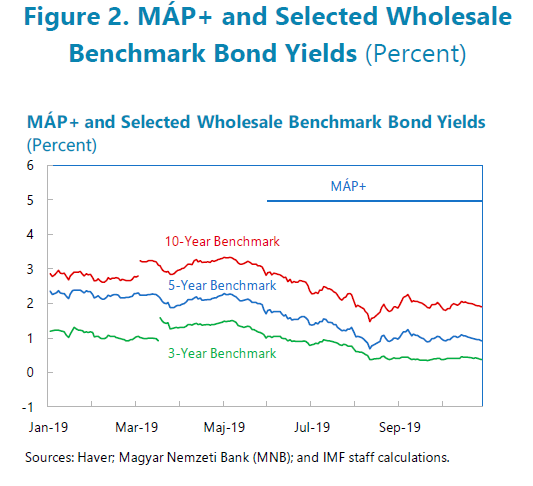
- The return on MÁP+: The return on this security is above the market but the authorities consider it a fair price to pay for the aforementioned objectives. MÁP+ are nominally costlier for the budget than current domestic wholesale or external funding (see chart below). Although the initial interest rate on the MÁP+ is 3.5%, the simple average annual yield is, as previously noted, 4.95%. The latter should be compared to the yield on the domestic 5-year domestic wholesale benchmark, which has declined from 1.7 to a record low 1.0% between mid-June and September. The Hungarian government has not recently issued a Eurobond, but with the current CDS spreads and swap rates, this alternative also seems cheaper. However, when the interest rate on MÁP+ was originally determined, it was only about 20 bp higher than the yield of a 5-year inflation-linked retail bond (PMÁP), based on the MNB’s inflation projections at that time.
- Opportunity cost: A few market observers are of the view that the same demand could havebeen achieved by a lower yield. If they were to be right—which is a strong assumption— perhaps, it would have been possible to achieve similar sales by an effective yield of 3%. The excess pricing solely due to the MÁP+ issued during Q3 2019 would have cost the budget an extra HUF 41 billion, or about 0.1% of GDP. However, compared to the 5-year wholesale benchmark interest rate (1.01 in September 2019), the additional budget expense is larger (almost 0.2% of GDP).
A paper recently published on Portfolio by MNB staff also shows that the average spread over markets rates has been between 3.3 and 3.6 percentage points over the last few months. The return of MÁP+ on certain maturities is 0.3-0.75 percentage points higher than the interest paid on other retail government securities. In view of that, we estimate that to achieve the HUF 1,100 billion excess MÁP+ issuance targeted by the retail government security strategy of the National Debt Management Agency's (ÁKK) it costs the state about HUF 27 bn more annually (including commission costs) than if instead it had been issuing retail government securities and other market instruments in the same proportion as in the last few years. The state argues that these costs could be mitigated if households are gently nudged towards making their purchases directly at the State Treasury.
- Arbitrage opportunities: The IMF says Hungarian authorities are trying to contain potential arbitrage opportunities. Some dealers were initially promoting MÁP+ to foreign individuals. ÁKK has since encouraged those dealers to focus their sale efforts on residents. Nevertheless, according to market observers, it is still possible for individuals with good credit rating to borrow abroad in euros, convert to HUF, buy MÁP+, and swap the return in HUF back into euros, and still make a profit— which partially reflects the sovereign risk. Another opportunity initially limited but explicitly prohibited effective October 14, 2019, was to use MÁP+ as collateral for loans with Hungarian banks, for instance to buy additional bonds.
- Other fiscal and market considerations: In addition to borrowing costs, there are other fiscal considerations. The higher funding costs of MÁP+ will increase the budget deficit, but the extension of maturities could reduce the annual gross financing needs in the near term. The average maturity of the retail portfolio has already increased from 18 to 30 months. MÁP+, however, is akin to a reduction of the personal income tax on savings. While it has been designed to be accessible to all individuals, the wealthier individuals are likely to benefit the most. In addition, the bond may be effective in reducing spending and the demand for real estate of the middle class, it is less convincing that the wealthy individuals would behave in the same way. Instead, they might move their investments from riskier investments to the safer MÁP+. The impact of exempting interest earnings of government securities from taxation seems ambiguous, as it may influence the distribution of savings toward government bonds and away from other financial assets. Finally, while tax revenue can increase somewhat due to the higher interest income generated by MÁP+, this would be moderate since interest income of government securities for individuals is no longer taxed. The additional tax revenue would only come from VAT on any increased spending generated by the bonds.
The MNB believes that spending the return paid does generate VAT revenues, although this happens with a delay.
- Monetary and credit policy implications: MÁP+ mitigates the adverse impact of negative realinterest rates on households—a consequence of the accommodating monetary policy. Arguably,MÁP+ could even enable prolonging the accommodative monetary stance: the adverse impacton private consumption and housing investment of the very accommodative monetary stance isnow contained and would thus be less likely to necessitate an early tightening. Generally, theaccommodating monetary policy contributes to aggregate demand, including privateconsumption and investment of households, while the objective of MÁP+ is to boost savings ofhouseholds and curtail aggregate demand. Finally, some recalibrations of day-to-day liquiditymanagement by the MNB are needed to account for the share of bank deposits and cash incirculation used to buy MÁP+.
What should be done with MÁP+?
A key objective of public debt management is to strike balances between reducing the cost of funding and limiting vulnerabilities.
MÁP+ has many reasonable objectives, although some of them, such as higher a savings rate of households and reduced external indebtedness, are to a major extent driven by macroeconomic policies.
Going forward, the question remains whether these objectives can be achieved by appreciably lower cost to the budget given less expensive alternative funding sources and policy options. Ultimately, it is a political decision how to weigh the opportunity cost of reducing external vulnerabilities, refinancing risks, maintaining a high savings rate of households, reducing cash hoarding, and how to redistribute budgetary resources.
However, a few market observers believe that the same objectives could be achieved at less cost and with fewer distortions.
Some presence in and continued access to diversified markets—including international markets—are also important and appear to be much cheaper than the MÁP+ given current market conditions. All other things equal, during Q3 alone, MÁP+ has cost the budget almost 0.2% of GDP extra per year compared to the similar domestic wholesale benchmark bond.
Hungary’s external vulnerabilities have declined significantly since the global financial crisis due to active public debt management and external debt is projected to decline even without MÁP+. The shadow price of further reducing foreign currency denominated and external funding risks thus reveals the authorities’ perceived risks of new external shocks.
Public debt management also needs to respond to changing market conditions. A good example in this regard is the ÁKK’s decision, announced late October 2019, to lower the interest rate on some retail bonds beginning early November 2019, as well as to cut the distribution fees to banks beginning 2020.
As the authorities continue to issue retail bonds, they may want to continue to review their programs, including MÁP+—ranging from pricing, maturities, to sales channels—as market conditions continue to change.
Consideration should also continue to be given to diversification and presence in international markets.
The IMf thinks it could be a problem that there is no cap on the amount of máp+ households and individuals may purchase which provides potential arbitrage opportunities. consequently, an upper limit to máp+ purchases should be considered and its future return should be adjusted more to the government security yield curve.