Mol finds oil on the outskirts of Vecsés


Mol finds significant quantities of oil
In 2015, Mol won the exploration concession for the area around Vecsés, and after preliminary geological investigations, the exploration well site was selected on the outskirts of the municipality. The drilling, which started in July, lasted 31 days and reached a depth of 2100 metres. The well tests required at this time proved that
the oil was suitable for economic use, and the well was made operational on 11 November.
The oil is transported directly to the Dunai Refinery in Százhalombatta.

"Every drop of oil extracted in Hungary contributes to reducing the country's energy dependence, which is why we are delighted with this success. The reserves currently in production are being depleted, it is part of a natural process. We are making a huge effort to keep production at the same level, Mol has spent HUF 133 billion in the last 5 years, otherwise our production would decrease by 15-20% per year. During these years we have achieved significant successes in domestic exploration, for example, we have discovered and brought several shallow gas fields into production. The Vecsés drilling strike, on the other hand, led to the discovery of a deeper oil field, on the basis of which Mol plans to drill further wells in the area to exploit the field and increase production," said Zsolt Hernádi, CEO of the Mol Group.
Mol is the largest producer of hydrocarbons in Hungary, and in 2021 the oil company supplied about half of the domestic production of crude oil (3.5 million barrels) and about 90% of natural gas (1.4 billion cubic metres). Hungary is also the largest country in the Mol Group's oil and gas production portfolio, currently accounting for one third of its total production. Mol is implementing a continuous programme of work, meaning that projects are being carried out simultaneously in several parts of the country, with around 300 wells completed and 16 new wells coming on stream in the last 5 years. In the shallow gas exploration programme, 13 new wells have been brought on stream so far. Without investments in the range of hundreds of billions of dollars, domestic production would have fallen to less than half of current levels in the past 5 years, the statement said.In the next 5 years, Mol plans to invest almost HUF 200 billion in the development of oil and gas production in Hungary, of which 60-65% will be for natural gas, 20-25% for oil, and the rest for the safe maintenance and replacement of infrastructure, the statement said.
Growing difficulties in supply
In recent days, the oil company has been in the spotlight several times, for example, last Friday it was announced that refuelling at all domestic service stations would be restricted again, with the limit on fast-fill pumps now being 100 litres per transaction. And before that, it was also reported that according to a message sent to Mol's partners, "in the interests of the country's operations and energy supply", they would not be able to supply them with diesel and petrol for the week starting today, 21 November.
From today, Mol will stop supplying fuel to 194 small stations, the temporary restrictions are indefinite, and there are several reasons for the decision, including the need to carry out maintenance work at the Dunai Refinery.
According to the Independent Petrol Stations' Association (FBSZ), a nationwide fuel shortage is coming,
and they have published a recent list of municipalities where fuel shortages at small pumps are possible.As the fuel price freeze has proved difficult to maintain from the outset and has been highly distortive of market conditions, the government has in recent months revised the fuel price cap in several rounds, in addition to quantitative regulations, successively exempting a growing share of consumers from the price freeze. The government imposed the official price of HUF 480 on 15 November last year and extended it in several steps until the last day of the year. In the meantime, it has narrowed the scope of those eligible to buy at the reduced price, excluding, among others, heavy goods vehicles, foreign vans, cars with foreign registration plates and company cars:
- In early March, the Hungarian Road Transport Association (MKFE) started to raise voices about the disruption of the supply chain, and the government responded by presenting measures at a briefing to address the fuel market with the aim of maintaining the fuel price freeze and security of supply. Among other steps, for the first time, the scope of those entitled to the fixed petrol price of HUF 480 was narrowed, with Hungarian vehicles over 7.5 tonnes and foreign vehicles over 3.5 tonnes now only being able to fill up at high-pressure pumps at market prices.
- Then, at the end of May, it was announced that Hungary was imposing different fuel prices for vehicles with foreign plates and those with Hungarian plates. Vehicles with Hungarian registration plates, including tractors and agricultural machinery with Hungarian documents, could fill up at official prices 60-70% lower than market prices (at the time). Conversely, all vehicles with foreign plates lost their entitlement to reduced fuel prices. The European Commission has also taken Hungary to the European Court of Justice over this decision, calling on the Hungarian authorities to comply with EU law on the free movement of goods and services, including transport services, the freedom of establishment, the free movement of citizens and workers, the principle of non-discrimination and the notification rules under the Single Market Transparency Directive.
- At the end of July, another restriction was introduced, and the HUF 480 price has since been maintained only for private vehicles, taxis and agricultural machinery. As a prelude to the tightening, Mol announced the shutdown of the Százhalombatta refinery for maintenance, which has made the supply of petrol in the country more difficult - Gergely Gulyás, Minister of the Prime Minister's Office said that the two ways of supply are imports and strategic stocks, the latter being possible only up to a certain limit, and that imports were not an option because foreign companies could not afford to export to Hungary at this fixed domestic price. Therefore, the government decided that, while releasing part of the stocks, the HUF 480 price would be maintained only for private cars, taxis and agricultural machinery, effectively excluding company cars - shortly afterwards, sources close to the government told us that about 20% of all cars, about 800.000 could be company cars.
- From 1 October, fuel retailers will again have to pay a stocking charge for petrol and diesel at the official price. Since 1 July, the charge has been set at HUF 1990 per litre for petrol and HUF 1 864 per litre for diesel, and it was known in advance that the charge would be an incentive to increase the price of officially priced fuels, even though they are not directly affected by the recent change.
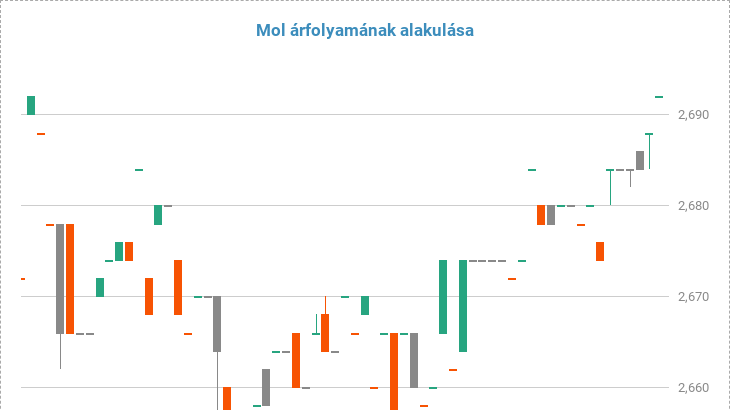
Exchange rate reaction
Mol investors have not yet reacted to the latest news from Vecsés, with the share price currently trading at a minus 0.4%.
Cover photo: Mol