Hungarian public no longer the largest creditor of the state


The order of public debt financing reversed again
October was the first month in which the public became the largest creditor of the state, but November brought another shift.
The share of government securities held by Hungarians fell to 27.3% at the end of November, but this is still the second highest share in the ownership breakdown.
Thus, once again, foreign players took first place, with a government bond market share of more than 29%. Among the main holders, credit institutions' share of government bonds was 26.2%, putting them in third place:

Investment fund portfolio growth exceeds HUF 1 billion
The government bond bandwagon is still not performing very well, if we look at the National Bank of Hungary's (MNB's) latest securities statistics:
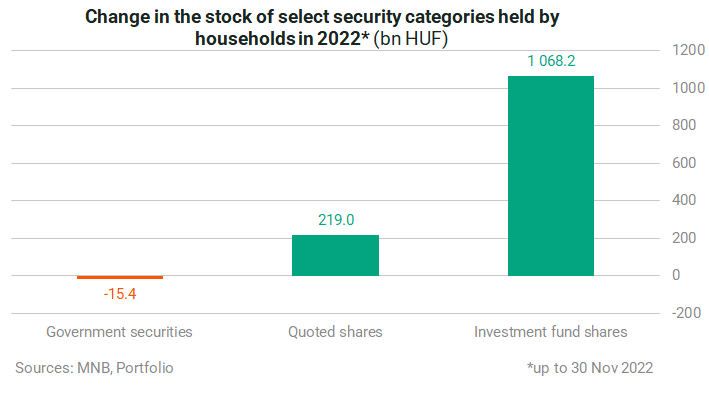
As of November, government securities remain the only category among the main securities whose holdings have decreased compared to December 2021 levels within household savings.
The redemption rate of retail government bonds has not eased in December either, and the fall in assets is clearly due to the Hungarian Government Bond Plus, which could not be offset by the increased demand for Premium Hungarian Government Bonds (PMÁPs).
Meanwhile, retail savings in investment funds are enjoying a new heyday: at the end of November, more than HUF 5,783 billion in savings were already managed, and thus the increase in wealth by November exceeded HUF 1,000 billion. According to recent data, the stock of savings in shares also increased by more than HUF 200 billion in the first 11 months:
One government bond in high demand
Despite the fact that the stock of government securities held by households fell in the first 11 months of last year, it exceeded the HUF 10 thousand billion level again in November, while the stock of HUF government securities held by households amounted to only HUF 8646 billion. A significant part of the difference can be explained by the increasingly popular Discount Treasury Bill, which swelled to €852 billion.
The rise of Discount Treasury Bills (DKJs) started last year, in parallel with the rise of the base rate and bond market yields. Of course, this is not surprising, given that
the 12-month DKJ already offers yields well above 13%, but even 3 and 6-month Treasury Bills are tempting with annual yields above 13%.
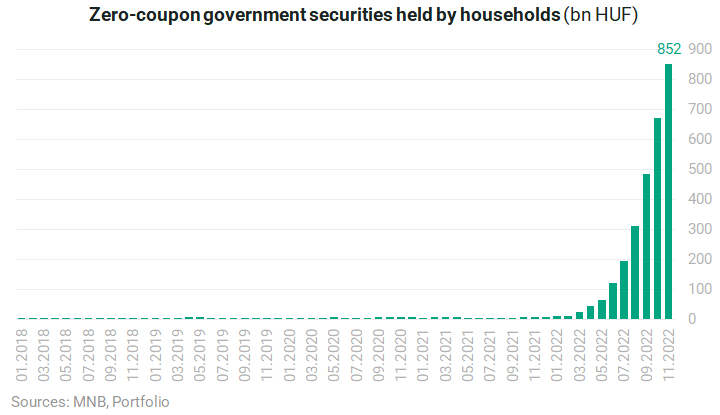
Thus, Hungarian households' holdings of government securities were able to grow to over HUF 10 thousand billion by the end of November, mainly thanks to the demand for DKJ. Investment fund holdings showed a significant increase of over HUF 300 billion in one month, but household equity holdings also grew by over HUF 100 billion, despite negative capital flows in November. Although not shown in the chart below, it is also worth highlighting the bank bond category, which saw a more significant accumulation of household wealth in November, with holdings swelling from HUF 87bn to HUF 134bn at the end of October.

The public on the lookout for bond and financial market funds
As we have already pointed out, the stock of household investment shares shows a large variation, which is also related to the higher interest rates in financial markets:
money market and bond funds are attracting more and more household money each month, to the extent that since the beginning of last year, the value of household savings in money market funds has increased 23-fold (from a low base) and bond funds have seen a 2.5-fold increase.
That still leaves mixed funds with the largest amount of retail savings (nearly HUF 1550 billion), but bond funds are rapidly catching up (HUF 1404 billion).

Cover photo: Shutterstock