Hungary retail gov't securities erase 3-year growth, HUF 1.4 trillion of savings withdrawn


Stock down HUF 1.4 trillion in 2022
Despite the redesign of the Premium Hungarian Government Security and the Bonus Hungarian Government Security, the erosion of the stock characterising the whole of 2022 failed to be broken, and so
HUf retail government securities ended the year with a stock of huf 8,620 billion, down by nearly huf 1,400 billion over december 2021.
Although there was not such a big decline in December in terms of assets under management, the outflow of funds from the MÁP+, which was visible throughout the year, had its effect: retail government bonds practically wiped out the increase in holdings of the past 3 years.

As we have pointed out, the decline in retail government bonds is clearly driven by disillusionment with the Hungarian Government Security Bond Plus (MÁP+).
THE STOCK OF MÁP+ FELL BY A FURTHER HUF 243 BILLION IN DECEMBER ALONE, AND IN ONE YEAR THE PAPER HAS LOST HUF 3,927 BILLION IN SAVINGS, I.E. MORE THAN 60% OF ITS END-2021 STOCK.
This brings the stock of the former 'superbond' back to its October 2019 level, erasing three years of its history:

Inflation-linked gov't security was the hottest item in 2022
The stock of the inflation-linked premium government security (PMÁP) rose to an unprecedented level as MÁP+ savings declined, exceeding HUF 4,320 billion by the end of December, an increase of nearly HUF 2,120 billion in a year.
This means that last year, the PMÁP had the largest portfolio among retail government bonds, way bigger than the máp Plus.
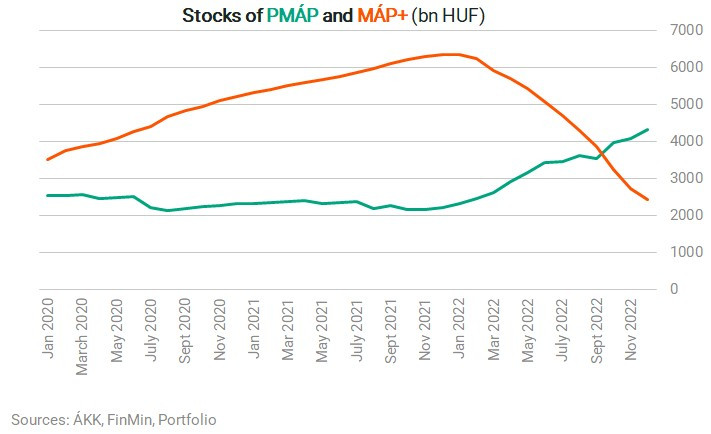
While it is not surprising that in last year's high inflation environment a significant part of savings flowed out of the low fixed interest rate MÁP+, it is also clear that the PMÁP was only able to absorb part of the outflow, with large amounts going into bond and money market funds, as well as institutional government securities such as the Discount Treasury Bill.
The Bonus Hungarian Government Security (BMÁP) attracted some of the savings last year, with the renewed scheme closing last year with HUF 515 billion in assets. Meanwhile, like the MÁP+, the stock of the One-Year Hungarian Government Security also declined last year, with the year-end stock standing at HUF 808 billion after a yr/yr decline of HUF 193 billion, despite the fact that the ÁKK raised the interest rate on this security in December, although the 9% annual interest rate is still below the yield levels available with discount T-Bills practically throughout the year.
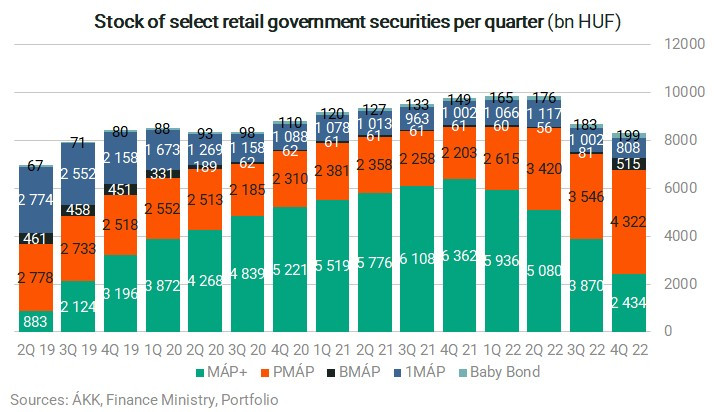
We'll see what this year brings for the retail government bond market, now that premium government security will bear a higher interest, thanks to last year's extremely high inflation. The Government Debt Management Agency (ÁKK) plans to launch another new government bond this year, but the question is whether a fixed-rate scheme will attract meaningful funds in a still rising inflation environment.
Cover photo: Getty Images