Government securities? Nah. It's amazing what Hungarians went for last year!


Highlights of the article:
- Investment funds have made quite a splash in retail savings, with bond funds taking the lead.
- There has been a clear rebalancing of the Hungarian government bond holdings, but even the surge in the popularity of Treasury Bill has not been enough to boost their stock.
- The amount of money held in bank deposits has not changed much in a year, while savings held in long-term investment accounts (TBSZ) are falling.
- Once again, foreigners hold most of Hungary's public debt.
Investments funds take off
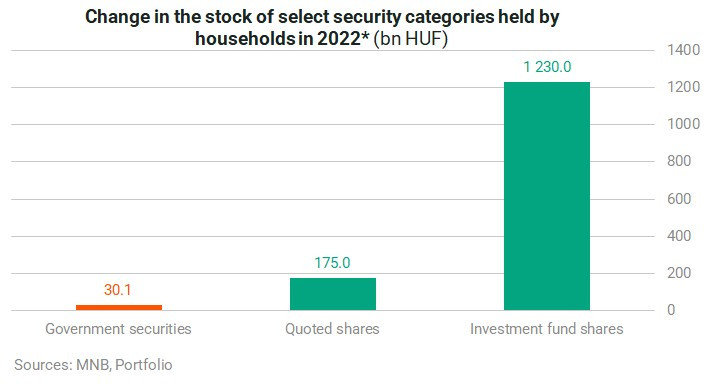
Investment fund holdings have shown a spectacular growth last year. According to the Hungarian central bank's (MNB) latest securities statistics, the stock of investment fund shares held by households increased by more than HUF 1,200 billion in one year, almost reaching HUF 6,000 billion at the end of December.
The picture is quite different if we look at the change in the stock of government securities, where we mostly see stagnation, with just over HUF 10,000 billion on record at the end of the year. As we have written several times, this is clearly the 'fault' of retail government bonds, and within this, primarily the Hungarian Government Security Plus (MÁP+), a.k.a. 'superbond'.
It is also worth highlighting the holdings of quoted shares, where we had the second largest asset growth after investment funds last year, with a HUF 175 billion increase, bringing the total equity holdings of households to nearly HUF 1,200 billion at the end of the year.
Government security holdings of households rebalanced
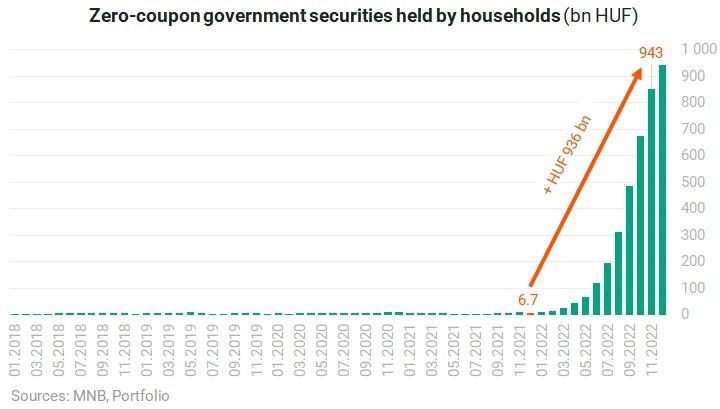
The situation of government securities is also interesting in the sense that, despite a staggering increase in the stock of Treasury Bills in 2022, the stock of government securities within household savings only managed to stagnate.
BY THE END OF DECEMBER, THE STOCK OF t-bills held by households HAD SWOLLEN TO HUF 943 BILLION in 12 months from ALMOST zero.
The rise in T-bill holdings has gone hand in hand with the rise in the base rate and bond market yields, which is not surprising given that the 12-month T-bill already offers a yield of nearly 14% and the 3-month Treasury Bill is offering an annual yield of over 14%.
There is therefore a clear shift in the holdings of Hungarian government securities: while the share of retail government securities is decreasing, the share of institutional papers (such as T-bills) is increasing.
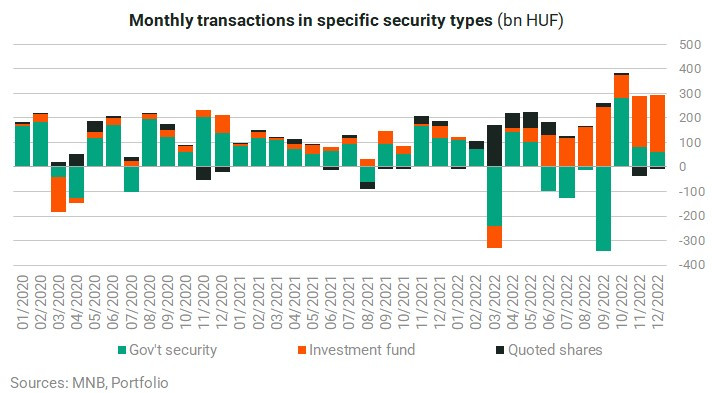
Nevertheless, it is still true that the government securities category failed to attract substantial fresh retail funds in 2022, but rather a reallocation was observed. Last year, the total amount of new allocations in government securities by Hungarians was below HUF 30 billion.
The situation is different for investment funds, which boast absolutely outstanding figures: last year, a total of HUF 1,185 billion in fresh savings flowed into this category, but even within this some rearrangement took place (details below).
Hungarians were also fond of quoted shares, with HUF 364 billion net savings placed there in last year, but the stock grew only by HUF 175 billion from December 2021, i.e. half of the fresh money was lost to the population due to the change in the exchange rate.
Bond funds take over
As we have already pointed out, the stock of investment fund shares held by households shows a massive change, which is also related to higher interest rates on the money market:
money market and bond funds attracted more and more retail money each month last year, so much so that by the end of the year, bond funds managed the largest retail assets (dethroning mixed funds).
By the end of December, there were HUF 1,592 billion of household savings in bond funds, followed by mixed funds with HUF 1,520 billion and real estate funds with HUF 1,056 billion.
Money market funds swelled from HUF 10 billion at the beginning of the year to HUF 283 billion by the end of the year.

Bank deposit stock flat too
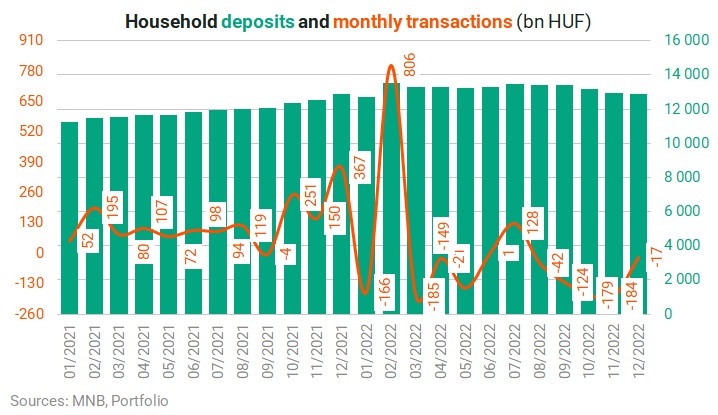
Last year, there was not much growth in bank deposits either, with the stock rather stagnating at HUF 12,850 billion at the end of December. 2022 was dominated by negative transactions in the bank deposit market, with a total of HUF 132 billion of net assets withdrawn from this asset category.
TBSZ: fewer accounts, smaller savings
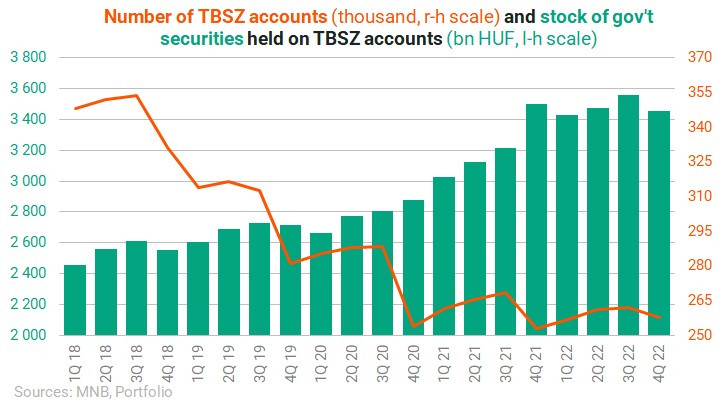
Hungarians are finding Long-Term Investment Accounts (TBSZ) less and less attractive, with the assets and number of accounts decreasing quarter by quarter. The fact that government bonds issued since June 2019 are exempt from interest tax, so the tax-saving advantage of TBSZ has been greatly eroded, is clearly playing a role in the fading attractiveness of this savings vehicle.
Most debt held by non-residents
It was last October that the public first became the largest creditor of the state, but since then the rest of the world has again assumed this role.
THE SHARE OF HUNGARIANs' GOVERNMENT security holdings FELL TO 27.6% AT THE END OF DECEMBER, BUT IT IS STILL THE SECOND HIGHEST SHARE IN TERMS OF OWNERSHIP.
The share of the rest of the world in the government security holdings reached 29.4%. Among the main holders, credit institutions' share of government securities is 25.4%, ranking third:

Cover photo: Getty Images