Hungary Mol posts record profit in 2022


Record profit is here
We already wrote in our analysis preceding Mol's preliminary earnings report that after the records of the third quarter, Mol could again produce exceptionally high figures in the last quarter of 2022, although the consensus of analysts did not project new records from the oil company due to falling energy prices and the narrowing Brent-Ural spread.
Parlty due to the sligthly narrower margins, Group EBITDA (addressed in more detail later) declined by 26% compared to the Q3 record, but it was up 21% in annual terms, while EBIT jumped 55% yr/yr.
Mol's net profit was in negative territory, though, at USD -106 million in Q4. It is worth noting here, however, that a significant portion of last year's income tax expense ($612 million out of $1.223 billion) was recognized in the fourth quarter.

Overall, the oil company exceeded analysts' expectations in most segments, with Downstream being the only area where Mol failed to meet the consensus forecast. Total EBITDA came in 3% higher at USD 29.5 million, with Upstream exceeding expectations by 6.6% and Downstream falling short by 29.4%. Overall, this was offset by the performance of the Gas Midstream and Consumer Services segments, which thoroughly surprised analysts.

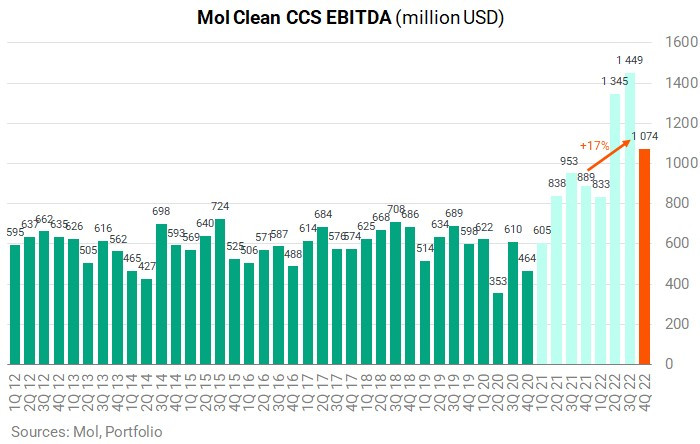
Fourth-quarter EBITDA thus "consolidated" somewhat after the record-breaking second and third quarters, but still came in at USD 1,074 million, an increase of 21% from the very high level in Q4 2021. In the last decade, the company's quarterly EBITDA has averaged around $660 million, and now Mol has almost doubled that. (Mol signed an agreement with Waldorf regarding the sale of its entire Exploration & Production portfolio in the UK, so the figures have been adjusted with retroactive effect to include this as a discontinued operation, and the figures are shown in light green in the graphs without the North Sea Upstream portfolio figures.)
A good indication of the extremity of last year is that
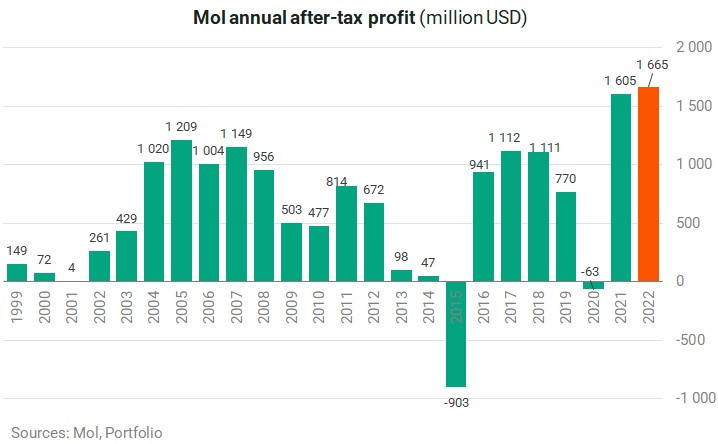
DESPITE THE LOSS IN THE LAST QUARTER, MOL achieved an all-time high profit in 2022,
with its after-tax profit reaching $1.665 billion. The result is not surprising, of course, after the oil company posted unprecedented figures twice in a row in Q2 and Q3.
Deceleration and risks
Mol has had an incredibly successful year, thanks in particular to its steady access to cheap Russian oil, while it was and still is pricing most of its products at world prices that are high compared to Russian prices, which has allowed the company's margins to be particularly wide. And although the spread had narrowed somewhat from the previous level of over $30 at the end of August and was between $23 and $24 for much of the fourth quarter, by the end of November spreads had returned to around $30, which is how much cheaper Russian oil was than Brent.

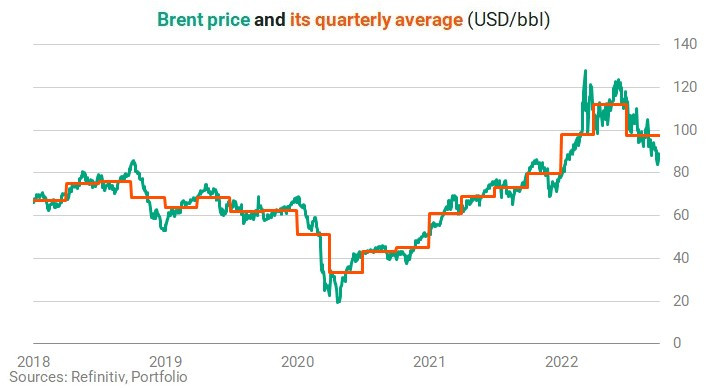
The significant narrowing of the Brent-Ural spread compared to the second and third quarters was mainly due to the decline in world prices. As energy security risks for this winter have faded into the background, recent months have been and continue to be about steeply falling energy prices, including lower oil prices. The benchmark Brent crude oil price is currently below $85 per barrel, even though Russia announced a few days ago that it will voluntarily cut the country's oil production by 500,000 barrels per day in March, or around 5% of production.
As a current systemic risk element potentially affecting Hungary and Mol, it is worth highlighting here that the 500,000 barrels of Russian production cutbacks aimed at raising oil prices is not yet clear how it will affect the imports of Russian crude oil to Hungary via the Friendship II pipeline, since Hungary also participates in the Western sanctions measures with tacit approval, thus complying with the principles of the price cap, which makes it an "unfriendly" country in Russia's eyes.
Shortly after announcing the 500,000 barrel per day reduction in oil production, Russia’s Deputy Prime Minister Alexander Novak said his country
PLANS TO SELL MORE THAN 80% OF ITS CRUDE OIL EXPORTS TO “FRIENDLY” COUNTRIES THIS YEAR.

Upstream
But returning to the current fourth quarter figures, the gap between the hydrocarbon price realized by the company and the extraction cost has widened in recent quarters, because while the former has increased by more than one and a half times compared to 2021, the latter has remained virtually flat. However, the fourth quarter saw a decline here too, with the average realized hydrocarbon price falling by 24% to $102.4 per barrel. Within this, the realised crude oil price fell by 16% and the realised gas price was 30% lower, while the unit cost of production rose by 11% to $5.5 per barrel.

The still relatively high oil price has once again had an impact at Mol, with the segment's result at USD 492 million, 8% above the very high 2021 Q4 level of USD 492 million, well above the average performance of the last decade.
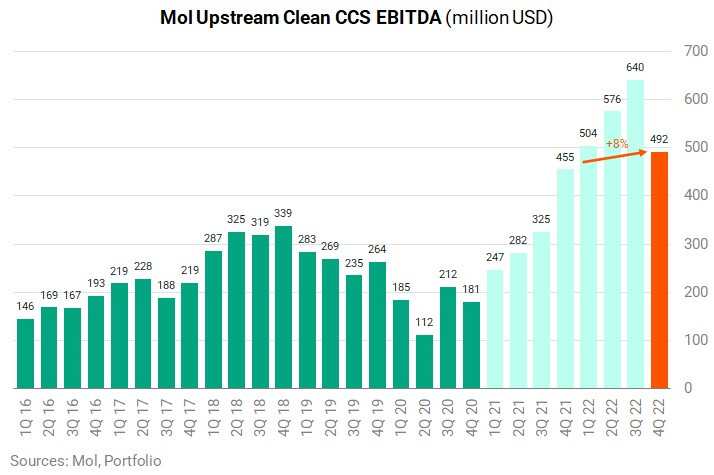
As regards the Upstream performance, Mol's management highlighted that the introduction of a regulated gas price scheme in Croatia and extra royalty levied upon production had significant negative impact on the results. Meanwhile, oil and gas production reached 92 mboepd in 2022, exceeding the annual guidance. A country breakdown can be found in Mol's investor presentation.

Source: Mol
Downstream
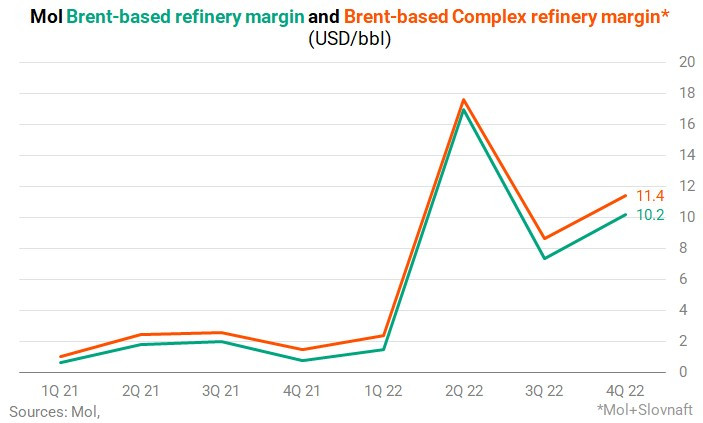
This should be the part where we present Mol's refinery margins, but the company has not published them since April, and after the third quarter we have not found any data for the fourth quarter, although the Brent-Ural spread of $25-30 per barrel suggests that the margins could still be very high (see chart above). However, another data series published by Mol illustrates the trend, as the Brent-based refining margin jumped from $0.7 in the same period last year 13.6 times to $10.2, although this is still much lower than in the second quarter.
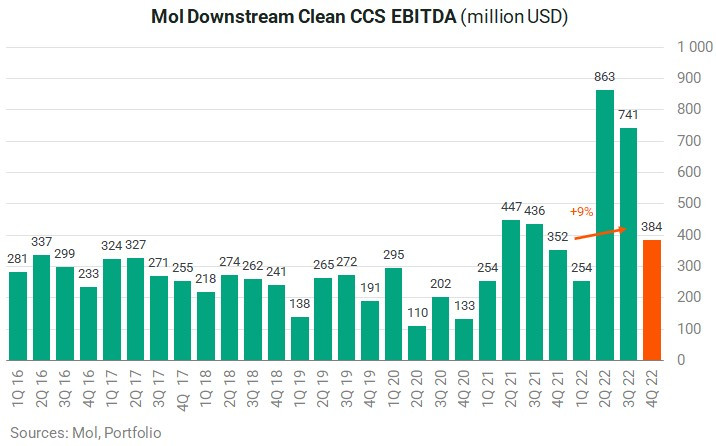
Downstream Clean CCS EBITDA reached USD 384 million in Q4, up 9% yr/yr, supported by strong R&M contribution, while Petchem EBITDA turned to negative, annual clean CCS EBITDA reached USD 2,240mn in 2022. Mol pointed out that total sales volumes decreased by 1% in Q4 yr/yr, however own production was down by 6% mainly in line with the delayed start-up of the Danube refinery following the completion of the planned shut-down in November.
It also noted that motor fuel demand contraction continued in Hungary and Slovakia (both down by 4%), whilst the Hungarian market was also affected by tight supply conditions as a result of the price cap. 2023 processing level of landlocked refineries is expected to exceed 2022 levels due to more limited turnaround activity.
Mol highlighted that
a test run on Arab Light crude was successfully completed in the Slovnaft refinery, where all preparations have been completed to increase the crude intake of non-Russian oil grades
after EU sanctions entered into effect on 5 February.
Consumer services
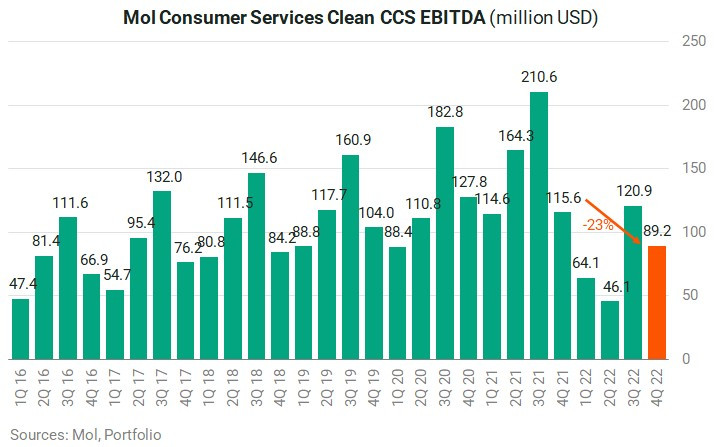
The segment's results were much better than what we have seen for most of this year and significantly exceeded analyst expectations in this regard, but the nearly $90 million EBIDTA was still 23% lower than in Q4 2021.
Mol's spectacularly worse results in Q4 are attributed to price control regulation in Central and Eastern Europe.
The estimated impact of fuel price regulation and windfall taxes across the CEE amounted to more than USD 1.6 bn on EBITDA in 2022,
Mol said.
Increasing sales, sales growth of non-fuel products and expansion in Poland only partly offset the negative effects, they underline. In the last quarter of 2022, Mol successfully completed the Lotos acquisition, which saw the purchase of around 414 petrol stations in Poland, and the number of Fresh Corners increased to 1,179 from 1,130 in the last quarter.
Gas (Midstream)
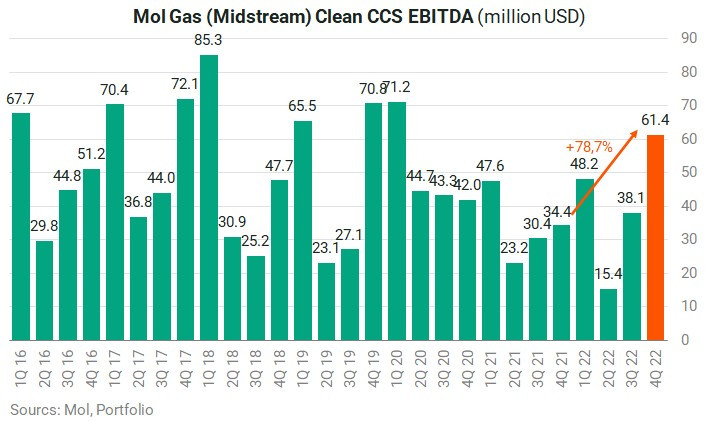
Exceeding analysts' expectations, the division's EBITDA grew by more than three quarters to $61.4 million. Mol attributed the good result to increased cross-border capacity, higher export transmission volumes, and the continued replenishment of storage facilities.
Targets overshot
After the third quarter of last year, Mol's management updated its outlook for 2022, raising several of its expectations, and the actual results have surprised on the upside in a number of them. In terms of adjusted EBITDA, management had forecasted more than USD 4.1 billion, and the result at USD 4.7 billion was 7% higher than the top estimate. Mol managed to keep group CAPEX around USD 1.5 billion, free cash flow was forecasted at more than USD 2.4 billion, and FCF was higher by a third at USD 3.18 billion, and debt was reduced, with the net debt/EBITDA ratio fell to 0.3.

Management comment
Chairman-CEO Zsolt Hernádi commented:
“Last year was a real test from every possible aspect in our industry, I am proud to say that MOL managed to navigate successfully through the countless challenges and delivered both operationally and financially. The war in Ukraine and its consequences on supply security, the unpredictable macro conditions and regulatory measures have brought unprecedented challenges to MOL’s skilled employees who did great during the constant crisis situation.
The robust EBITDA in 2022 – even with the extreme high taxes, price caps and regulatory measures in place – gives the possibility to continue our transformational and development journey laid down in the Shape Tomorrow 2030+ strategy.
"Accordingly we made inaugural investments in green hydrogen production, and set foot in waste management that is a big step towards our circular economy-related strategic goals.
"It is clear to us that 2023 will be no easier, but I believe that MOL’s proven resilience will help us navigate through these uncertain times with confidence.”
Outlook on 2023
In terms of this year's outlook, investments (group CAPEX) are expected to be at a higher level than last year at USD 1.7 billion, hydrocarbon production may decline slightly, oil production is forecasted to go up and the net debt/EBITDA ratio is expected to remain below 1.

What does the chart tell us?
At the time of the release of the Q3 earnings report in early November last year, the share price jumped to close to HUF 2,600, and since then the rise has continued with minor or greater volatility, so the price has already risen significantly by 20% since the local low at the end of September.

More to follow!
Cover photo: Portfolio