It's almost unbelievable where Hungarians rescued savings from killer inflation


Money going up in smoke
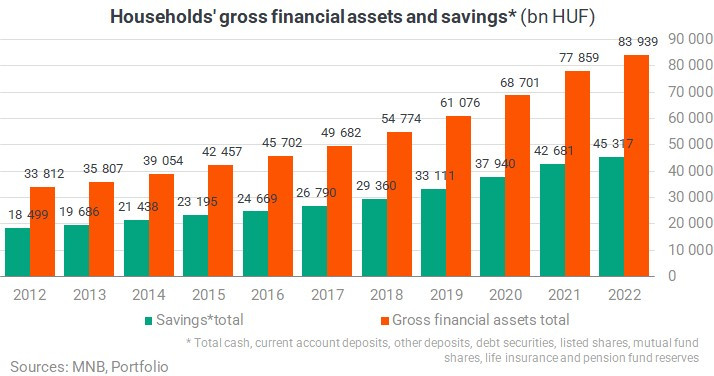
Several interesting facts emerge from the MNB's preliminary financial accounts statistics. On the basis of the raw data, all seems well and good: the stock of gross (i.e. unleveraged) financial assets of families has reached nearly HUF 84 trillion, after a 7.8% increase in one year.
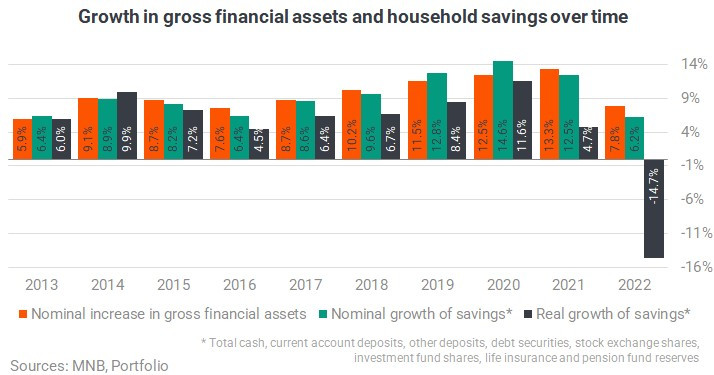
But if you think about it, even this nominal growth figure is much lower than the 24.5% inflation rate between 2021 and December 2022. And if we make a list of financial assets that can be considered savings in the narrow sense (see footnote to our graph), we see a nominal growth rate of only 6.2%. And if we adjust for inflation, we find that
THE REAL VALUE OF HOUSEHOLD SAVINGS FELL BY 14.7% IN 2022.
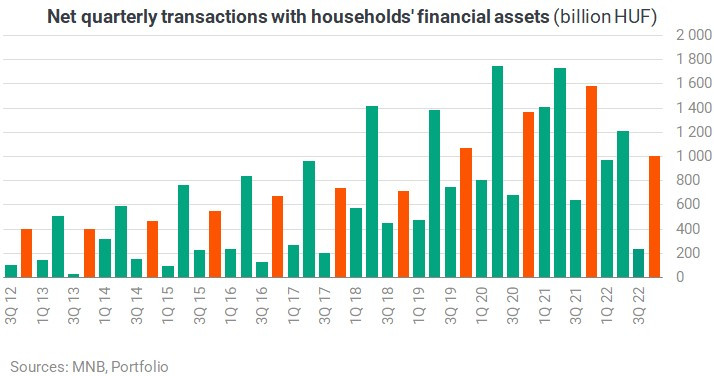
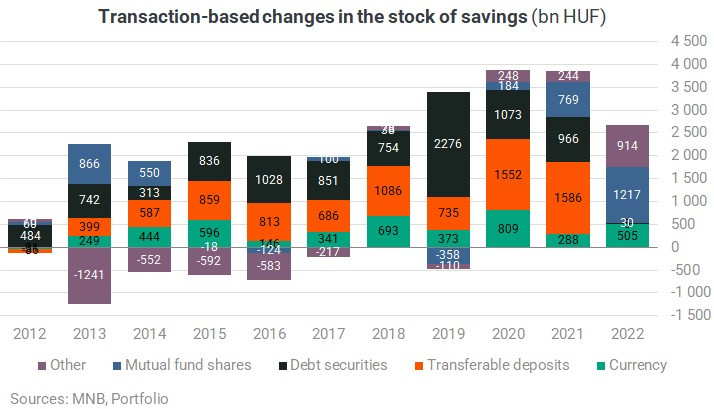
Not only is the value of Hungarians' savings falling, but their ability to save has also been deteriorating. While in 2020 and 2021, households generated more than HUF 4,000 billion in new savings, last year the figure was only HUF 3,125 billion. The third quarter was particularly weak. The Q4 net savings transaction value matched the level we saw between 2018 and 2019 and so did the annual figure.
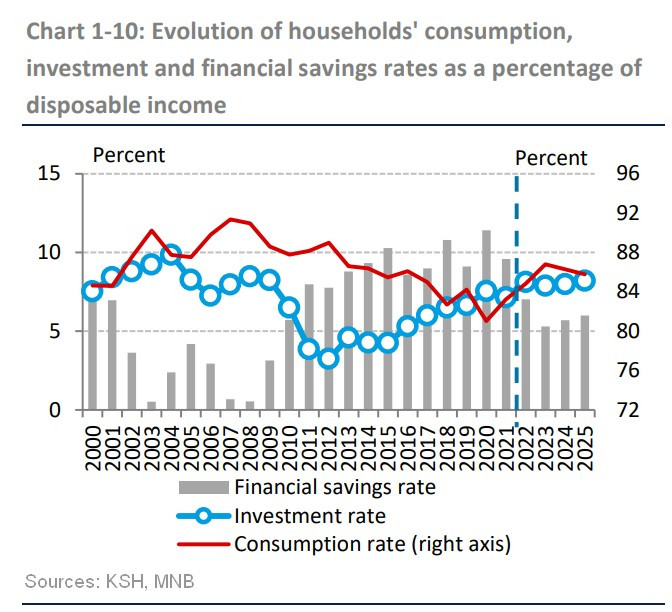
The year 2023 does not bode well in this respect: according to the MNB's latest Inflation Report, this year the increase in nominal consumption expenditure induced by high inflation will be mainly reflected in a fall in the savings rate. Those in the lower income decile will finance their higher consumption expenditure partly through a stronger reduction in their savings, while the household investment rate will decline slightly. The household financial savings rate has already fallen to around 7% last year from 9-10% in 2021, and could fall to a 14-year low of just under 5% this year.
Restructuring within savings
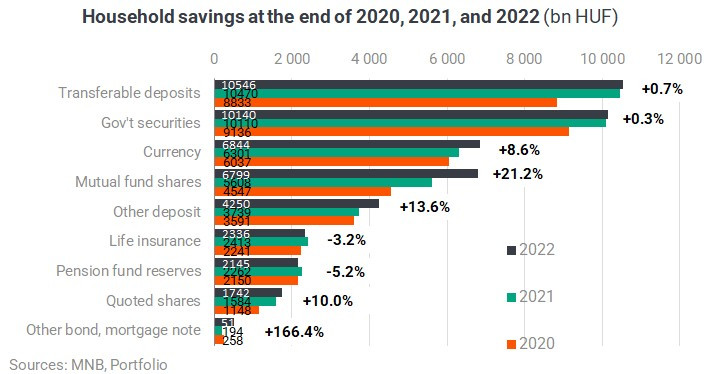
2022 turned out to be an exciting year, not only in respect of the aggregate value of savings, but also in terms of their structure. Transferable deposits and government securities remained the number one form of savings for the population, but both saw a dramatic slowdown in growth: their portfolios expanded by less than 1%. However, mutual fund shares, which ranked fourth, were the stars of 2022: their holdings grew by 21% and came very close to currency holdings.
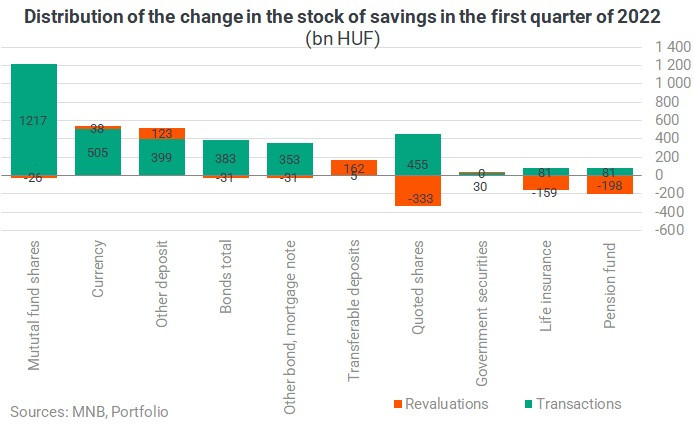
The party pooper in this case was the fact that the good performance of mutual fund shares is not due to their returns (which were negative overall, as the data show negative revaluations), but entirely to capital inflows. Last year, an unprecedented HUF 1,217 billion of fresh money flowed into mutual fund shares held by households. The net inflow of HUF 455 billion into listed shares also shows a strengthening of risk-taking, but unfortunately the negative revaluation of these securities was much higher.
Out of 100 new household forint savings, 39 went into mutual fund shares, 16 into currency and 15 into quoted shares last year. This is dwarfed by last year's transaction data for government securities and transferable deposits, which shows that the state was late to the game: the new Premium Hungarian Government Security (PMÁP) and the 'revived' Bonus Hungarian Government Security (BMÁP), which are more closely adjusted to inflation and the yield environment, were only launched at the end of September, when significant amounts of money had already been withdrawn from government securities investments in favour of mutual fund shares.
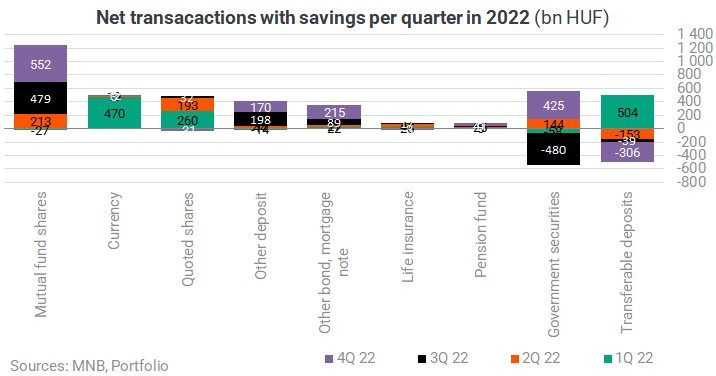
For example, in the third quarter and the fourth quarter, net retail flows into mutual fund shares amounted to HUF 479 billion and HUF 552 billion respectively. In comparison, HUF 480 billion were withdrawn from debt securities in the third quarter, and in the fourth quarter "only" HUF 425 billion of this minus was worked off.
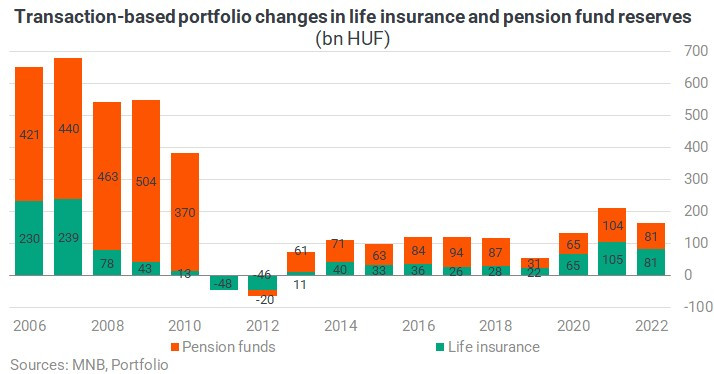
The same can be said for self-care products, but on a much smaller scale than for listed shares and mutual funds: they have managed to attract fresh capital in net terms, but have failed to preserve the value of their investments, with massive negative returns, especially in the first half of the year. In historical comparison, sales have been particularly strong for life insurance: looking back over the past decade, only in 2021 did more fresh money flow into life insurance than last year.
Cover photo: Getty Images