Amount of currency in circulation drops in Hungary for the first time in a decade


The National Bank of Hungary (MNB) has published its preliminary statistical balance sheet data for April. One of the most interesting new developments is that the liabilities side of the central bank's balance sheet is showing a decrease in the stock of currency in circulation.
which totalled huf 8,106 billion at the end of april, corresponding to a 2.3% year-on-year decline and to a 2.7% drop compared to end-2022.
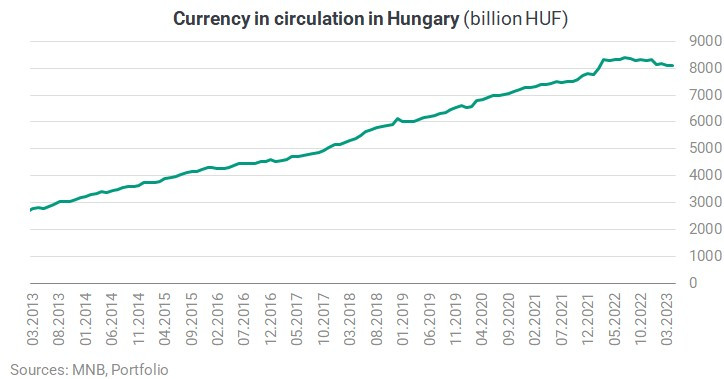
March and April saw the first year-on-year decline in the amount of currency (HUF) in circulation.
Historically, the following factors have had a strong upward impact on cash holdings for many years:
- the introduction of the financial transaction tax (FTT) in 2013, which mainly affects digital transactions,
- the possibility to withdraw cash twice a month free of charge up to HUF 150,000, and
- the low interest rate environment, which significantly reduces the disadvantages of cash as a savings instrument compared to alternatives.
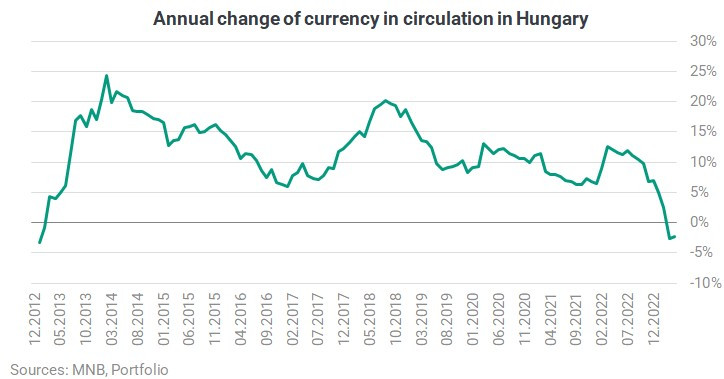
Well, it's history now. We now see three partly independent and partly very interrelated factors behind the negative turn in the cash position:
- high inflation: today, HUF cash with a 0% yield is considered an extremely poor saving, as it loses more than 20% of its value every year, while, for example, good part of this loss in real value can be avoided with a 16% interest rate on the retail Premium Hungarian Government Security (PMÁP);
- increased demand for foreign exchange: the significant volatility of the forint and the speculative demand related to HUF weakening have led to a significant increase in the demand for foreign exchange by the public, with forint cash being the main victim,
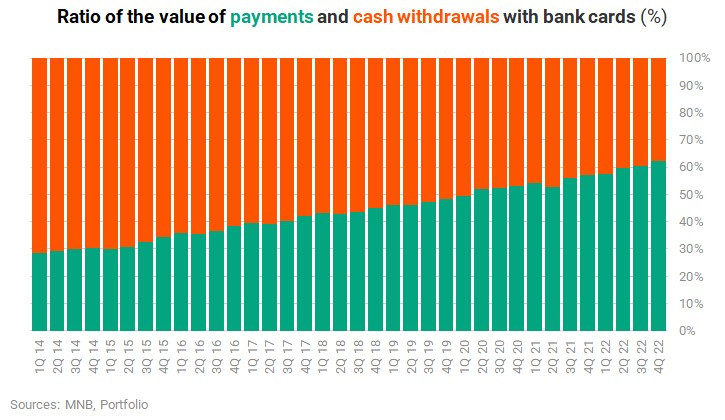
- long-term changes in cash flows: the use of bank cards is becoming more important than cash for purchases.
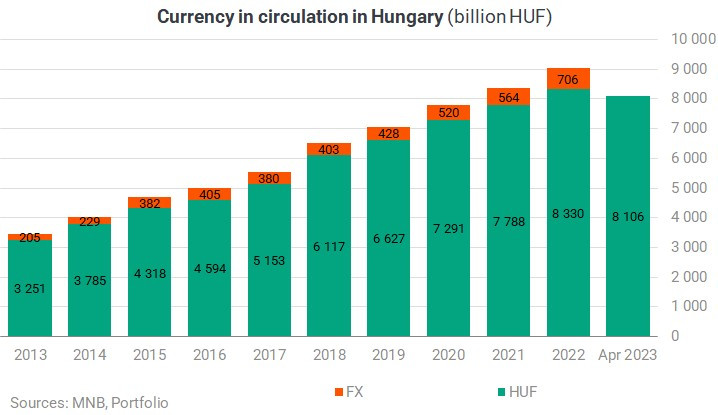
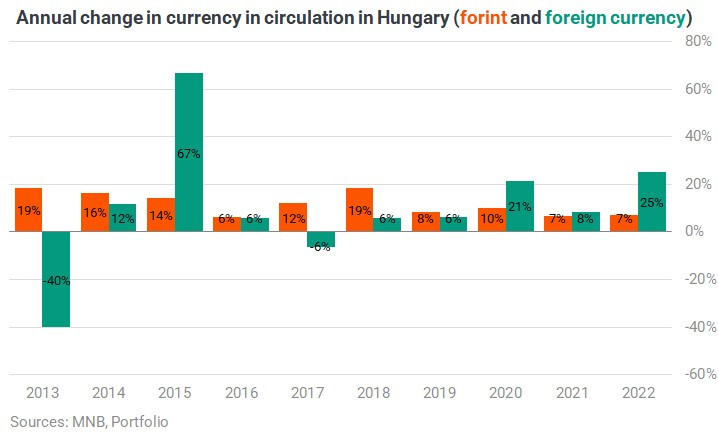
We have no recent data on the foreign exchange stock, but we could see a significant rebalancing already in 2022. Just a month ago, we wrote that at the end of 2022, HUF 706 billion of FX was in circulation in Hungary, of which HUF 501 billion was held by households, both new records. The stock of foreign exchange in the Hungarian economy grew by 25%, a rate not seen for seven years, while the stock of forint coins and banknotes grew by "only" 7%.
Today, we spend more than 1.6 times as much with bank cards as we withdraw in cash. More on this in detail here.
Cover photo: Getty Images