Are Hungarians moving their money abroad? Here is the painful truth


Swiss accounts, Erste in Vienna, Raiffeisen in Burgenland, Slovak banks. These are old favourites of Hungarians, but they are doing even better than before, if possible, and the money parked with them has also gained a lot of weight recently, said a much-seen private banker source of Portfolio, adding that a whole industry has been built on Hungarians seeking euro savings abroad, partly with the participation of private banking advisors who were previously successful in Hungary.
To these we can add Revolut accounts, which are popular among the less wealthy, foreign (particularly American) stocks, crypto currencies and gold, but also the occasional queues at domestic money exchangers. What they all have in common is that they channel the money of Hungarian savers into non-home-grown forint assets, in return for which they receive a large inflow of fresh money.
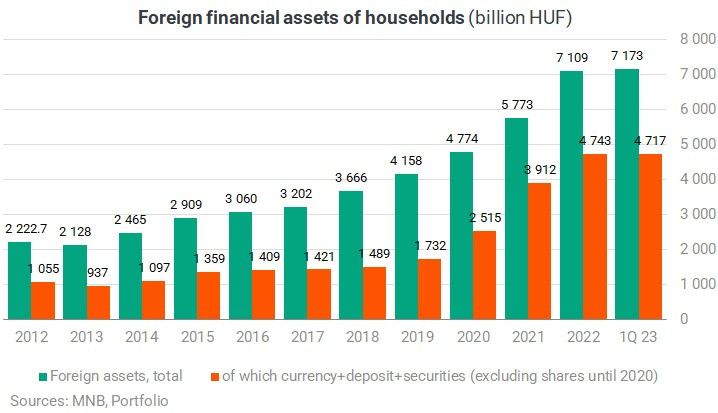
Central bank statistics also show the growing popularity of foreign assets. According to the MNB's preliminary financial accounts data, Hungarian residents held HUF 7,173 billion in financial assets abroad at the end of March this year, but this includes the value of foreign equity interests. If we look at savings alone, two-thirds of this amount, HUF 4,717 billion, were held in foreign currency, bank deposits or securities at the end of the first quarter by resident individuals in the country.
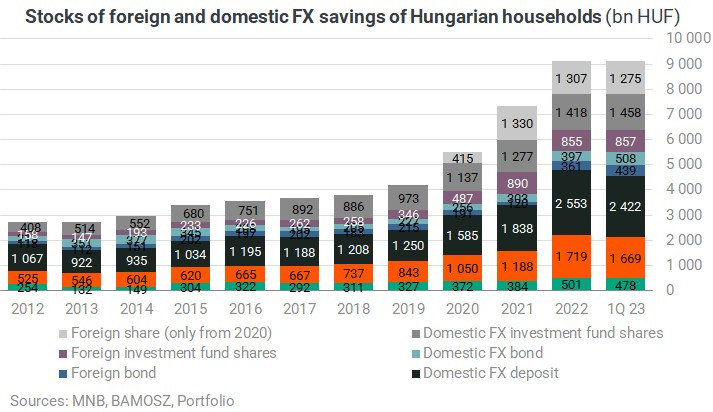
These figures do not yet include savings held by households domestically but in foreign currency (the location of the currency is unknown, we have included savings in foreign assets). Combining data of the MNB and of the Association of Hungarian Investment Fund and Asset Management Companies (BAMOSZ), in addition to the HUF 4,717 billion held abroad, households hold a further HUF 4,388 billion in domestic foreign currency deposits or foreign currency-denominated securities. This includes, of course, government securities in euros, which are dear to the state, but these added up only to HUF 421 billion at the end of March.
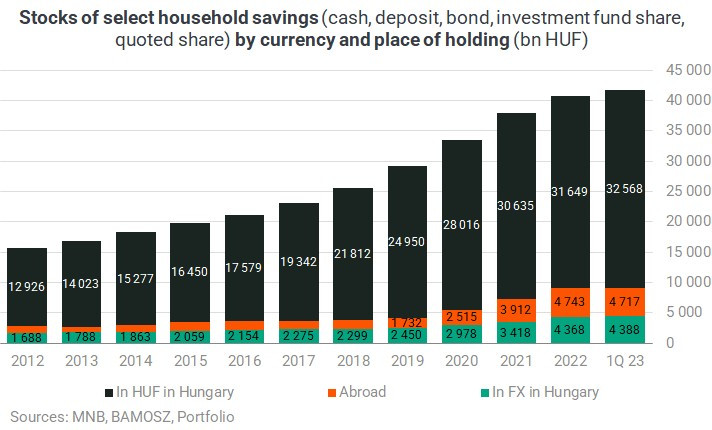
Based on the residual principle, we looked at how much the population holds in the same type of asset (cash + deposits + securities) in HUF in Hungary. We see that of course much more, almost HUF 33 trillion, but the proportions have started to shift significantly as the volume of savings held abroad and in foreign currency has increased much more strongly. In 2022 as a whole, the stock of financial assets held abroad increased by 21% and the stock of foreign currency assets held domestically by 28%. Meanwhile, domestic savings denominated in forint increased by only 3%.
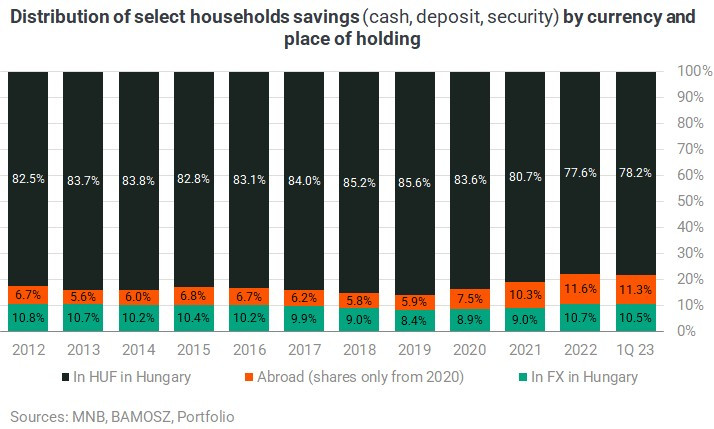
In the past, the share of Hungarian households' savings (still referring to cash + deposits + securities) was held in domestic HUF savings was well over 80%, but this has now fallen to 78%. One could say that this is not a significant shift yet, but if we look at the transaction data for last year, we can already see a landslide of changes.
It makes a difference whether revaluation effects, such as the weakening of the forint exchange rate, are the sole cause of this shift, or whether capital has actually started to flow out of the country and out of forint assets.
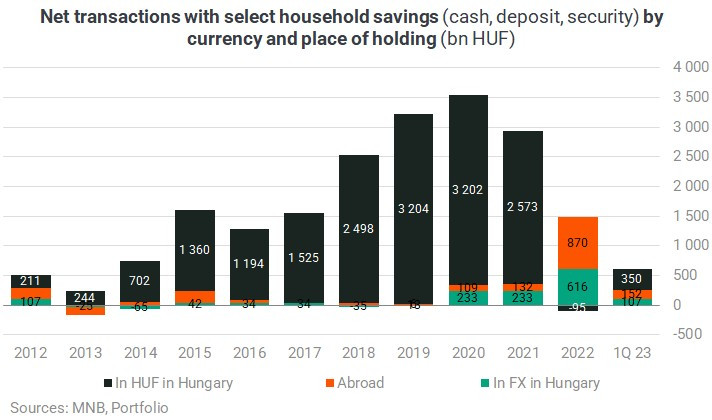
Net transaction figures, which show the difference between inflows and outflows, are a good way to quantify this. As shown in the chart below, domestic foreign currency deposits, foreign deposits and foreign bonds were also strong in the second half of last year,
with a total of HUF 1,486 billion, or almost EUR 4 billion, of fresh money flowing into these three categories in the whole of 2022.
No transaction statistics were found for domestic FX investment fund shares, so this figure is probably an underestimate.
According to our calculations, last year a total of HUF 870 billion net capital flowed into foreign assets and HUF 616 billion into domestic foreign currency assets, while domestic HUF assets increased by only HUF 269 billion, also on a transaction basis.
The differences became particularly apparent in the second half of the year, when HUF 615 billion went into foreign assets and HUF 351 billion into domestic currency, while HUF 667 billion were withdrawn from Hungarian forint assets, not only because of the conversion into foreign currency, but probably also partly because households tapped into these savings.
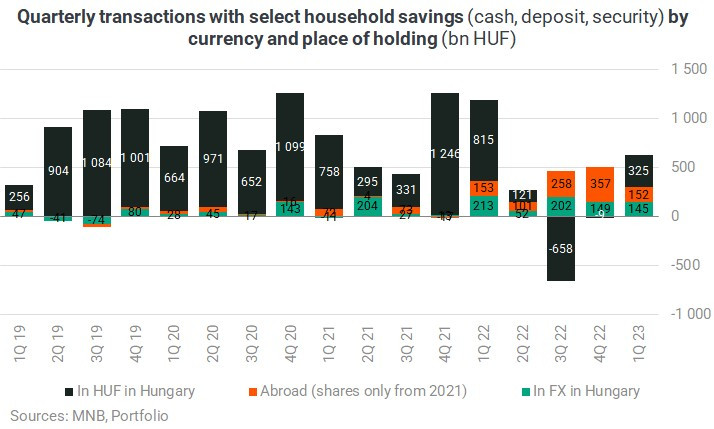
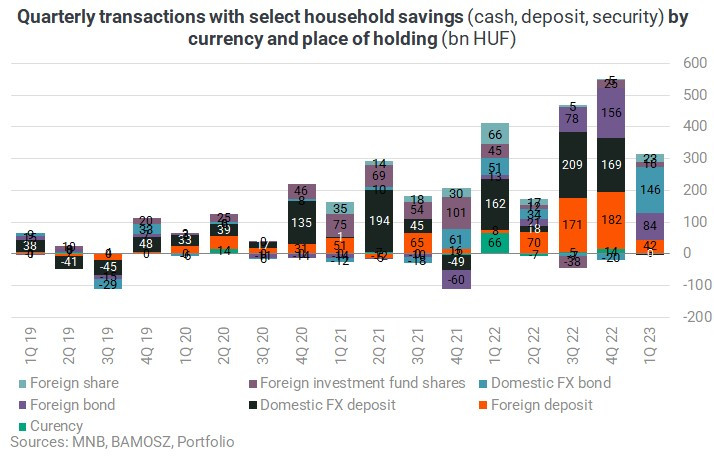
Foreign asset holdings and foreign currency savings were still accumulating in the first quarter of 2023, but to a much smaller extent. Fortunately, the HUF savings balance also turned positive. As a result, a quarter of fresh capital continued to flow abroad in the first three months of 2023, with another one-fifth finding a home in domestic foreign currency assets.
The first quarter of this year did not prove these strategies right in the short term, at least for those who then use these savings in forints (by spending them at home):
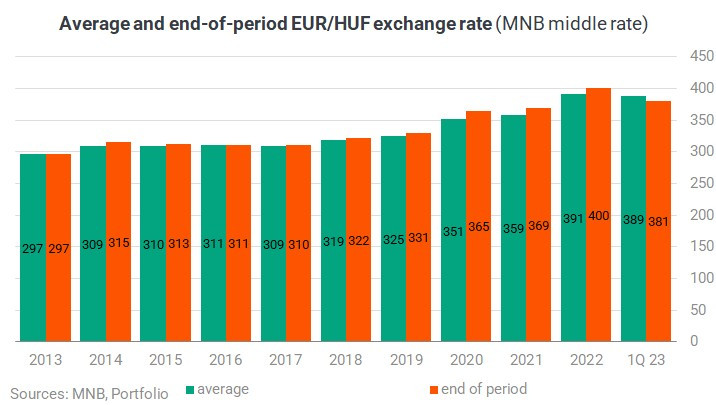
THE FORINT STRENGTHENED AGAINST THE EXPECTATIONS OF MANY, and BETWEEN 31 DECEMBER AND 31 MARCH, for example, SAVINGS HELD IN EURO LOST AN AVERAGE OF 4.8% OF THEIR VALUE IN FORINT ONLY BECAUSE OF THE STRENGTHENING OF THE FORINT
(It is not known what percentage of these savings is in other currencies). The forint appreciation continued in the second quarter: the euro has fallen from 381 forints at the end of March to 368 forints so far, much to the chagrin of euro savers.
Negative revaluations alone caused the forint value of foreign deposits to fall by HUF 91.7 billion, bonds by HUF 6.6 billion, foreign investment fund shares by HUF 13.7 billion and currencies by HUF 25.8 billion in Q1, of which, excluding investment fund shares, this was largely due to the strengthening of the forint.
For a large part of those saving abroad or in foreign currency, this represents an unrealised loss for the time being, but at the same time (depending on the exchange rate) it can only become a realised gain in the longer term, with an uncertain investment duration. This proves that choosing foreign or foreign currency assets is not necessarily rational behaviour even in times of a weakening forint, and a late conversion, which tracks the the trend with a delay, may prove to be a downright error of judgement.
Especially if the conversion is into foreign currency instruments with lower interest and yield potential, which is almost a given for developed market currencies.
Cover photo: Shutterstock