Battle for our savings: where will Hungarians put their money?


Portfolio has already looked at the preliminary financial accounts published by the National Bank of Hungary (MNB) on Friday morning: as we reported, the decline in public debt as a share of GDP has stopped at 75%. The statistics are also interesting in terms of the financial situation of households: gross financial assets of households rose to HUF 88,437 billion by mid-2023, an increase of 4.9% this year. In nominal terms, this is how much we have gained if we exclude real estate and other real assets. The stock of financial assets less debt (net) increased by 6.1% to HUF 73,974 bn, despite the fall in lending.

It is worth narrowing the scope to the assets we regard as savings, which at the end of June amounted to HUF 47,466 billion of household assets. Nominal growth in savings was 5.1% in the first half of the year, which is not bad considering that high inflation has a negative impact on households' ability to save. However, inflation has slowed down in the first half of this year, with an overall rate of money deterioration of 4.6% from December last year to June this year. Calculated in this way,
the real value of savings has already increased marginally by 0.5% in the first half of this year, after a 15% fall last year.
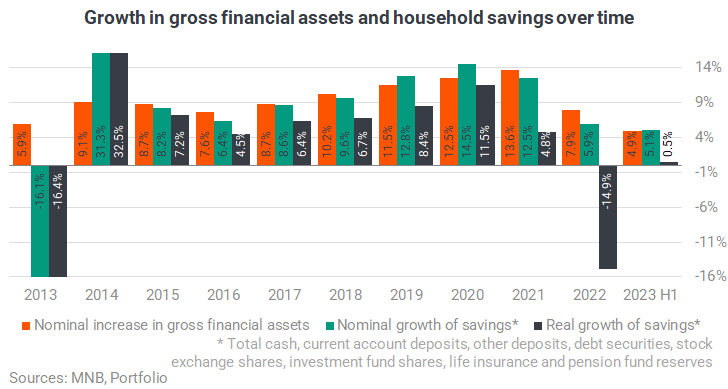
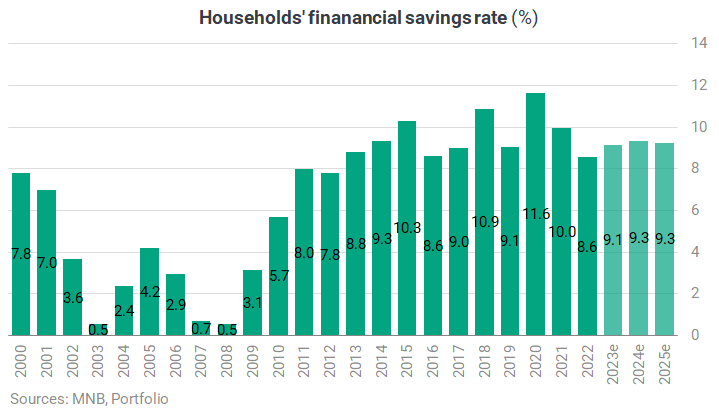
So there is no drama in the savings market, mainly because households have cut back on consumption and the MNB estimates that the savings rate, i.e. the share of disposable income set aside for savings, will rise this year. We are far from the 10-12% level seen during the pandemic, but the 9.1% expected this year is higher than last year's 8.6%, which overall is favourable for financial service providers in the savings market.
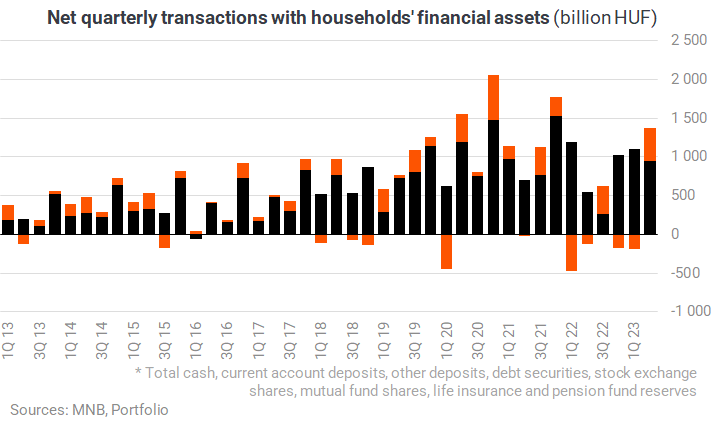
We seem to have come through two of the most difficult quarters: the second and third quarters of 2022, when inflation was soaring, saw the biggest drop in net savings transactions by Hungarian households, but since the end of last year the savings market has recovered, at least in nominal terms.
Even more exciting than the above is the shift in the structure of savings away from cash and current account deposits, which offer no protection against inflation, and towards government bonds and investment fund shares, which offer greater yield promise. After the second half of last year,
government bonds have come back to the fore: their holdings grew by 14% to HUF 11,573 billion in the first half of the year, accounting for 24% of savings.
Meanwhile, investment fund shares held by households grew even more strongly in relative terms, up 20% to HUF 8,122 billion, or more than 17%.
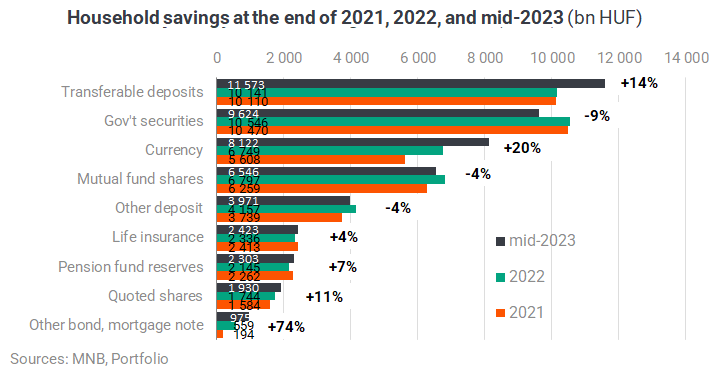
While the battle between government bonds and investment fund shares - in which the state has actively participated, including with the introduction of the 13% social contribution tax on 1 July - is still not over,
current account deposits and cash, which are a poor means of saving in an inflationary environment, are being squeezed back spectacularly.
In the first half of this year alone, HUF 214 billion in cash and HUF 764 billion in current account deposits "disappeared", while government securities and investment fund shares increased by HUF 1,432 billion and HUF 1,128 billion respectively on a transaction basis. It can be said that out of every HUF 100 of new savings, 70 went into government securities and 55 into investment funds (the aggregate balance of other savings was dragged down into negative territory by cash and deposits).
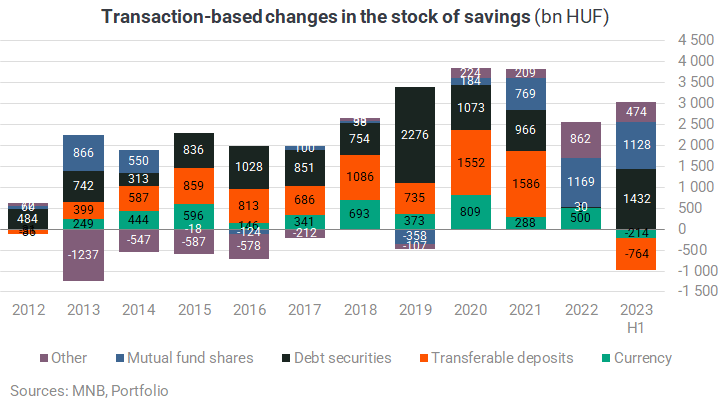
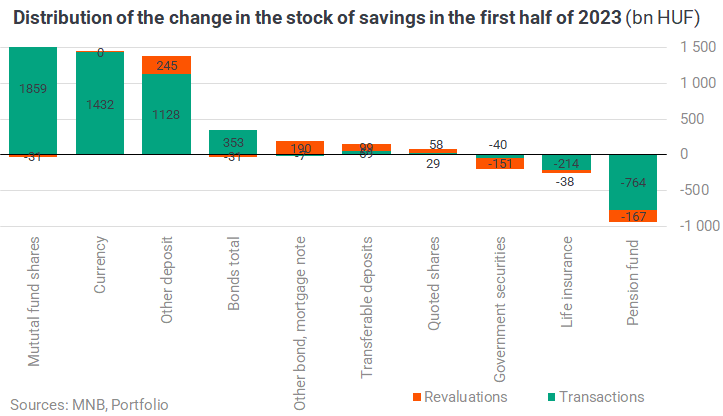
Thanks to the favourable situation in money and capital markets, revaluations, i.e. market returns, also contributed positively to savings in the first half of 2023, with positive effects also seen in equities, pension funds and life insurance. However, from the point of view of foreign and FX assets, the strengthening of the forint has not been favourable, which is why we see negative figures not only in terms of transactions but also in terms of revaluations for cash and bank deposits (see the fall in the forint value of currency and FX deposits).
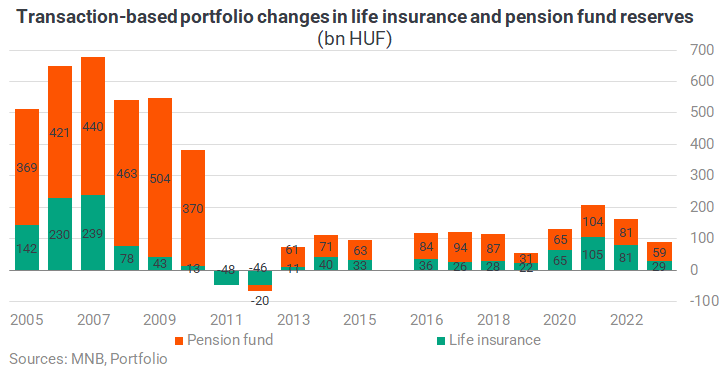
Compared to previous years, there was also a relatively strong inflow of money into self-provision products in the first half of this year, mainly pension funds and life insurance. However, while life insurance has been the top performer in previous years, pension funds are stronger this year, and life insurance marketers will have a lot of work to do to ensure that this year is as strong as the previous two.
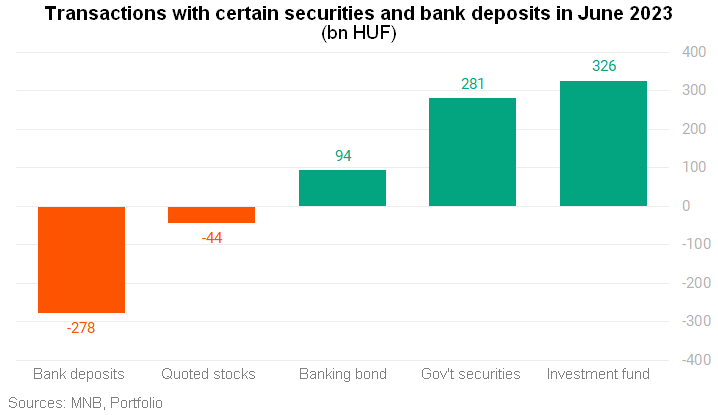
The big question for the second half of 2023 will be which side will emerge victorious in the battle between government bonds and investment trusts. Government interventions, the introduction of the 13% social contribution tax and the likely rise in the inflation-linked government bond rate next year clearly favour the former, while mutual funds have shown fairly strong sales potential in recent months.
Cover photo: Shutterstock