A rare occurrence: Hungarians hold more savings in gov't securities than in bank deposits


Turnaround in gov't securities and bank deposits
According to the central bank's (MNB) latest securities statistics, the stock of government securities held by households increased by more than HUF 1,800 billion this year, reaching nearly HUF 12 trillion by the end of August.
Investment funds are running almost neck and neck with government securities, with the former category growing by HUF 1,774 billion to over HUF 7,700 billion by August.
At the other end of the rankings are bank deposits, where savings had fallen by EUR 1,124 billion by August, meaning that
for the first time we can now say that Hungarians hold more money in government securities than in bank deposits.
The question is to what extent this process will be sustainable and how the letter that banks will be obliged to send to customers will affect the demand for government bonds and bank deposits. Under a recent government decree credit institutions established in Hungary must send an alert notice once between 1 October and 31 December 2023 to natural persons who have a bank account with them.
In this information notice, the credit institution must present, in a clear table format, a calculation showing the yields achieved in the specified reference period by those who have purchased or subscribed for HUF 100 000, HUF 500 000 and HUF 1 000 000 government securities issued by the Hungarian State, which can be purchased by individuals, and have held them continuously.
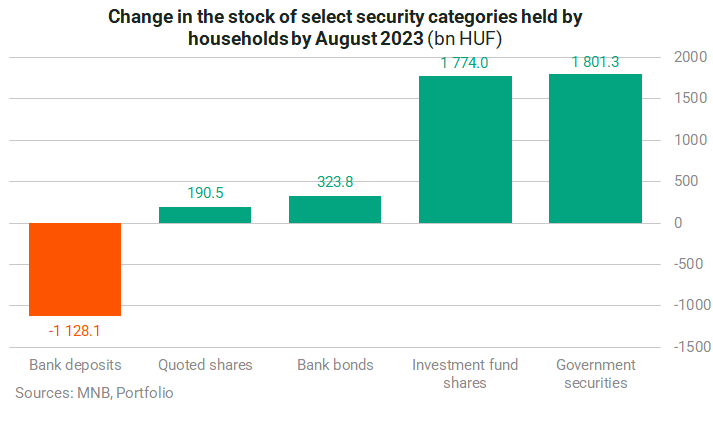
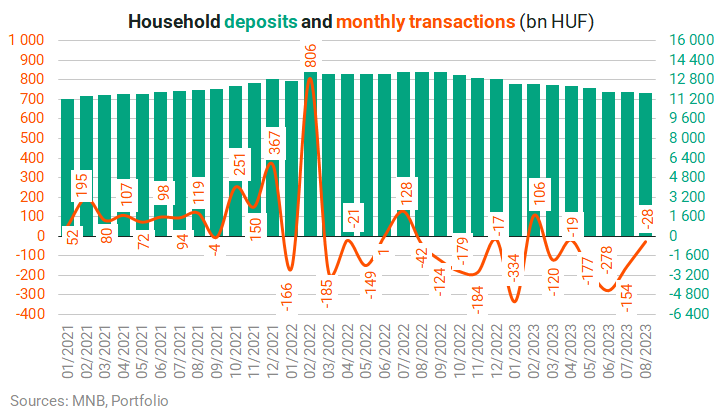
The stock of bank deposits at the end of August amounted to HUF 11,723 billion, with some HUF 30 billion outflows in the month under review and more than HUF 1 trillion so far this year.
The graph below shows that both quoted shares and investment funds have benefited from the revaluation effect, i.e. favourable market exchange rate effects, which has contributed strongly to the stock growth.

Milestone at bond funds too
August saw a turnaround not only in the government bonds vs. bank deposits relation, but also in investment funds, as
the stock of bond funds held by households exceeded HUF 3 trillion for the first time.
By far, bond funds manage the largest retail assets among the mutual fund categories, with mixed funds a distant second with HUF 1,623 billion, followed by real estate funds with HUF 1,230 billion.

Demand for T-bills drops
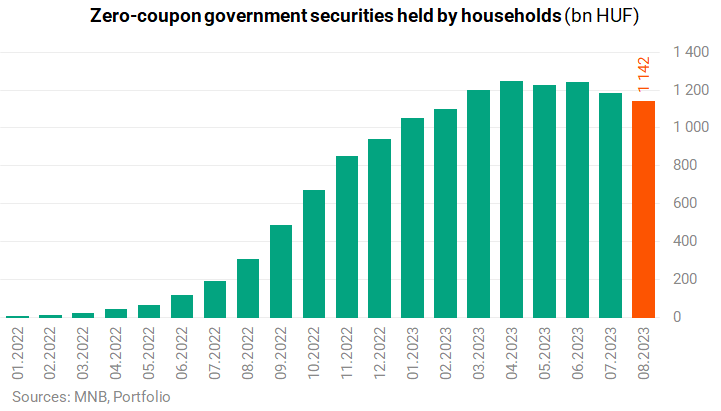
The structure of government bonds held by households seems to be changing, as the stock of discount Treasury Bills held by residents continued to fall in August, from HUF 1,184 billion at the end of July to HUF 1,142 billion at the end of August.
We could easily see a downward trend here in the coming months as the era of T-bill yields around 13% has come to an end, with the latest data now showing yield levels falling to around 8-8.5%.
Investment funds piling up government securities
It is no coincidence that T-bills have seen such a significant drop in returns in recent months. Firstly, as inflation has fallen, the central bank has been steadily reducing the benchmark rate, which obviously has an impact on short yields. Secondly, investment funds have also generated stronger demand in the T-bill and government bond markets in recent times, due to the mandatory holdings of government bonds prescribed by the state.
The government has taken the following measures to encourage investment funds to move to the government bond market:
- From 1 July, the assets held in the portfolio of securities funds, including only bond funds, equity funds and mixed funds, must be at least 60% securities (not, for example, bank deposits, as was the case for some funds).
- Also from 1 July, securities funds and real estate funds have to hold at least 20% of their liquid assets in discount Treasury bills issued by the Hungarian state (this does not apply to funds investing at least 80% in foreign assets).
- From 1 August, the government will also require investment funds to hold at least 95% of their bond investments in HUF government securities (with some exceptions).
To be sure, the impact of the mandatory holding of government securities required of some securities funds is already visible in investment funds:
while in May the funds held HUF 1,350 billion of government bonds, by the end of August this had jumped to over HUF 1,900 billion, an increase of more than 40% in three months.
So it seems that the government's intention to attract an extra HUF 500 billion from the fund management market to the sovereign debt market has indeed been realised. It is interesting to note, however, that the higher demand from the investment fund side was more visible in June-July, although the stricter requirement for Hungarian bonds came into play in August. This may indicate that most of the funds concerned were already trying to comply with the new requirements in time, rather than leaving the government bond requirements to the last minute.
The requirement to hold government bonds will be applied to banks later, but they have apparently not started to buy a whole lot of government bonds just yet. In fact, banks' holdings of government securities are declining for the time being.
As a reminder, Minister of Economic Development Márton Nagy said at a background discussion on this issue that the move could create additional demand of around HUF 1,800 billion from institutions in the government bond market. Of this, HUF 500 billion could come from investment funds, and at the level of the banking sector, HUF 1,300 billion of additional demand for long government bonds could arise from the change in the extra profit tax.

Changes started in the public debt front too
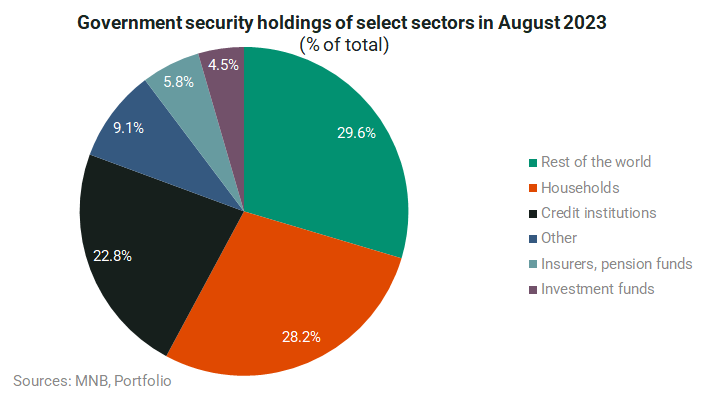
Statistics also show that non-residents held the most government debt in August, but the ratio fell below 30%, while the share of government debt held by the Hungarian population exceeded 28%, the second highest in the ownership breakdown.
Among the main holders, the share of government securities held by credit institutions rose to 22.7%, while the share of investment funds increased to 4.5% from 3.3% at the end of May.
Cover photo: Getty Images