Here is OTP's 2023 Q3 flash report, the figures are hard to believe


Rising revenues, soaring profits
Total revenues of the OTP Group increased by 33% to HUF 597.8 billion, of which fee and commission income rose by 31% to HUF 381.8 billion, fee and commission income increased by 18% to HUF 125.2 billion, and other non-interest income jumped by 70% to HUF 90.9 billion.
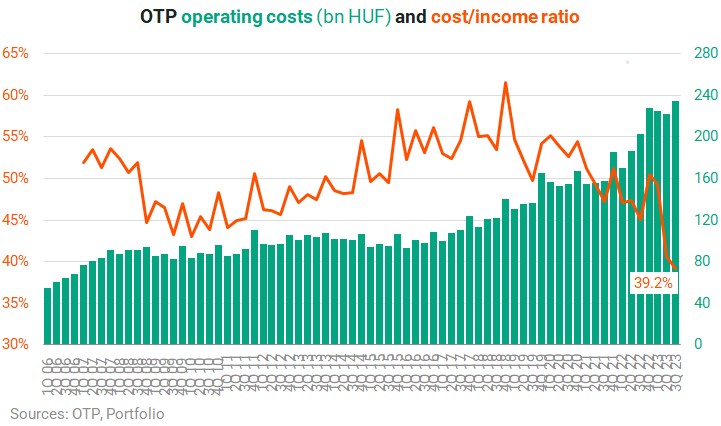
Operating expenses grew much less than revenues, rising by 15% to HUF 234.4 billion, so operating profit jumped by 47% to HUF 363.4 billion.
The quarter's result was negatively impacted by negative adjustment items of HUF 26.5 billion, the largest of which was an acquisition impact of HUF -24.1 billion, of which HUF 13.2 billion related to the third quarter review of badwill related to the acquisition of Ipoteka in Uzbekistan.
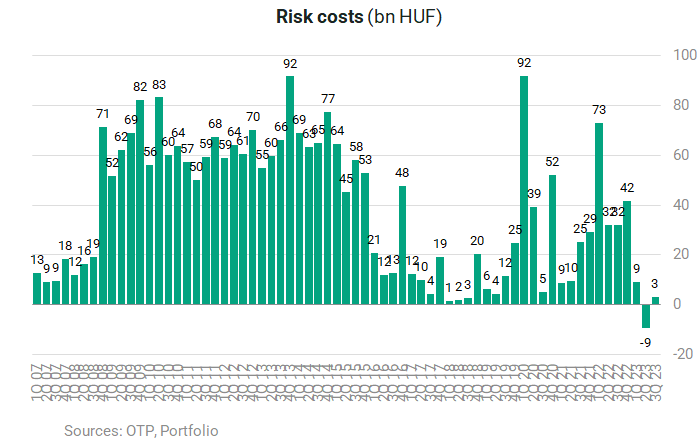
The risk costs heading shows a low amount of only HUF -3.3 billion.
The banking group's profit after tax increased by 49% to HUF 281 billion.

Total revenue and operating profit are both at new highs, and profit is not a record only because of the staggering result in the second quarter of this year, with many extra items.
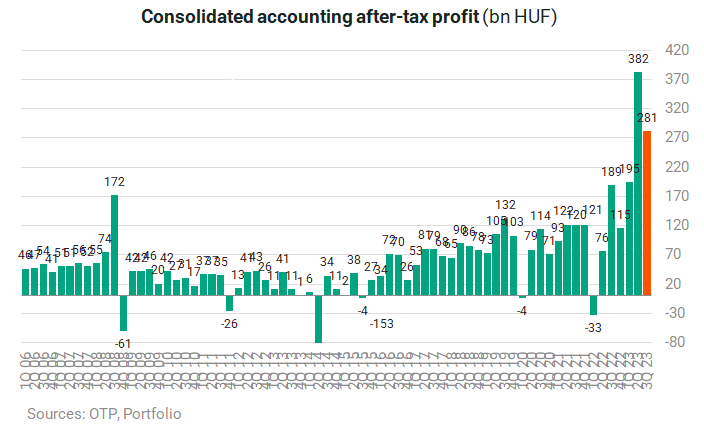
PROFIT FOR THE FIRST 9 MONTHS WAS HUF 858 BILLION, A NEW RECORD OF COURSE, AND ALMOST FOUR TIMES THE PROFIT OF A YEAR EARLIER.
All operations were profitable in the quarter, with most foreign operations making more profit in the first nine months of this year than in the whole of 2022.
THIS YEAR, TWO-THIRDS OF THE BANKING GROUP'S PROFITS HAVE COME FROM ITS SUBSIDIARY BANKS.
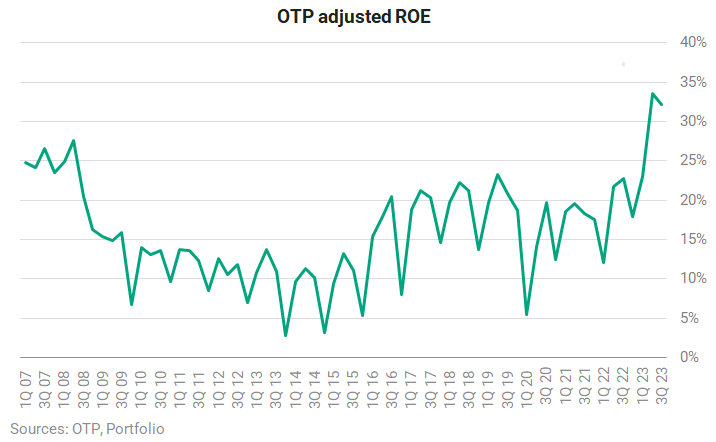
The banking group's return on equity is outstanding, with an adjusted ROE of 32.2% for the quarter. OTP had a higher ROE only once, in Q2 this year. In its latest forecast (see details below), management expects adjusted ROE to exceed 25%. In the first nine months it was 29.8% , so something would have to go badly wrong to avoid 25+ percent.
Expanding loan book, rising margins
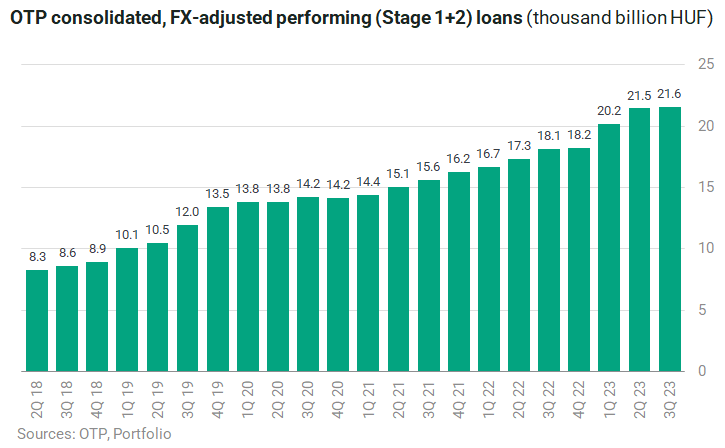
By the end of the quarter, the Group's outstanding loans had grown to HUF 21.6 billion, and if acquisitions were excluded from the picture, organic growth would have been 4% in the first 9 months. On a quarterly basis, the Bulgarian (+2%), Croatian (+3%), Ukrainian (+2%) and Russian (+10%) portfolios grew nicely, while the Uzbek and Moldovan portfolios declined by 3% and 5% respectively. At group level, consumer loans grew by 6%, leasing by 3% and mortgage loans by 2%, with the 3% decline in the corporate portfolio being driven by the Stage 3 reclassification at Ipoteka and the decline in the Hungarian and Slovenian portfolios.
Not only are stocks growing, but margins are also improving, with a group net interest margin of almost 4% at the end of the quarter, a level last seen at the end of 2019. The ECB's base rate hike had a positive impact on several group rates, while in the Hungarian core business, interest margins have already increased partly due to the MNB's rate cut.

The big story at OTP is that expenses are growing at a much lower rate than revenues, while the group is also growing larger due to acquisitions, synergies are working, and the expense/revenue ratio has never been lower than it is now, based on our database going back to early 2006.
The risk cost line shows only HUF -3.2 billion, which is the result of provision reversals at several Group banks (HUF 14.3 billion in Hungary, HUF 6.9 billion in Ukraine, HUF 4.3 billion in Bulgaria), while larger provisions were made at the Uzbek (HUF 22.3 bn) and Russian (HUF 8.5 bn) banks.
Ipoteka
The balance sheet figures of the Uzbek Ipoteka were already included in the group's financial statements in the second quarter, but the results figures have just been published, so it is worth taking a look at what the Uzbek bank adds to the group and what the main developments are.
Ipoteka is Uzbekistan's fifth largest bank by total assets, with a market share of nearly 8%, 1.6 million retail customers, 39 branches and more than 4,000 employees.
The Uzbek bank has a balance sheet total of HUF 1,261 billion, or 3.2% of the group, and a total outstanding loan portfolio of HUF 889 billion, or 4.1% of the group's total, with 83% of the Uzbek portfolio in retail and 17% in corporate loans. Deposits amount to only HUF 304 billion, 1% of the group's portfolio.
With a very high net loan-to-deposit ratio of 297%, the bank's funding structure continues to rely heavily on public funds, which typically finance interest rate subsidised loans: liabilities to credit institutions amount to HUF 605 billion on the bank's balance sheet.
The Uzbek bank had total revenues of HUF 31.8 billion, representing 5.3% of group revenues, and an operating profit of HUF 21.4 billion, representing 5.9% of group profit. However, the bank's profit after tax was only HUF 242 million, explained by high risk costs: there was a negative item of HUF 25.7 billion (of which HUF 22 billion related to corporate loans), which is the result of data cleansing following consolidation, the implementation of risk management and classification principles applied in the group, and the evolution of portfolio quality.
When acquiring the Uzbek bank OTP had a relatively short period of time to thoroughly examine Ipoteka's loan book, but it is now clear that a larger provision is needed on the loan book, and the previously determined badwill value has been changed, Deputy CEO László Bencsik told reporters today.
This could easily change even in the next quarter,
he added.
The Uzbek corporate portfolio started to deteriorate rapidly, especially the quality of the corporate loan portfolio. For example, clients in the cotton growing and processing sector were negatively affected in the third quarter.
Portfolio quality was worse than expected, but this was reflected in the purchase price. We are still very pleased with the acquisition and think there is huge potential in the Uzbek bank,
underlined the Deputy CEO.
Hindering circumstances
Regarding the outlook, it is worth noting that the regulatory environment in several of the banking group's operations is unfavourable for banks, and the negative effects of this will be felt in the coming quarters:
- In Slovenia, to compensate for the damage caused by the August floods, financial institutions will have to pay a tax of 0.2% of their balance sheet total over the next 5 years, a targeted repayment moratorium and a compulsory solidarity tax.
- In Serbia, the central bank has capped interest rates on previously disbursed variable-rate mortgages and newly disbursed fixed-rate loans until the end of 2024 (with an expected impact of - HUF 7.1 billion in lump-sum bookings in the third quarter).
- In Romania, the government has proposed the introduction of an extraordinary tax from 2024, amounting to 2% of revenues in the first two years and 1% thereafter.
Raised expectations for this year
OTP management has become even more optimistic on the basis of the first 9 months (and, presumably, based on what they also see of the results of the more than 10 months that had passed):
- While after the second quarter it was expected that the organic growth in the stock of performing loans at constant rates would reach 5%, it is now forecast that growth could exceed 5%.
- Based on this year's nine-month trends, management forecasts an improved net interest margin, lower credit cost ratio and expense/income ratio for 2023 as a whole compared to 2022, which could result in an adjusted ROE of more than 25% in 2023, compared to expectations after the second quarter that the adjusted ROE in 2023 could meaningfully exceed the 18.8% in 2022.
Economic expectations
Hungary is the only country where OTP is present that could experience a recession (-1%) in 2023.
For 2024, OTP expects economic growth in all group member countries, with GDP growth rates of 2% in Hungary, 2.1% in Bulgaria, 2.4% in Slovenia, 1.5% in Russia and 3.9% in Ukraine.
The good news is that everywhere OTP expects a better year than this year, with acceleration in economic activity, demand and demand for credit,
Deputy CEO László Bencsik told reporters today.
Cover photo: Jaap Arriens/NurPhoto via Getty Images