Savings crisis averted in Hungary, with people's money flowing into two large investment types


The MNB has published its third quarterly "preliminary financial accounts" statistics, which show that Hungary's debt-to-GDP ratio is still 75%, but also that
the stock of gross financial assets of households had grown to huf 93 trillion by the end of September, an increase of 9.1% since the end of 2022.
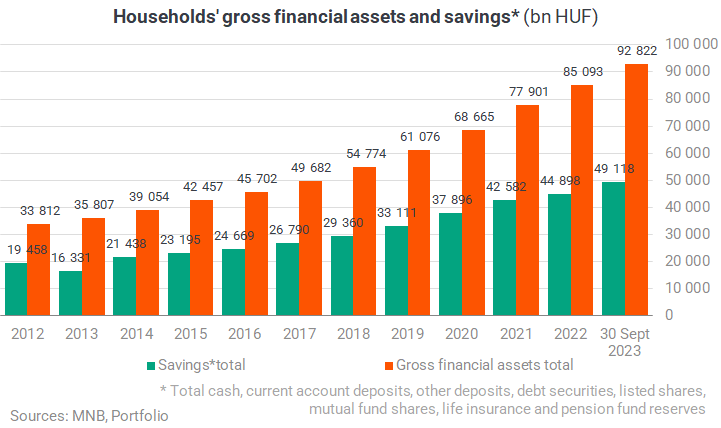
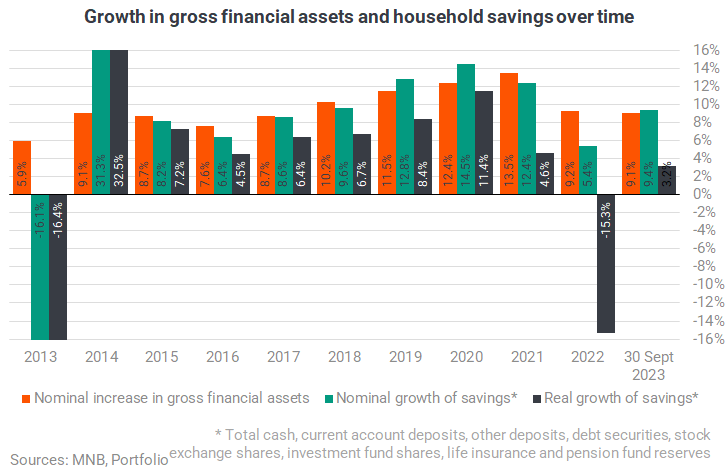
As usual, we have broken down the financial assets that can be considered household savings (for example, excluding a large share of corporate shares), which amounted to HUF 49 trillion at the end of September, and grew by 9.4% this year alone. This is a surprisingly great figure, as it is broadly in line with the growth seen in the first three quarters of 2019-2021. Last year as a whole, the nominal growth in savings was just under half that.
If we adjust the figures for inflation,
we see a 3.2% increase in the real value of household savings this year, after a 15.3% fall last year.
Overall, the savings market is performing much better than was expected last autumn. In an attempt to keep up their consumption, households have tapped their existing savings a lot less and curbed their new savings less dramatically than a lot of experts had previously expected.
For example, in its September Inflation Report last year, the MNB forecast consumption and savings rates of 85.8% and 5.5% respectively for this year, compared to 83.9% and 9.9% recorded in September this year, with consumption weaker and savings markets stronger than expected (with the largest adjustment compared to expectations in household investment).
THIS YEAR'S SAVINGS RATE OF 9.9%, AFTER LAST YEAR'S LOW, IS A VERY FAVOURABLE RATE LOOKING BACK OVER THE PAST DECADE.
The ratio shows the average percentage of disposable income (i.e. less taxes) that households save.

Even more interesting, if possible, is the change in the structure of savings, which is the result of changes in the yield and interest rate environment over the past two years.
Inflation has intensified households' hunt for yields, although the amount of savings parked in 0% interest current accounts and currency still seems excessive,
with current accounts still the second most important form of savings after government bonds, followed by mutual funds in third place and cash in fourth.
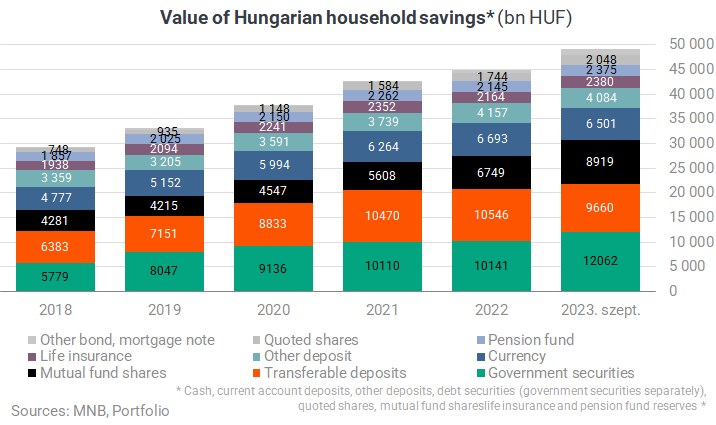
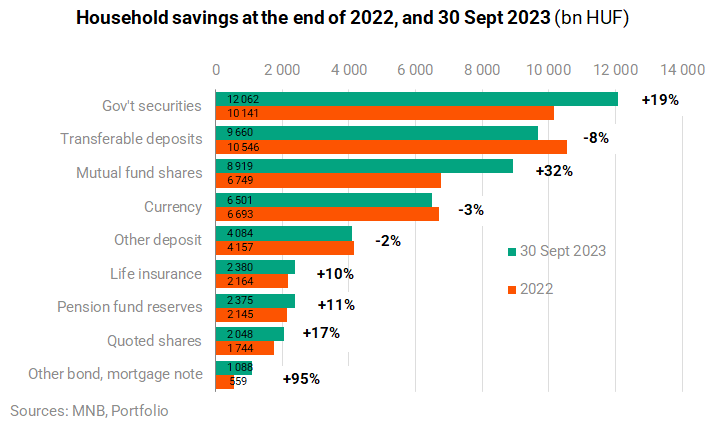
This year, almost HUF 1,000 billion has flowed out of the two forms of interest-free savings, while almost HUF 3,500 billion of fresh capital was invested in government securities and investment funds in the first three quarters.
In absolute terms, government securities (+ HUF 1,885 billion) have been the winners so far this year compared to investment funds (+ HUF 1,631 billion), while investment funds (+32%) have outperformed government securities (+19%).
The balance is tipped in favour of government securities by the stable double-digit yield of the Premium Hungarian Government Security (PMÁP, currently with an interest of 14.75%, expected to be above 18% from next January) and the fact that government securities have remained exempted from the social security contribution tax as of 1 July. In contrast, some banks are actively switching their clients from deposits to investment funds, where they can better use their clients' money, both for the distributing banks and their investment fund managers and for the investors.
Overall, out of every 100 forints saved, 62 forints were invested in government securities and 53 in mutual funds, while the aggregate balance of other savings was massively negative.
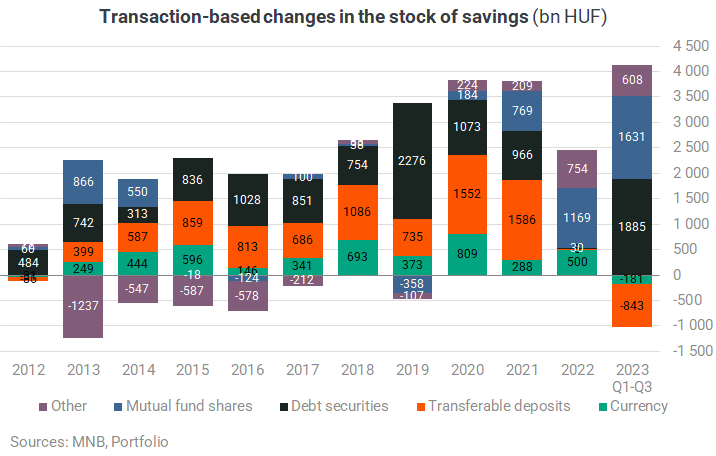
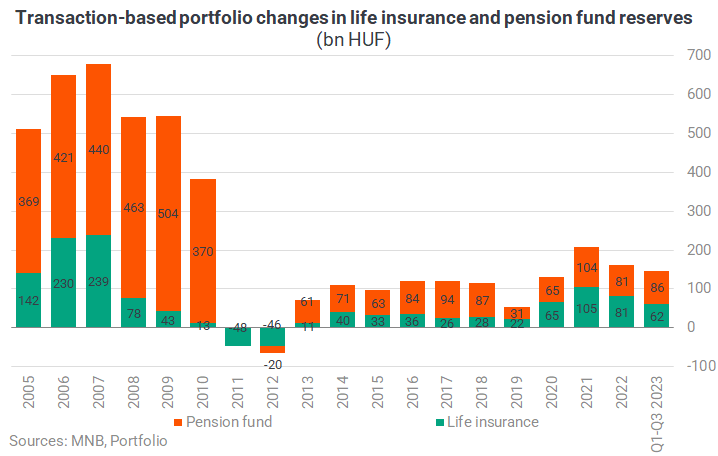
This is also true for shares traded on the Budapest Stock Exchange (BSE), from which households have withdrawn HUF 50 billion more this year than they have invested. On the positive side, life insurance and pension savings have been the main sources of fresh capital, with HUF 62 billion and HUF 86 billion respectively this year.
Life insurances and private pension funds closed last year with a total transaction balance of about HUF 81 bn each, but while
the former should be able to repeat its 2022 feat this year, pension funds should clearly have a better year than 2022.
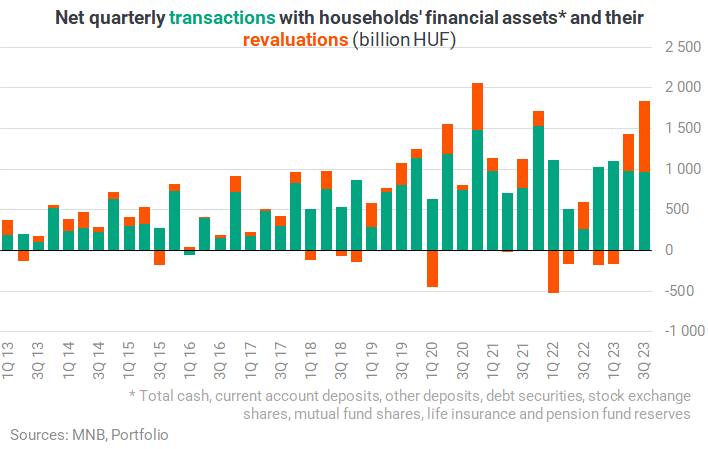
On a quarterly basis, the third quarter was not particularly strong for savers, but it is not usually so either. At the same time, last year's big slump in the June-September period has not been repeated this year (presumably also thanks to the easing of the energy crisis), which may well contribute to
a relatively positive end to this year for domestic savings market players, who have managed to avoid a savings crisis.
Cover photo: Getty Images