PMÁP finally steals the show among Hungary's retail gov't securities after 18 months


HUF 10 trillion mark hit after 18 months
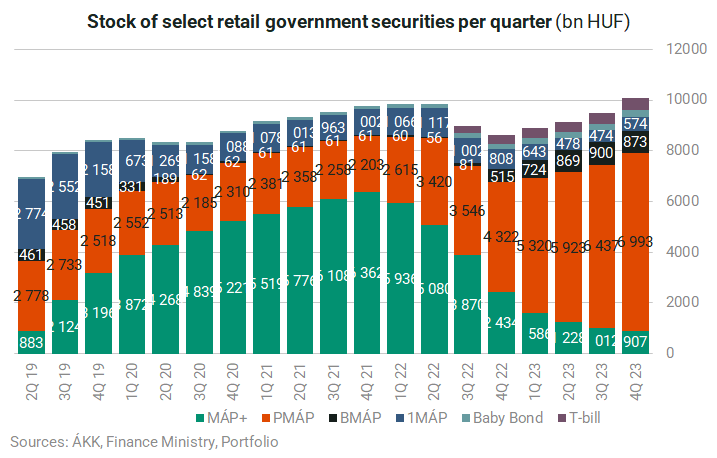
After a weak year in 2022, retail government securities are back in the saddle, with holdings rising above HUF 10 trillion again after a year and a half. By the end of December last year, the market was back where it was in June 2022.

The fact that the retail market managed to increase its holdings by EUR 1,500 billion last year almost entirely owes to the Premium Hungarian Government Security (PMÁP).
The stock of PMÁP amounted to nearly HUF 7,000 billion by the end of December, making it by far the most popular government security among Hungarians.
After the PMÁP, most money is still kept in MÁP+ among retail government securities with more than HUF 900 billion, but the Bonus Hungarian Government Security (BMÁP) is close behind with HUF 873 billion.
PMÁP does the lion's share of the work
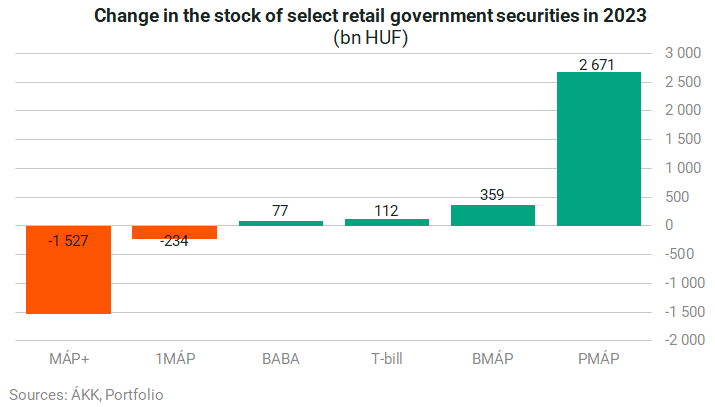
The graph below better illustrates what the population has done with PMÁP in 2023:
in one year, the stock of pmáp increased by nearly HUF 2,700 billion, an increase of 62%.
Compared to the PMÁP, the increase of HUF 360 billion in the BMÁP is dwarfed. Demand, fuelled by high inflation, also helped to offset the not insignificant outflow of funds that characterised the MÁP+ last year: the stock of this instrument shrank by more than HUF 1,500 billion. This is not surprising, of course, given that the annualised yield on MÁP+ is less than 5%, while last year there were already many PMÁPs with a 16% interest rate.
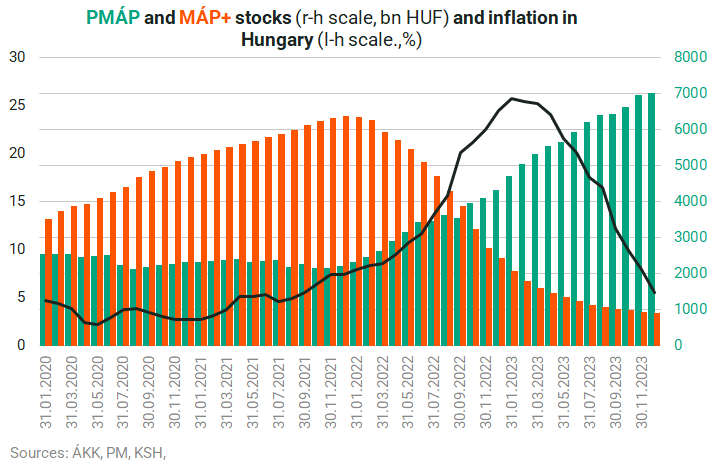
The relationship between MÁP+, PMÁP and inflation is also illustrated in the graph below: the higher inflation was rising, the stock of MÁP+ was falling and the stock of PMÁP holdings was increasing last year. And although we saw inflation decelerate in the second half of last year, demand for PMÁP persisted as many gambled that average annual inflation would be high ((and they were right, as it came in at 17.6%), and that it would still mean nice returns over a one-year time horizon.
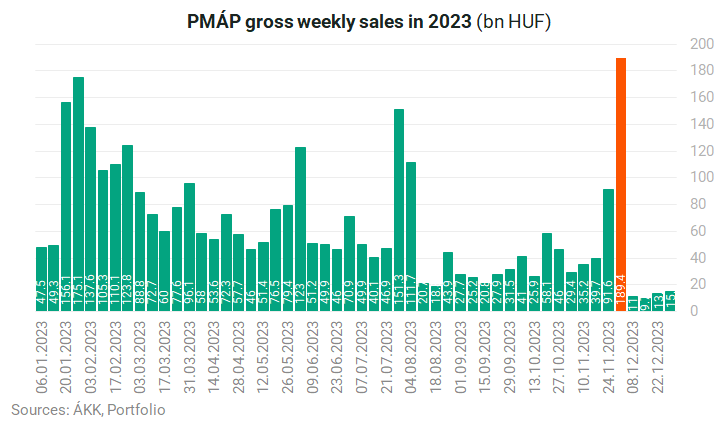
An interesting fact about the PMÁP is that although it had its best year ever in 2023, the month of December was the weakest month of the year in terms of stock growth. The reason for this is that at the end of November, the Government Debt Management Agency (ÁKK) launched a new premium paper paying a fixed interest rate in the first interest period, so those who had the means to buy the traditional PMÁP, which pays an inflation-linked interest rate in the first interest period, did so in November. The latter 2033/I series is the first PMÁP whose interest rate has already been indexed to last year's inflation, so it offers an interest of 17.85%.
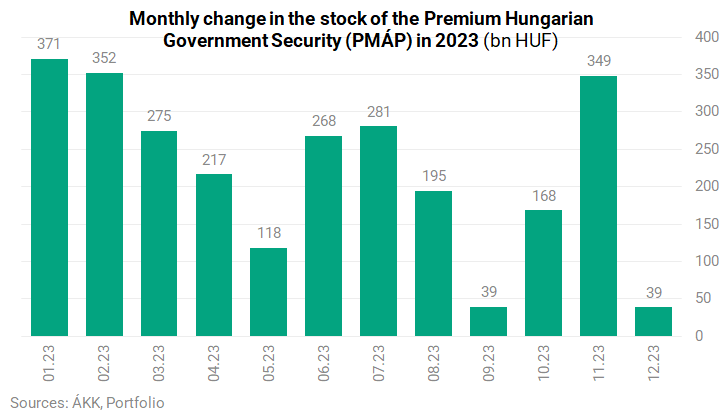
The popularity of the PMÁP has lasted virtually all year, with gross sales figures showing an average of HUF 64 billion a week bought by Hungarians in 2023. The highest weekly sales were in November, when it was announced that 2033/I would be discontinued and replaced by the hybrid-rate 2032/I series.
Cover photo: Getty Images