Hungary hasn't seen anything like this for 18 years: money cascades on those who can save


On Tuesday, the National Bank of Hungary (MNB) published its "Preliminary Financial Accounts" statistics for the first quarter of this year, which paint a very encouraging picture of the development of the savings market.
This is the first time that the total value of gross financial assets of households has exceeded HUF 100 trillion, which represents an increase of 15.4% in one year.
This is, of course, the figure for the whole economy. According to a representative survey we conducted a year and a half ago, only 39% of Hungarians have enough savings for at least a month, and only 18% have sufficient financial resources for six months.
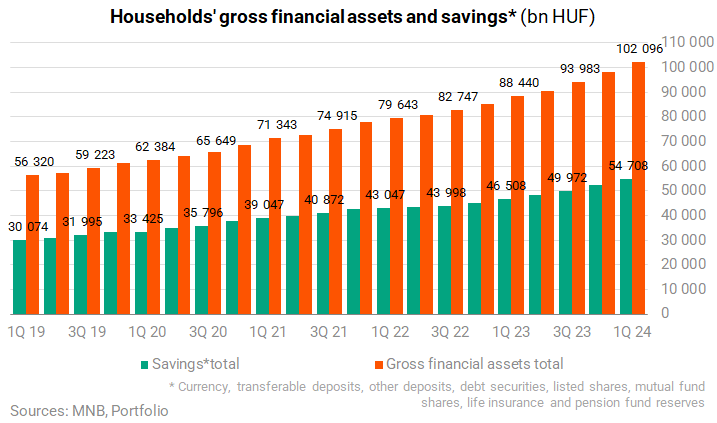
In addition, the amount in excess of HUF 100,000 billion also includes corporate holdings and less savings-like assets, so we have selected assets that compete specifically in the savings market. The stock of household financial assets considered as savings by Portfolio stood at HUF 55 trillion at the end of March,
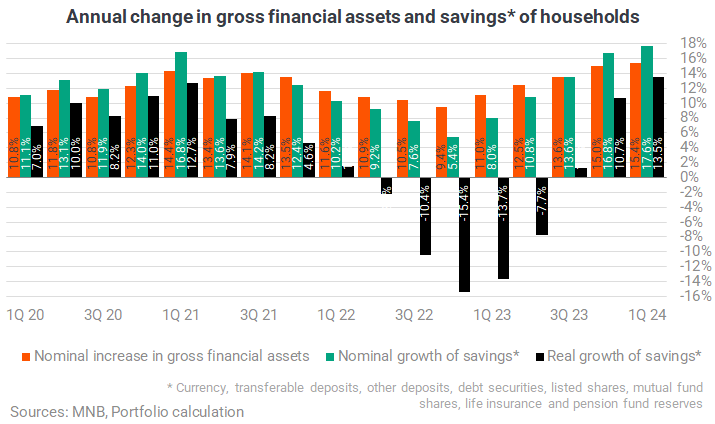
up by 17.6% in nominal terms and roughly 13.5% in real terms compared to a year earlier.
Such nominal growth has not been seen since the first quarter of 2006, just at the start of an election year. And as the chart below attests, since the end of 2022 the annual growth rate of savings volumes has been gradually increasing not only in nominal terms but also in real terms, leaving behind the adverse effects of runaway inflation.
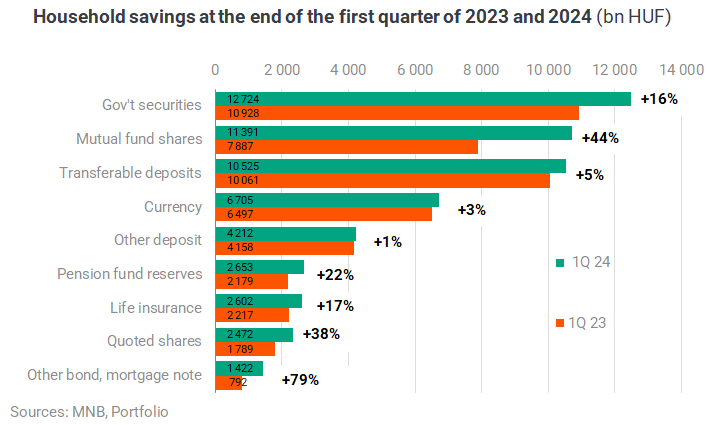
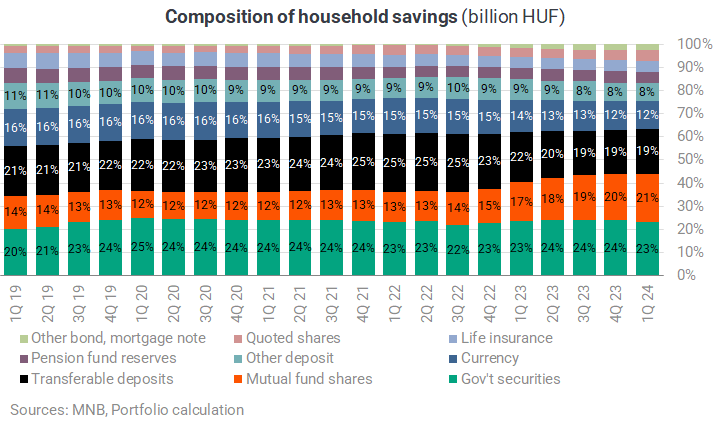
Although most of the savings, almost HUF 13 billion, is held in government securities,
the most spectacular increase of 44% was achieved by investment funds over the past year,
but apart from cash and bank deposits, other forms of savings also performed well. This is partly due to an increase in household risk-taking (inflation has forced many to take risks) and partly to the favourable yield environment for capital market savings.
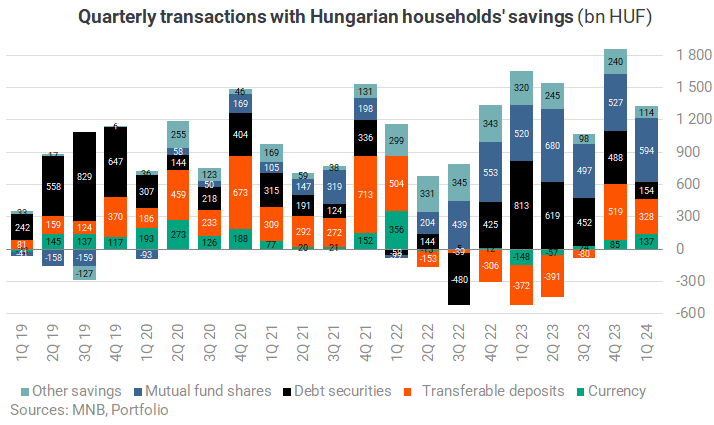
In line with receding inflation
the erosion of currency holdings and bank deposits has stopped in q4 2023,
with the balance of transferable deposits up by nearly HUF 850 billion over the past six months. The changes have taken place without a decline in government securities holdings. Even if we consider their interest payments as negative transactions (as the MNB does in these statistics), we still see capital inflows of HUF 154 billion even in the first quarter of this year, putting them in third place after investment funds, which boast HUF 594 billion of inflows, and current account deposits, which grew by HUF 328 billion.
Households had 23% of their savings in government securities, 21% in mutual fund shares, 19% in transferable deposits and 12% in currency in Q1.
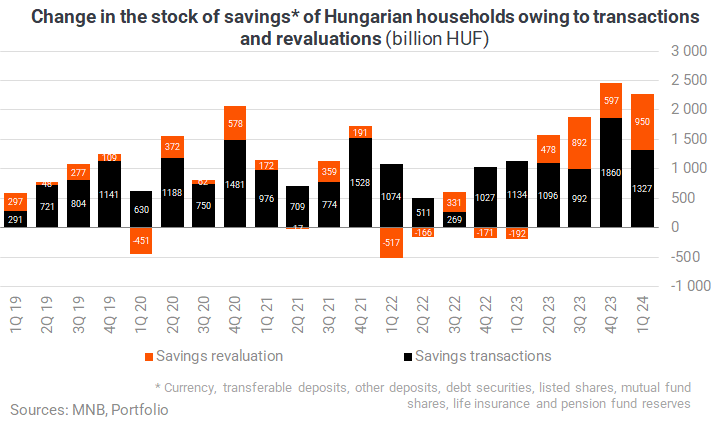
In addition to transactions, revaluations have also had a positive impact on household savings for the fourth quarter in a row. Here we see another record:
Never before have yields boosted the value of household financial assets that we consider savings by HUF 950 billion.
Some EUR 402 billion of this appreciation was explained by mutual fund shares and EUR 160 billion by bank deposits, the latter also clearly reflecting the weakening of the forint, which increased the forint value of foreign currency-denominated savings.
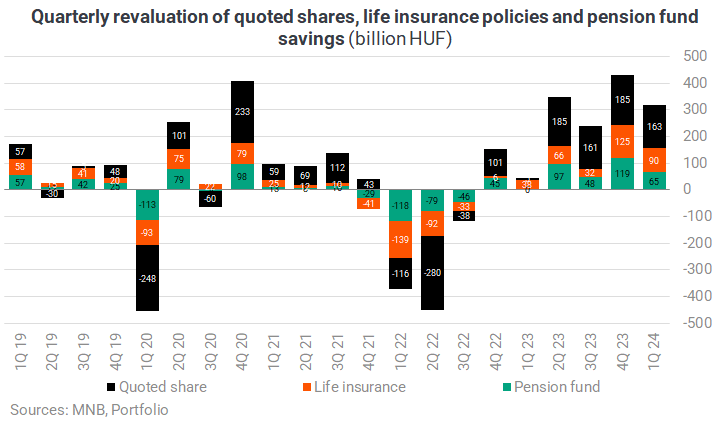
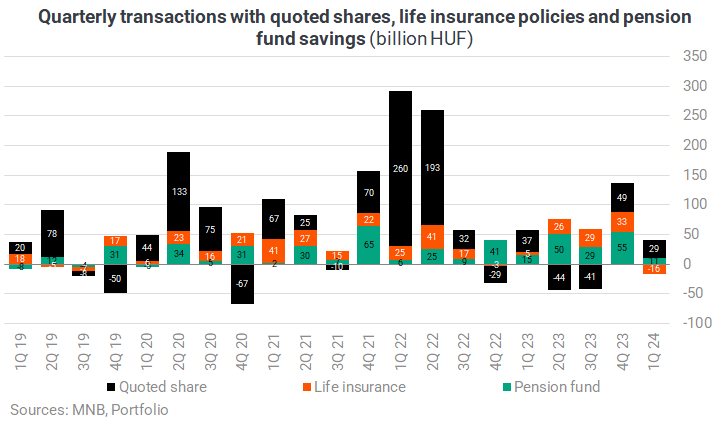
Among the smaller volume but capital market-dominant financial assets, quoted shares, pension fund savings and life insurance policies also
showed significant positive revaluations,
but on a transaction basis, i.e. in terms of net capital inflows, they performed rather poorly. For life insurance, withdrawals even exceeded inflows by HUF 16 billion.
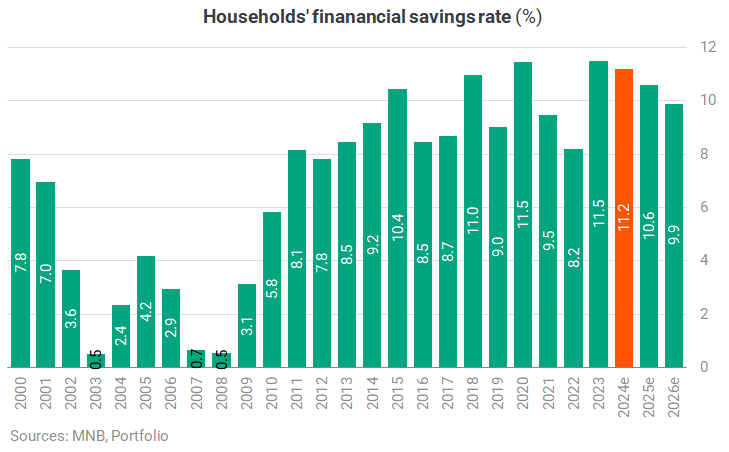
Household savings growth in the coming years is also supported by the fact that the MNB's latest Inflation Report forecasts that the savings rate (i.e. the average amount saved as a share of disposable income) could remain above 10% for Hungarian households.
Cover photo: Getty Images