Retirement savings: Hungary penultimate in Europe and could sink further


On the surface, everything looks fine:
- The institutional framework for self-care retirement savings has been stable over the past decade. The state has consistently rewarded those with a 20% contribution credit who have tried to provide for their financial security in retirement by saving in 1) a voluntary pension fund, 2) a pension insurance scheme or 3) a retirement savings account (NYESZ),
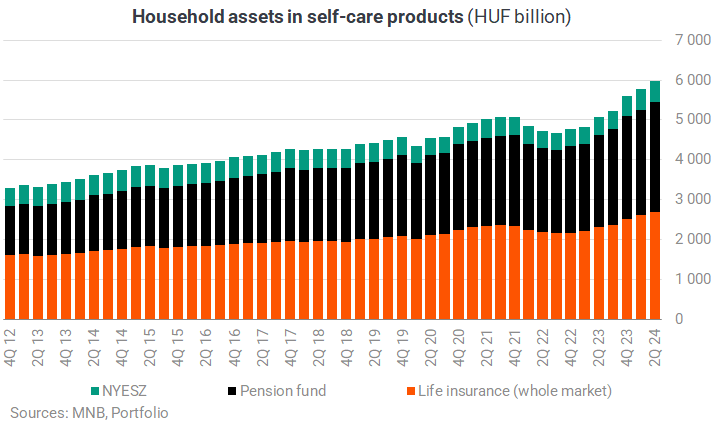
- Ten years ago, there was only HUF 3 600 billion in these self-care products; today there is HUF 6 000 billion. (Since we do not know the exact size of the assets in pension insurance, we have included all life insurance policies.) Hungarians have also dug themselves out of a shallower pit created by the coronavirus pandemic and a deeper pit created by a turbulent period following the outbreak of Russia-Ukraine war.
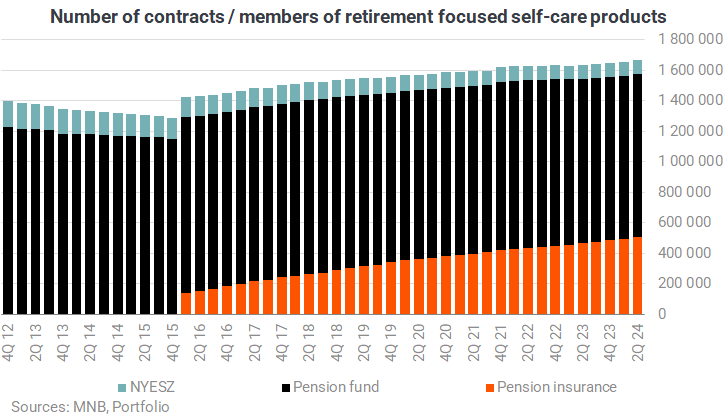
Ten years ago, there were 1.334 million and now there are 1.668 million contracted parties / members in these retirement savings - officially.
But if we look beyond these figures, we find serious problems:
- The institutional system is indeed stable, but it has made almost no progress since the introduction of the tax credit for pension insurance in 2014, the last positive measure. Moreover, the conditions for employer contributions to pension funds have deteriorated, with 29% less employer contributions paid into the system last year in nominal terms than at the peak in 2008, while most of the developed private pension systems in Europe operate with massive employer contributions.
- While it may sound good to see the value of client assets for self-care rose to HUF 6,000 billion from HUF 3,600 bn in ten years, in reality this represents an annual increase of only 5.1%, including both the positive impact of contributions and returns.
- Pension fund members made contributions of HUF 117 billion last year, while pension insurance customers paid in HUF 148 billion, an average of HUF 9,200 a month for the former and HUF 24,600 a month for the latter. Needless to say, the former in particular is almost worthless when it comes to supplementing your pension once you retire.
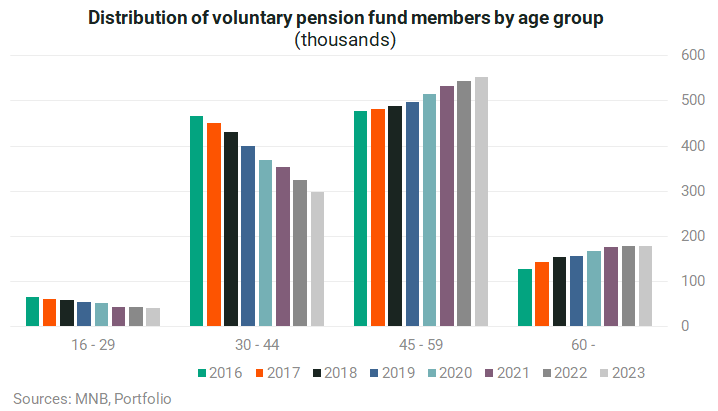
- Pension fund membership is ageing at an extraordinary rate, with few young people and relatively few truly active members, as we wrote about here.
- While the number of pension insurance policies has risen from almost zero to half a million today, the official number of pension fund members has fallen from almost 1.2 million to 1.07 million, with the number of active members likely to have fallen even more.
- The number savers in a Retirement Savings Account (NYESZ), i.e. those who make their own investment decisions to supplement their income in retirement, has fallen to 93,000 from 154,000 in ten years.
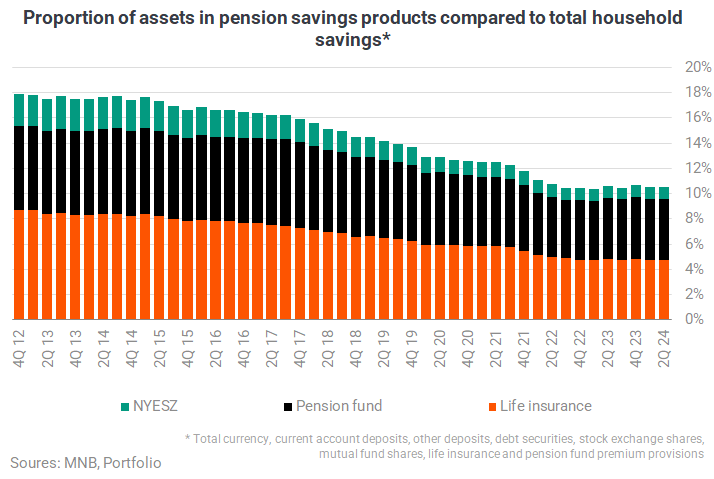
- Within the savings market, the share of life insurance, pension funds and NYESZ accounts in terms of assets has fallen to 10% from 18% ten years ago.
According to the central bank's (MNB) latest Competitiveness Report, the level of supplementary pension and life insurance reserves in 2021 was only 8.5% of GDP (based on Eurostat data), much lower than not only the EU average of 47.3%, but also the average of 15.2% in the Visegrad countries. Only Greece was behind Hungary in this ranking.
A number of forward-looking proposals have emerged in recent years to improve the market for retirement savings:
- The MNB's welfare fund concept, which was presented in detail in 2019 and has been discussed in numerous forums and studies since then, would build on public incentives and employers in both retirement and health self-care.
- There was talk that the Government Debt Management Agency (ÁKK) would introduce a retirement bond offering a favourable opportunity for regular retirement savings, but this has not yet come to fruition.
- Last year, the government came up with the idea of changing the ownership structure of insurance intermediaries to get the message of self-sufficiency across to a wider section of society by mobilising pension funds.
- The MNB's new Ethical Life Insurance Concept 2.0, which would increase customer value for newly sold life insurance policies, is being developed, but the specifics have not yet been revealed.
Except for the latter, there seems to be no progress on domestic self-care, and the government's recent proposal would be a step backwards, even if it could argue that it would help the growth of a real asset for self-care, namely real estate.
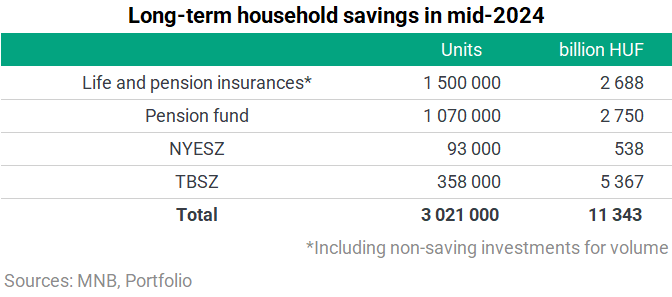
Under the recent proposal, the government would introduce a tax exemption to encourage people to use part of their long-term savings (e.g. retirement savings) to buy a new home, build or renovate their existing home or repay loans.
The decision, which is yet to be finalised, would put long-term financial self-care on the back burner in order to generate housing equity as soon as possible and accelerate the turnaround in consumption that should help boost growth. Potentially 11,000 billion forints in savings could be affected by the change, of which we estimate that such a controversial measure would have HUF 100-300 billion reallocated per year. The question is whether this will be too big a sacrifice in the long run.
Cover photo: Shutterstock